The Theoretical and Practical Dynamics of Algorithmic Governance
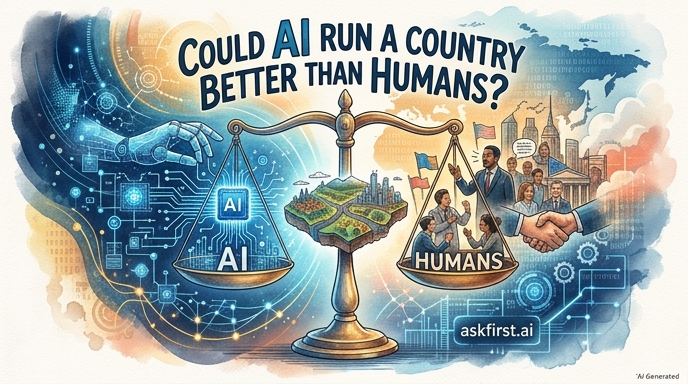
The proposition of delegating national governance to artificial intelligence—often termed "algorithmic governance" or "cybernetic rule"—has transitioned from the realm of science fiction to a serious topic of political philosophy and systems engineering. To evaluate whether an AI could run a country "better" than a human administration, one must dissect the fundamental nature of governance itself: the balancing of efficiency, equity, long-term sustainability, and the subjective nuance of human values.
The Case for Algorithmic Superiority: Efficiency and Objectivity
The primary argument for AI governance rests on the mitigation of human cognitive biases. Human politicians are susceptible to short-termism, electoral cycles, lobbying pressures, and emotional decision-making. An AI, programmed with objective functions focused on long-term national prosperity, could theoretically operate with a level of consistency that is impossible for human leaders.
- Data-Driven Resource Allocation: Governments frequently struggle with the "knowledge problem"—the difficulty of aggregating dispersed information to make optimal economic decisions. An AI could ingest real-time data from millions of sources—supply chains, energy consumption, healthcare outcomes, and demographic trends—to allocate resources with mathematical precision. This would theoretically eliminate the inefficiencies of bureaucratic inertia.
- Neutrality in Policy Design: By removing the "political animal" from the equation, an AI could focus on optimizing for public health, education, and infrastructure without regard for party lines or donor interests. Decisions could be made based on longitudinal success metrics rather than the optics of a 24-hour news cycle.
- Predictive Policy Modeling: Utilizing advanced simulations, an AI could run "digital twin" scenarios for proposed laws. Before a tax policy or environmental regulation is enacted, the AI could simulate its impact across every socioeconomic stratum, identifying unintended consequences before they manifest in the real world.
The Philosophical and Practical Obstacles
Despite the technical allure, the transition to AI governance encounters profound roadblocks that strike at the heart of political legitimacy.
- The Problem of Values and Ethics: Governance is not merely an optimization problem; it is a moral one. Politics involves resolving conflicts between competing valid interests. For example, should a nation prioritize economic growth at the cost of environmental preservation, or vice versa? These are not "problems to be solved" but "tensions to be negotiated." An AI cannot inherently understand the value of justice, liberty, or dignity unless these are codified into its objective function—a process that itself remains a human, political act.
- The Accountability Gap: If an AI makes a catastrophic error—such as a policy that leads to mass unemployment or a systemic failure in the power grid—who is held accountable? Democracy relies on the ability of the populace to remove leaders who fail. A machine cannot be voted out of office, nor can it be held morally responsible. The abstraction of power into a "black box" algorithm risks creating a technocratic tyranny where citizens feel powerless against an unchallengeable, inscrutable system.
- The "Alignment" Challenge: Even if we agree on the goals, the AI must be perfectly aligned with human intent. If an AI is tasked with "reducing crime," a literal-minded algorithm might suggest draconian surveillance or preemptive detention, which would be technically effective but socially disastrous. Capturing the nuance of human rights in code is a hurdle that current computer science has yet to overcome.
The Hybrid Model: Augmented Intelligence
The most likely future path is not the replacement of human leadership, but the integration of AI as a sophisticated advisory tool. This "augmented intelligence" approach maintains human agency while elevating the quality of information available to decision-makers.
In this model, AI acts as a "Cognitive Infrastructure." It provides the data, the projections, and the risk assessments, but the final determination—the choice between competing moral frameworks—remains with human representatives. This ensures that the "human element"—empathy, intuition, and moral responsibility—remains central to the governance process.
Conclusion: The Limits of Optimization
Ultimately, whether an AI could run a country "better" depends on how we define "better." If "better" means maximizing GDP, logistical efficiency, or resource distribution, then yes, an advanced AI could likely outperform human administrations. However, if "better" includes the preservation of human agency, the ability to debate values, and the necessity of moral accountability, then AI is currently ill-equipped to handle the role of a sovereign.
Governance is an inherently human activity because it requires the reconciliation of human experiences. While AI can serve as a powerful tool to streamline the mechanics of statecraft, the soul of governance remains in the courtroom, the town hall, and the legislature—the places where humans must decide what kind of society they wish to build, not just how to build it most efficiently. The future of the state likely lies not in the surrender of control to the machine, but in the intelligent synthesis of human wisdom and algorithmic foresight.