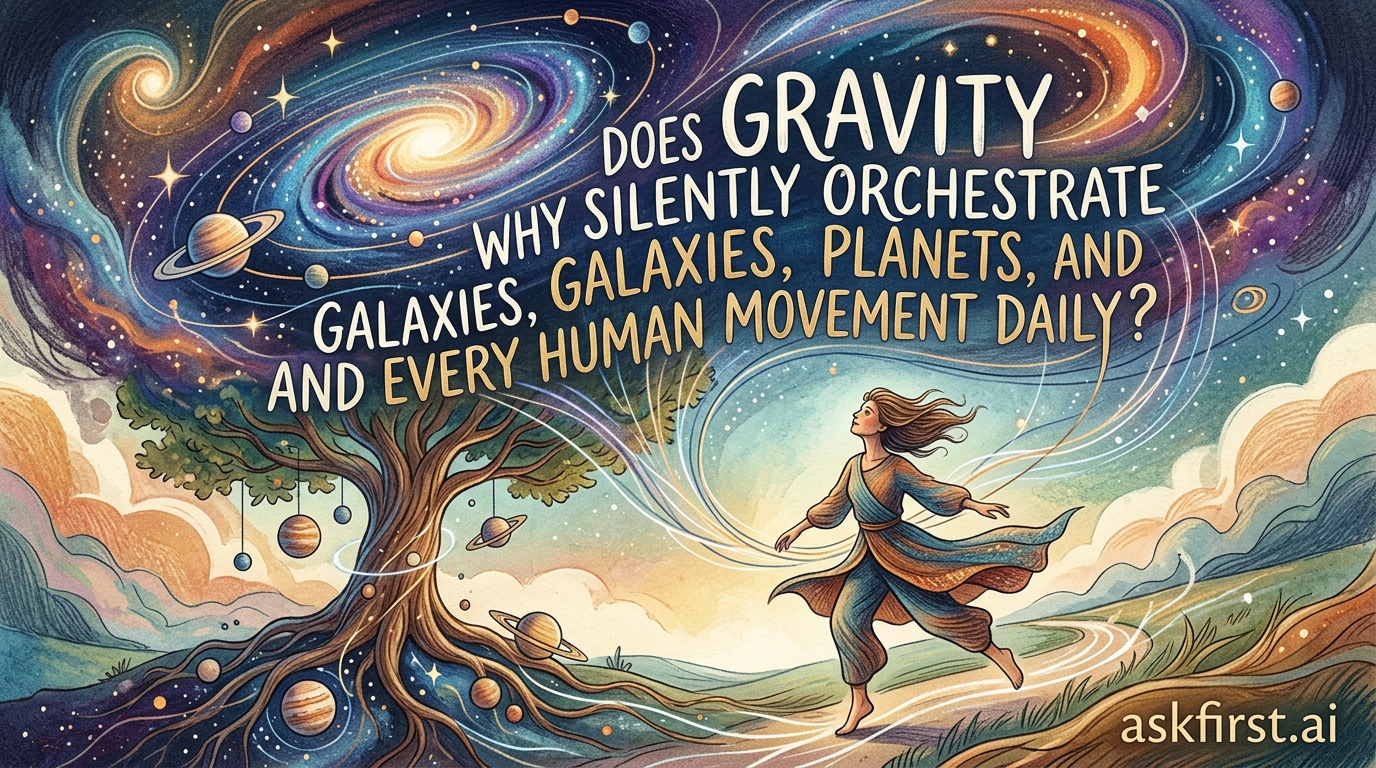
Gravity is the invisible architect of the cosmos, a fundamental force that defines the architecture of reality from the subatomic scale to the vast, dark filaments of the intergalactic web. While we often perceive it as a mundane feature of our existence—something that merely keeps our feet planted on the floor—gravity is, in truth, the primary curator of structure in the universe. It is the silent orchestrator that dictates the birth of stars, the orbital choreography of planetary systems, and the kinetic possibilities of every human action.
The Curvature of Spacetime: The Einsteinian Revolution
To understand why gravity orchestrates the universe, one must move beyond the Newtonian conception of gravity as a simple "pulling force." In his 1915 paper The Foundation of the General Theory of Relativity, Albert Einstein revolutionized our understanding by describing gravity not as a force, but as a geometric property of spacetime itself.
Imagine a stretched rubber sheet; if you place a heavy bowling ball in the center, the sheet curves downward. If you roll a marble across that sheet, it follows the curve created by the bowling ball. In this analogy, the bowling ball is a massive object like the Sun, and the marble is a planet. Gravity is the "dent" in the fabric of the universe. Because mass tells spacetime how to curve, and spacetime tells mass how to move, the entire universe is in a constant state of falling along these invisible curves. This is why galaxies maintain their spiral shapes and why planets remain locked in stable orbits; they are simply following the path of least resistance through a warped landscape.
The Cosmic Sculptor: Galaxies and Star Formation
On a galactic scale, gravity acts as the ultimate cosmic sculptor. Following the Big Bang, the universe was a relatively uniform soup of gas and dark matter. However, gravity acted upon microscopic density fluctuations, amplifying them over billions of years. As described by astrophysicist Martin Rees in his seminal work Just Six Numbers, if the strength of gravity were even slightly different—if it were stronger, stars would burn out too quickly; if weaker, they would never coalesce—the universe would be a featureless void.
Gravity pulls hydrogen and helium gas into massive, spinning disks. As these clouds collapse under their own weight, the pressure at their cores becomes so intense that nuclear fusion ignites, birthing a star. Galaxies like our own Milky Way are held together by this gravitational binding energy. Without the massive gravitational well created by the dark matter halo surrounding our galaxy, the stars at the outer edges would simply fly off into the void. Gravity is the glue that prevents the dispersal of complex matter.
The Human Scale: Gravity and Biological Function
While we often think of gravity as an external force acting upon objects, it is deeply woven into the fabric of human physiology. Every movement we make—walking, lifting an object, or even the act of standing—is a negotiation with the Earth’s gravitational field. Our skeletal structure, particularly the evolution of the spine and the density of our femur bones, is a direct response to the constant load of gravity.
In the book Gravity's Engines by Caleb Scharf, the author explores how the gravitational environments of celestial bodies dictate the potential for life. On Earth, gravity is strong enough to hold an atmosphere—a mixture of gases vital for respiration—yet weak enough to allow for the development of complex, mobile organisms. If we lived on a planet with significantly higher gravity, our physiology would have to be vastly different, likely requiring more robust, squat structures to prevent bone fractures. Furthermore, gravity influences our cardiovascular system; our hearts are constantly working against gravity to pump blood to the brain. When we stand up, our bodies engage in a sophisticated, silent reflex to counteract the pooling of blood in our lower extremities.
The Silent Orchestrator of Motion
Every human movement is essentially a kinetic dialogue with gravity. When you throw a ball, you are imparting energy into a trajectory that gravity will eventually reclaim. When you walk, you are utilizing gravitational potential energy; you shift your center of gravity forward and allow the force to "pull" you into your next step.
This orchestration is so seamless that we rarely notice it. We inhabit a world where gravity defines "up" and "down," providing the reference frame for all human orientation. It dictates the physics of architecture, the design of our cities, and the mechanics of our sports. Whether it is the tides of the ocean, which are caused by the gravitational dance between the Earth, Moon, and Sun—a phenomenon detailed extensively in The Tides: A Scientific History by David Edgar Cartwright—or the simple act of a pen falling to the floor, gravity is the persistent, silent background noise of existence.
Conclusion
Gravity is not merely a physical constant; it is the fundamental language of the universe. It is the force that transformed a chaotic, hot, and dense early universe into the structured, life-bearing reality we occupy today. By warping the geometry of spacetime, gravity provides the stage upon which the drama of stellar evolution, planetary formation, and human history unfolds. It is the silent, omnipresent conductor that ensures the galaxies keep their spin, the planets stay their course, and our very lives remain grounded in the physical reality of our home planet. To understand gravity is to understand the very mechanism that allows for the existence of complexity in a universe that otherwise trends toward entropy.