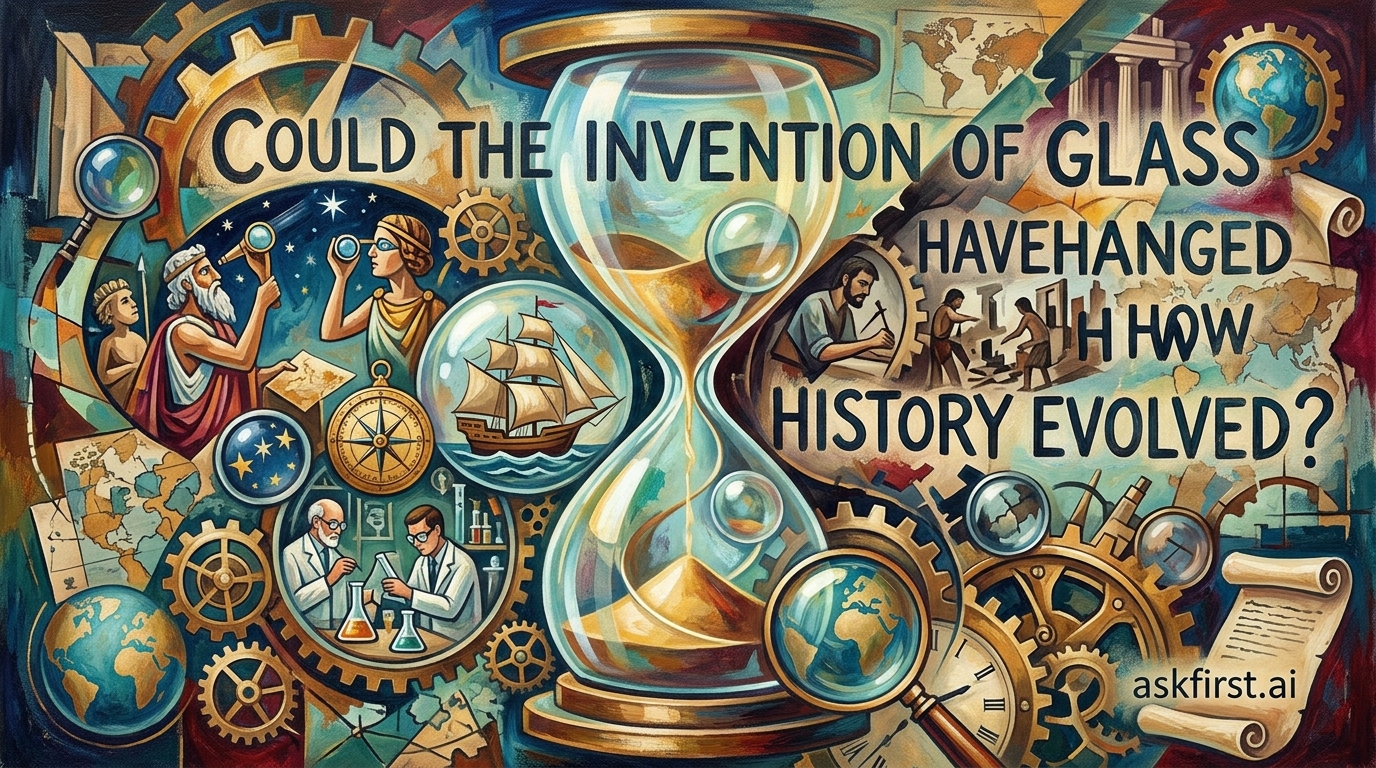
The Invisible Catalyst of Civilization
The invention of glass, often overlooked in favor of monumental technological breakthroughs like the wheel or the steam engine, serves as the silent, transparent pillar upon which the modern world rests. From the first accidental fusion of silica and heat in the deserts of antiquity to the fiber-optic cables that carry our digital consciousness, glass has functioned as a primary engine of scientific, cultural, and industrial evolution. Without this miraculous substance, human history would not merely be different; it would be unrecognizable.
The Birth of Precision Science
Before the widespread mastery of glassmaking, the human understanding of the universe was limited to what the naked eye could perceive. The invention of the microscope and the telescope—both dependent on the high-clarity optical glass—shattered these boundaries.
- Biological Breakthroughs: Antonie van Leeuwenhoek, using primitive but effective glass lenses, first observed 'animalcules,' now known as bacteria. This discovery eventually led to the germ theory of disease, fundamentally increasing life expectancy and transforming medicine from a guessing game into a rigorous empirical science.
- Astronomical Revolution: Galileo Galilei’s improvement of the telescope allowed humanity to look past the terrestrial sphere. Seeing the moons of Jupiter and the phases of Venus provided the definitive evidence needed to transition from the geocentric (Earth-centered) model to the heliocentric (Sun-centered) model. This shift ignited the Scientific Revolution, moving humanity toward rationalism.
The Glass Economy and Global Connectivity
Glass did more than provide scientific clarity; it facilitated the creation of global commerce and the preservation of historical knowledge. In the ancient world, glass trade routes acted as conduits for culture, spreading artistic techniques and mathematical insights across civilizations.
In the medieval era, the development of window glass transformed architecture, allowing people to live in better-lit, climate-controlled environments. This change in domestic lifestyle is argued by some historians to have shifted the psychological boundaries of home life, turning the house into a space for intellectual focus and long-term societal planning rather than mere survival.
Modern Infrastructure: The Digital Age
If one considers the contemporary landscape, glass is the heartbeat of information technology. The internet does not exist without glass. Fiber-optic cables, made from ultrapure silica glass, transmit data at the speed of light. Every email, video stream, and financial transaction across the globe is effectively a pulse of light traveling through a glass strand.
This material is the backbone of the 'information age,' enabling globalization, remote education, and the interconnected economy. Without glass, the world would remain physically disconnected, tethered to the physical transport of paper and voice.
Addressing the Counter-Intuitive Truths
Many assume that metals or plastics define modern industry. Yet, consider the structural limitations of those materials in high-pressure or chemically corrosive environments. Glass, specifically borosilicate glass, remains the standard for chemical laboratories and pharmaceutical production because it is inert and transparent. Without it, the synthesis of advanced chemicals, medicine, and clean energy storage solutions would be hampered by structural degradation and contamination.
Architectural Evolution
Architecture is perhaps the most visible record of the 'glass evolution.' The skyscraper, a symbol of modernity, is only possible through glass curtain walls. These innovations revolutionized urban density and the philosophy of public spaces, moving from heavy, oppressive stone masonry to light, airy, and transparent environments that encourage collaboration and openness in business and education.
Conclusion
History is a narrative of human curiosity constrained by physical reality. Glass has been the ultimate tool for overcoming these constraints. It has allowed us to see the infinitely small, the infinitely far, and to store and transmit the sum of human knowledge across the planet. If one were to remove the invention of glass from history, humanity would likely still be grappling with fundamental misconceptions about biology, astronomy, and physics. Glass has provided the clarity required to build the future, making it arguably the most influential material in the history of human progress.