The Eternal Sweetness: Understanding Honey’s Remarkable Longevity
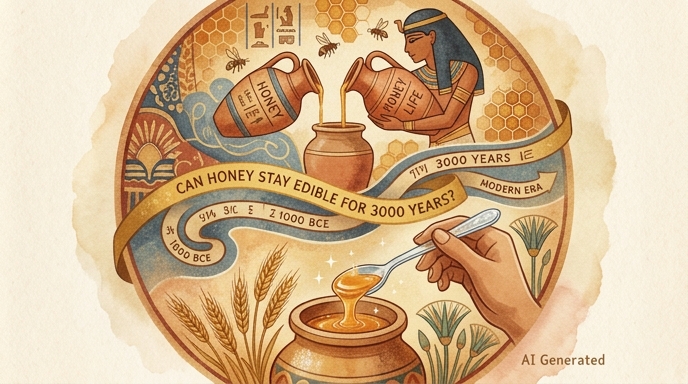
It is a well-documented phenomenon that honey is one of the few food substances on Earth that can remain edible for millennia. Archaeology has provided us with extraordinary proof: pots of honey discovered in ancient Egyptian tombs, dating back over 3,000 years, have been found in a state that is technically still consumable. While the texture may change—transforming from a smooth, viscous liquid into a hard, crystallized mass—the chemical composition remains largely unchanged, shielding it from the forces of decay that plague virtually every other organic food source.
The Chemistry of Immortality: Why Honey Doesn’t Spoil
The longevity of honey is not a result of a preservative process added by humans, but rather a perfect storm of chemical properties inherent to the substance itself. Several distinct factors work in tandem to create an environment where bacteria, fungi, and other microorganisms simply cannot survive.
1. Low Moisture Content (Hygroscopy)
Honey is naturally hygroscopic, meaning it contains very little water in its natural state. Most bacteria require a moist environment to thrive and reproduce. Because honey is essentially a supersaturated solution of sugars, it has an extremely low water activity. In fact, honey acts as a desiccant; if any bacteria or yeast cells were to land in honey, the substance would effectively pull the water out of those cells, dehydrating and killing them before they could cause spoilage.
2. High Acidity
Honey is acidic, typically possessing a pH level between 3.2 and 4.5. This level of acidity is sufficient to inhibit the growth of most common food-borne pathogens. While this acidity is mild enough for human consumption, it is hostile enough to prevent the colonization of the majority of microorganisms that would otherwise lead to fermentation or rotting.
3. The Role of Hydrogen Peroxide
Perhaps the most fascinating aspect of honey’s preservation is the presence of hydrogen peroxide. When bees produce honey, they introduce an enzyme called glucose oxidase from their hypopharyngeal glands. When the bees mix this enzyme with nectar, it breaks down into gluconic acid and hydrogen peroxide. This hydrogen peroxide acts as a potent antibacterial agent, providing a chemical barrier that protects the honey from contamination.
4. The Bee’s Secret Ingredient
Beyond the chemistry of the honey itself, the physical environment of the beehive plays a role. Bees seal their honey in wax combs, which are airtight and watertight. As long as the honey remains sealed and protected from external moisture, it is shielded from the introduction of yeast or humidity that could trigger fermentation.
Understanding Crystallization: The Myth of "Spoilage"
Many people mistake the crystallization of honey for spoilage. If you find a jar of honey that has turned cloudy, thick, or solid, it is not "bad." Crystallization is a natural physical process caused by the high glucose content. Because honey is a supersaturated sugar solution, the glucose molecules eventually precipitate out of the liquid phase, forming crystals.
This process is entirely reversible. By placing a container of crystallized honey in a warm water bath (avoiding boiling temperatures to preserve the delicate enzymes), the crystals will dissolve, and the honey will return to its original, fluid state. The only reason honey would truly "spoil" is if it were exposed to moisture. If a jar is left open in a humid environment, the honey can absorb water from the air, raising its moisture content to a level where natural yeasts can survive and begin the fermentation process.
The Archaeological Record and Human Consumption
The discovery of ancient honey in Egyptian tombs serves as the definitive evidence of its endurance. When archaeologists excavate these sites, they often find honey that has darkened significantly in color and lost much of its floral aroma, yet the substance remains chemically stable.
However, there is a caveat regarding the consumption of ancient honey. While it is technically "edible" in the sense that it is not putrefied, it may not be palatable. Over thousands of years, the volatile organic compounds that give honey its specific floral notes and nuanced flavors dissipate. Furthermore, ancient honey was harvested using methods that often included wax, bee parts, and other debris, which might make it unappealing by modern standards.
Conclusion: A Masterpiece of Nature
Honey’s ability to remain edible for 3,000 years is a testament to the sophisticated biological engineering of the honeybee. By balancing moisture, acidity, and enzymatic activity, bees create a product that effectively defies the biological clock. For the modern consumer, this means that if you store your honey in a cool, dry place with the lid tightly sealed, you have a pantry staple that will outlast almost anything else in your kitchen. It is, quite literally, nature’s most successful long-term storage solution.