The Geodynamics of Seismic Activity: Unlocking the Mechanics of Earthquakes
Earthquakes are among the most powerful and destructive natural phenomena on Earth, serving as a stark reminder of the planet's dynamic, ever-changing crust. While they may feel random to the casual observer, seismic events are governed by strict physical laws related to the movement of the Earth's lithospheric plates. To understand why earthquakes occur primarily along tectonic plate boundaries, one must first look toward the theory of plate tectonics, which posits that the Earth’s outer shell is broken into several rigid, moving segments floating atop the semi-fluid asthenosphere.
The Engine of Movement: Mantle Convection
The primary driver of all tectonic activity is mantle convection. Deep within the Earth, heat from the core creates convection currents in the mantle. As hot material rises and cooler material sinks, these currents exert a frictional drag on the overlying tectonic plates. This process, described extensively in The Dynamic Earth by Brian J. Skinner and Stephen C. Porter, acts as a conveyor belt, causing plates to drift at rates of a few centimeters per year—roughly the speed at which human fingernails grow.
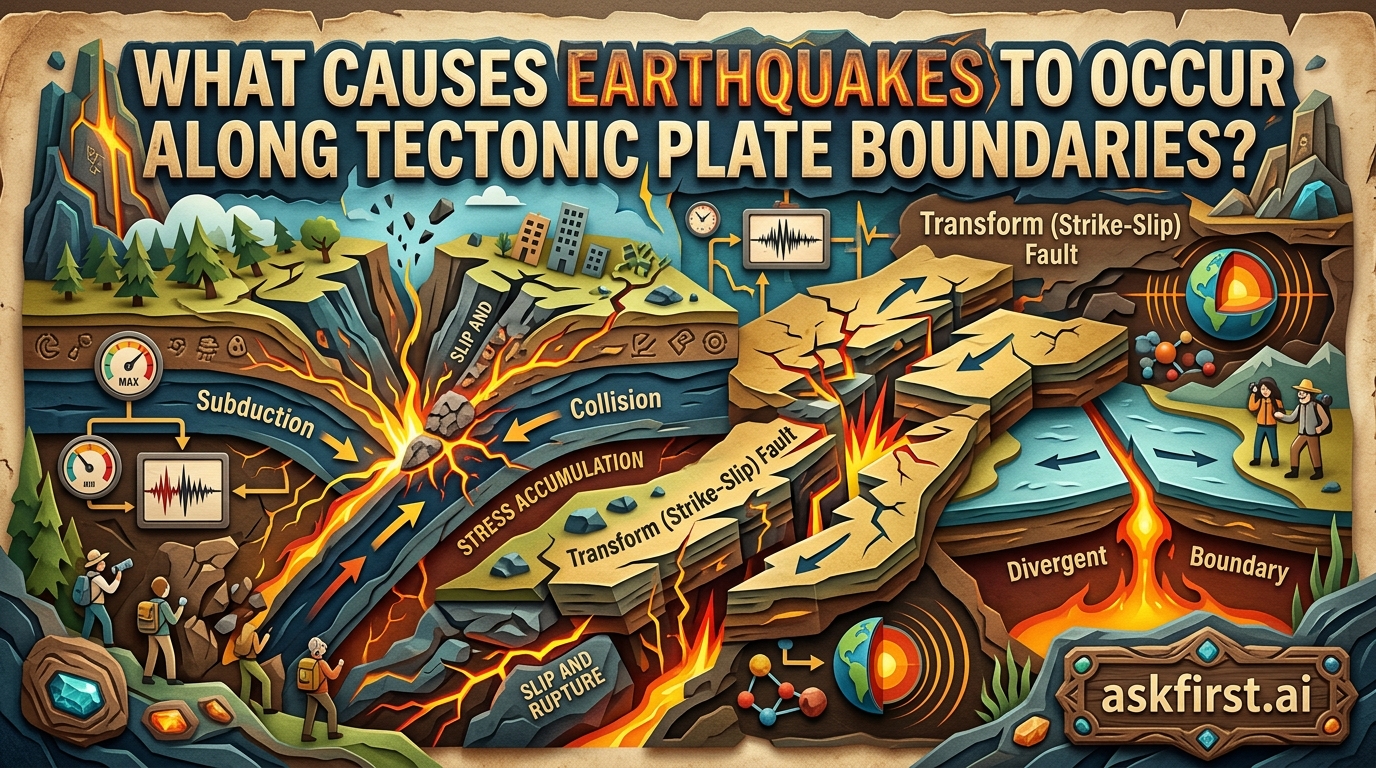
When these plates move, they do not slide past one another smoothly. Because the edges of the plates are jagged and composed of rough, brittle rock, they become locked together due to friction. This is known as "stick-slip" behavior. As the plates continue to push against each other, stress builds up in the rocks along the boundary. When the accumulated stress finally exceeds the frictional strength of the rock, the material suddenly ruptures, releasing centuries of stored potential energy in the form of seismic waves.
Types of Plate Boundaries and Their Seismic Signatures
Earthquakes occur differently depending on how two plates interact. There are three primary types of plate boundaries, each producing distinct seismic patterns:
- Divergent Boundaries (Pulling Apart): At mid-ocean ridges, such as the Mid-Atlantic Ridge, plates move away from each other. As the crust thins, magma rises to fill the gap. Earthquakes here tend to be relatively shallow and lower in magnitude because the rock is hot and ductile, preventing the buildup of massive stress.
- Convergent Boundaries (Colliding): These are the sites of the most catastrophic earthquakes. In subduction zones—where one plate dives beneath another—the subducting slab is cold and brittle. As noted by Kerry Sieh in The Earth in Turmoil, these zones can lock for hundreds of years, accumulating massive amounts of elastic strain. When the "megathrust" finally gives way, it produces the largest earthquakes on the planet, often exceeding magnitude 9.0, such as the 1964 Alaska earthquake or the 2011 Tōhoku event in Japan.
- Transform Boundaries (Sliding Past): Along transform faults, plates grind horizontally against each other. The San Andreas Fault in California is the classic example. Because the plates are locked in a side-by-side configuration, they experience intense stress that is released in sudden, lateral shifts. These earthquakes are typically shallow, meaning they can cause significant surface damage despite being less powerful than deep subduction events.
The Role of Elastic Rebound Theory
To truly grasp the mechanics of an earthquake, one must understand the Elastic Rebound Theory, first proposed by Harry Fielding Reid following his study of the 1906 San Francisco earthquake. Reid postulated that rocks behave like elastic bands. As tectonic forces pull or push the crust, the rock deforms, storing energy. When the fault finally ruptures, the rock "snaps back" to its original, undeformed shape. This sudden release of energy radiates outward in the form of seismic waves—P-waves (primary), S-waves (secondary), and surface waves—which are what we experience as the shaking of the ground.
Fault Rupture and Stress Transfer
It is a common misconception that an earthquake relieves all stress in a region. In reality, the rupture of one segment of a fault often transfers stress to adjacent segments. This phenomenon, known as Coulomb stress transfer, explains why large earthquakes are frequently followed by aftershocks or even subsequent major quakes along the same fault system. For instance, the sequence of earthquakes in the North Anatolian Fault in Turkey during the 20th century demonstrated a clear pattern of "stress triggering," where each major rupture pushed the next segment of the fault closer to its failure point.
Conclusion
Earthquakes are the inevitable byproduct of a planet that is actively cooling and rearranging its surface. The concentration of these events along plate boundaries is a direct result of the intense frictional resistance encountered when massive slabs of lithosphere interact. Whether through the grinding motion of a transform fault, the intense compression of a subduction zone, or the tension found at divergent ridges, the physical process remains the same: the crust stores energy through elastic deformation and releases it in a violent, kinetic burst. By studying the geological history of these boundaries—as documented in works like Earthquake Engineering by Robert L. Wiegel—scientists can better map the risks of future seismic activity, though predicting the exact moment of a rupture remains one of the greatest challenges in modern geophysics. Understanding these boundaries is not just an academic exercise; it is the foundation for global disaster mitigation and the preservation of human infrastructure.