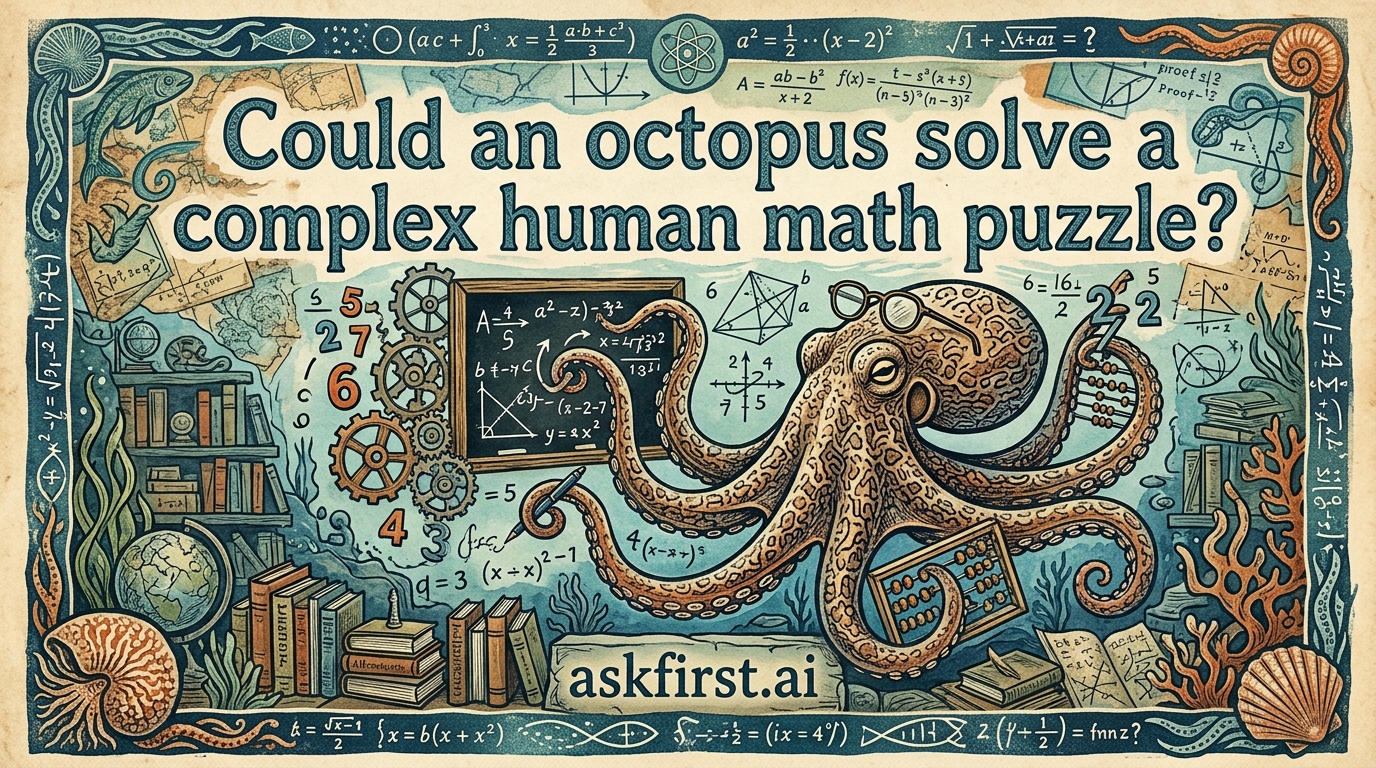
The Cephalopod Intelligence Paradox
When contemplating whether an octopus could solve a complex human math puzzle, one must first deconstruct the fundamental differences between human linguistic-symbolic logic and the sensory-based, distributed intelligence of cephalopods. Octopuses are widely regarded as the most intelligent invertebrates on Earth, possessing a central brain and a remarkable 'distributed' nervous system where two-thirds of their neurons reside in their arms. While they exhibit incredible problem-solving capabilities in physical domains, mathematics as humans define it is an abstract system of symbolic representation, which remains a uniquely human cognitive endeavor.
The Mechanics of Octopus Cognition
Octopuses operate primarily through tactile and visual information gathering. Their intelligence is deeply anchored in embodied cognition. Research from laboratories like the Marine Biological Laboratory at Woods Hole has demonstrated that octopuses can navigate complex mazes, open jars, and even recognize individual human faces. These tasks are essentially physical puzzles requiring spatial reasoning, sensory integration, and associative memory. An octopus does not use algebra to navigate a barrier; it uses a high-speed neural network to analyze physical properties and tactile feedback.
- Distributed Processing: Each arm of an octopus acts with a degree of autonomy. This allows them to multitask in ways that are biomechanically impossible for humans. However, this is distinct from mathematical reasoning, which requires the linear, logical sequencing of abstract symbols.
- Sensory-Rich Input: Their primary interface with the world is chemotactile. A math puzzle, being abstract and symbolic, lacks the environmental cues that trigger an octopus's problem-solving response.
Can Octopuses Grasp Abstract Concepts?
Mathematics requires the concept of numerosity—the ability to understand 'quantity' as an abstract property independent of specific objects. Some studies suggest cephalopods demonstrate basic numerical discrimination, choosing a box with three objects over a box with two, similar to primates or even certain species of birds. However, moving from basic numerosity to solving a 'complex math puzzle'—such as an algebraic equation or a calculus theorem—requires a symbolic syntax that octopuses do not possess.
Humans use language to encode math into symbols. Octopuses lack the vocal or written symbolic systems to represent these ideas. Without a system for recursive thought—the ability to nest concepts within concepts—they cannot hold the mental architecture necessary for higher-level mathematics.
The Barrier of Symbolic Logic
Why can't they bridge the gap?
- Life Span Constraints: The typical lifespan of a common octopus is only 1-3 years. Their cognitive development is rapid, but there is no time for the deep, multi-generational transmission of abstract cultural knowledge—a prerequisite for the development of complex mathematics in human society.
- Environmental Context: Human intelligence was sharpened by the need for social cooperation and tool development, driving the creation of abstract symbols. Octopus intelligence was driven by the need for predation and evasion in the complex three-dimensional environment of coral reefs.
- Communication: Human math is inherently social. It relies on the exchange of notation. Octopuses are largely solitary, and there is no evidence of a 'mathematical language' in their communication repertoire, which consists primarily of color and texture changes (chromatophores).
Defining the Limit
Could an octopus be trained to perform a task that mimics a math puzzle? Potentially. Through associative learning, an octopus could be taught to associate a specific visual pattern with a reward, effectively performing a mechanical 'calculation' to arrive at a solution. If presented with a puzzle where selecting '4 shells' results in a treat, the octopus will learn to select '4 shells.' But is this math? In a human sense, it is behavioral reinforcement. The octopus is not solving the equation; it is fulfilling a learned environmental sequence.
Conclusion: The Beauty of Alien Minds
While an octopus could never solve a human math puzzle in the way a mathematician would, this does not diminish their brilliance. Their intelligence is a testament to the evolutionary power of a non-human brain structure. They are experts in navigation, camouflage, and tactical physical manipulation—domains where they arguably outperform humans. Their 'math' is written in the geometry of the currents and the tactile resistance of the seafloor. To expect them to solve human puzzles is to measure the speed of a fish by how well it can climb a tree. Cephalopods demonstrate that cognition does not require human-like abstraction to be deeply, profoundly sophisticated.