The Physical Consequences of a Sudden Rotational Halt
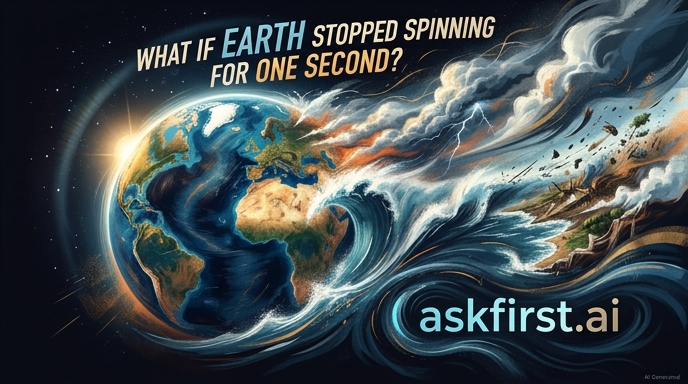
If the Earth were to stop spinning for exactly one second, the consequences would be catastrophic, transcending the simple cessation of movement. While the duration is brief, the laws of physics—specifically inertia—dictate that everything not physically anchored to the bedrock of the planet would continue moving at the Earth's original rotational velocity. At the equator, the Earth rotates at approximately 1,000 miles per hour (1,670 kilometers per hour). An instantaneous stop would be equivalent to a sudden, violent deceleration of a vehicle traveling at supersonic speeds.
Inertial Momentum and Global Destruction
The most immediate and devastating effect would be the inertial displacement of all surface matter. Because the Earth’s atmosphere, oceans, and every object on the surface are moving in tandem with the planet’s rotation, a sudden halt would cause these elements to maintain their momentum.
- Atmospheric Scouring: The atmosphere would continue moving at the speed of the Earth’s rotation. This would result in global, supersonic winds—a wall of air moving at over 1,000 mph. Such winds would be stronger than the most powerful hurricanes ever recorded, effectively scouring the surface clean of forests, buildings, and soil.
- Oceanic Displacement: The oceans would not stop moving. The inertia would cause massive, planet-wide tsunamis. Water would be forced toward the poles or simply surge over continents, depending on the latitude, creating waves kilometers high that would reshape the geography of every coastline on the planet.
- Human and Biological Impact: For any human or animal not subterranean or at the exact poles, the sudden deceleration would be fatal. Every object not bolted to the bedrock would be launched horizontally at the speed of sound. The sheer kinetic energy released would result in widespread structural disintegration.
Geodynamic and Seismic Repercussions
Beyond the surface-level chaos, the Earth’s internal structure would experience extreme stress. The planet is not a perfect sphere; it is an oblate spheroid, meaning it bulges at the equator due to centrifugal force.
- Global Earthquakes: The sudden stop would cause the tectonic plates to shift violently. The crust, having been under rotational stress for billions of years, would fracture. We would experience simultaneous, magnitude-9.0+ earthquakes across the entire globe as the crust attempts to adjust to the new, non-rotating reality.
- Volcanic Activation: The release of rotational tension would likely trigger massive volcanic eruptions. Magma chambers would be compressed and shifted, potentially leading to super-volcanic events as the internal pressure finds new pathways to the surface.
The "One-Second" Recovery Paradox
If the Earth were to resume spinning after exactly one second, the recovery would be just as damaging as the initial stop. The planet would experience a second "jolt" of acceleration, slamming everything—including the atmosphere and oceans—back into motion.
However, the "damage" would be permanent. Even if the Earth resumed its original rotational speed, the landscape would be unrecognizable. The topsoil would be stripped away, the forests would be flattened, and the infrastructure of human civilization would be reduced to rubble. The oceanic currents would be entirely disrupted, and the climate would likely enter a period of extreme instability due to the massive thermal energy released by the friction of the atmosphere against the surface.
Theoretical Limitations and Physics
It is important to note that stopping the Earth in one second requires an impossible amount of energy. The Earth possesses a massive rotational kinetic energy (approximately $2.13 \times 10^{29}$ Joules). To dissipate this energy in a single second would require a force so immense that it would likely liquify the Earth’s mantle. The heat generated by the friction of the atmosphere alone would be sufficient to scorch the surface of the planet, essentially "baking" the Earth as the air molecules collided with the surface at supersonic speeds.
Long-Term Climatic and Biological Consequences
Even if the structural integrity of the planet remained somewhat intact, the biological impact would be an extinction-level event. The loss of topsoil would end agriculture. The destruction of the atmosphere’s pressure gradients would disrupt weather patterns for decades. The marine ecosystems, destroyed by the massive tsunamis and the mixing of deep-sea layers with surface waters, would face a collapse of the food chain.
In summary, while the duration of one second seems negligible on a cosmic scale, the conservation of momentum ensures that such an event would be the end of the modern world. The planet would survive as a geological entity, but the biosphere—the thin, fragile layer of life that relies on the consistency of the Earth’s rotation—would be fundamentally and permanently erased. The Earth would remain, but the world as we know it would cease to exist within the first few milliseconds of the stop.