The Evolutionary Bias of Negative Memory
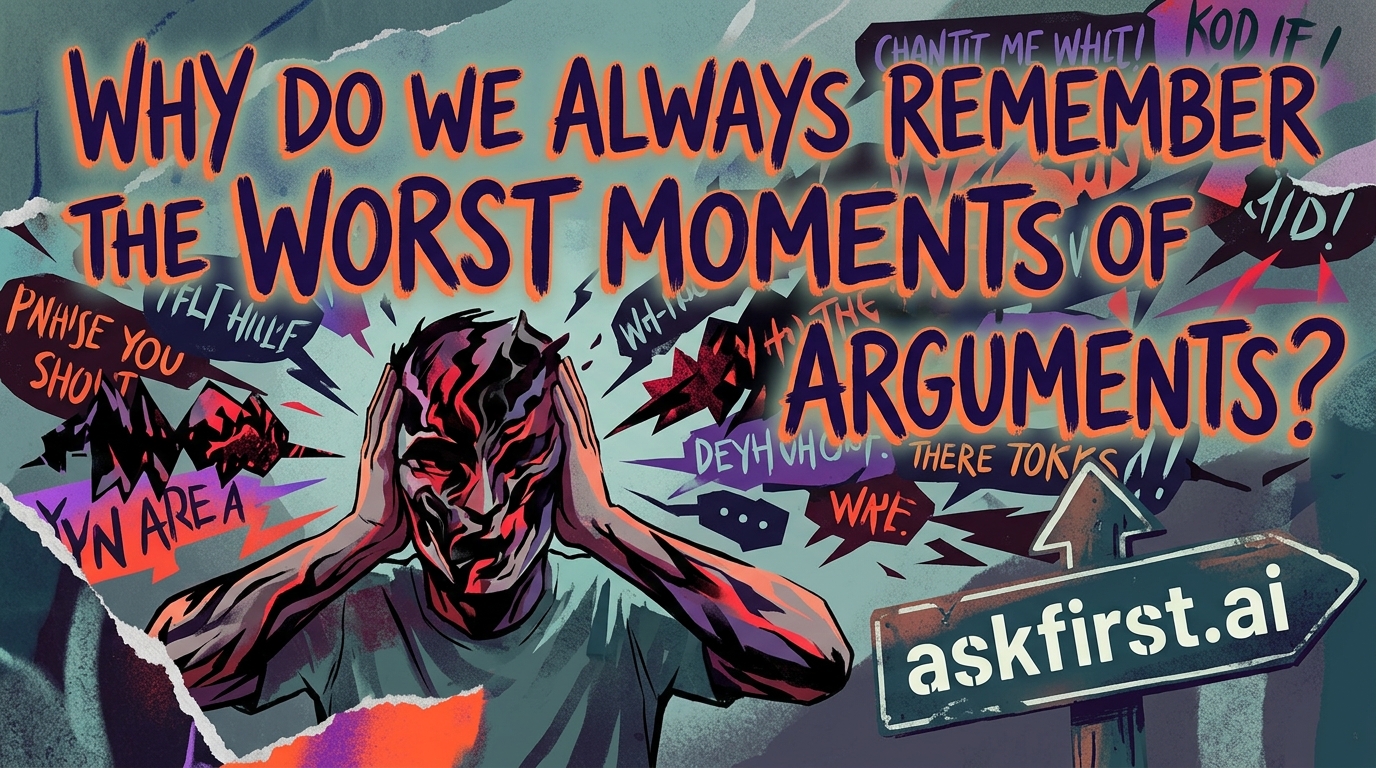
Human memory is not a perfect recorder of events like a digital camera. Instead, it acts as a dynamic reconstruction engine, heavily influenced by emotional significance and evolutionary priorities. The tendency to recall the most volatile or painful moments of an argument—a phenomenon often referred to as negativity bias—is deeply rooted in how the brain processes survival-critical information. During an intense disagreement, the brain shifts into a 'fight-or-flight' state, activating the amygdala. This structure serves as the emotional alarm system of the brain, prioritizing high-intensity, threatening experiences over mundane, neutral ones. In the ancestral environment, remembering a dangerous encounter clearly was the difference between survival and death, so evolution prioritized 'encoding' negative experiences with extreme precision.
The Role of Emotional Arousal
When people argue, emotional arousal spikes. Research indicates that the stronger the emotion associated with an event, the more robust the neural pathways linked to that memory become. Neurotransmitters like norepinephrine and cortisol are released, which help solidify memories of significant events. During an argument, the most toxic or hurtful comment becomes a 'flashbulb' of memory. Because these moments are perceived as social threats, the brain labels them as critical warnings to be stored for future avoidance. This is not a failure of character; it is a biological function designed to alert individuals to potential damage within a social hierarchy or relationship.
The 'Zeigarnik Effect' and Unfinished Business
In psychology, the Zeigarnik effect suggests that people remember uncompleted or interrupted tasks better than completed ones. Arguments often end in unresolved tension, leaving the brain in a state of cognitive dissonance. Because the conflict was not 'resolved' in a way that felt emotionally satisfying, the brain remains fixated on the most painful 'unresolved' data points. This creates a loop where the mind continuously revisits the worst moment, attempting to process or 'fix' it to achieve a sense of closure that is rarely found in the heat of the moment.
How Memory Reconstructs Reality
Memory is reconstructive, meaning every time an event is recalled, it is altered. When individuals ruminate on an argument, they often unconsciously highlight the most shocking components. This is known as selective abstraction, where the brain ignores the context or the 'good' parts of the discussion to focus on the 'spike' of emotional pain. Over time, the negative moment becomes the 'headline' of the entire event, effectively overwriting the more neutral or positive nuances of the conversation. This explains why an argument that was 90% reasonable can feel like 100% disaster.
Breaking the Cycle of Negative Recall
To overcome this cognitive trap, several psychological strategies are effective:
- Mindful Reframing: Consciously practicing the re-evaluation of an event can dampen its emotional charge. By focusing on the purpose behind the conflict rather than the delivery, the brain can transition the memory from an 'emotional threat' to a 'learning experience.'
- Externalizing Perspectives: Viewing the argument as a neutral observer can help strip away the visceral sting of the memory. This lowers the activity in the amygdala and engages the prefrontal cortex, which is responsible for logical reasoning and perspective-taking.
- Post-Hoc Resolution: Since the brain fixates on what is unresolved, proactively discussing an argument once the emotions have cooled can 'close the loop.' This turns an unmanaged threat into a manageable narrative, signaling to the brain that the danger has passed.
The Takeaway for Relational Health
Understanding that this behavior is a fundamental aspect of human neurobiology is liberating. It allows individuals to realize that their partner is likely not trying to hurt them or remember only the bad things; their brains are simply following a path of least resistance set by millions of years of evolutionary training. By recognizing the negativity bias, one can work toward creating 'emotional buffers'—deliberate efforts to affirm value and connection even after heated disagreements. Recognizing that memory is a biased storyteller helps in letting go of the need for the argument to have been 'perfect' and allows for a more forgiving view of both self and others. By actively choosing to narrate the positive aspects of a relationship, individuals can counterbalance the brain's inherent pull toward the worst-case scenario, building stronger, more resilient emotional bonds over the long term.