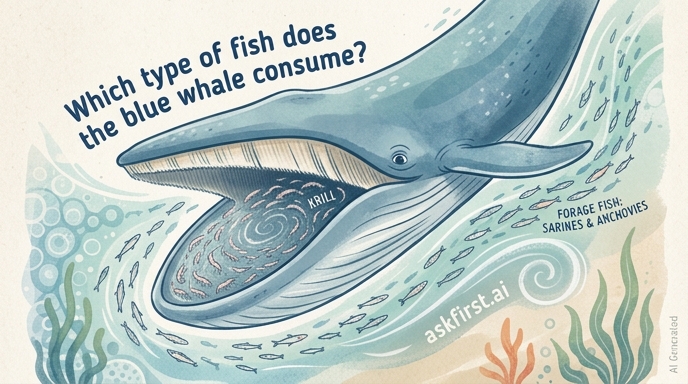
To understand the dietary habits of the blue whale (Balaenoptera musculus), one must first dispel a common misconception: despite their gargantuan size and status as the largest animals to have ever lived on Earth, blue whales do not consume fish in the traditional sense. Their diet is highly specialized, consisting almost exclusively of tiny, shrimp-like crustaceans known as krill.
The Biological Necessity of Krill
The blue whale is a rorqual, a type of baleen whale that feeds by engulfing massive volumes of water and prey, then filtering it through fringed plates made of keratin called baleen. While some smaller baleen whales, such as the sei whale or the Bryde’s whale, occasionally supplement their diets with small schooling fish, the blue whale has evolved to be a hyper-specialized predator of euphausiids, commonly referred to as krill.
In the Southern Ocean, the primary species consumed is Euphausia superba (Antarctic krill). In the North Pacific and North Atlantic, they target other species such as Thysanoessa spinifera or Meganyctiphanes norvegica. These organisms are incredibly nutrient-dense, providing the massive caloric intake required to maintain the blue whale’s enormous body mass—which can reach up to 190 tonnes.
Why Not Fish?
The evolutionary decision to focus on krill rather than fish is driven by thermodynamic efficiency. Blue whales are "bulk filter feeders." If they were to hunt individual fish, the energy expenditure required to catch, manipulate, and swallow prey one by one would far exceed the caloric gain. By targeting massive swarms of krill, a blue whale can consume up to 4 to 8 tonnes of biomass in a single day during the peak feeding season.
Krill aggregate in dense patches that can contain tens of thousands of individuals per cubic meter. For a blue whale, this represents a "high-density energy resource" that requires minimal effort to harvest relative to the volume of food ingested. While small fish (such as herring or sand lance) do exist in the same ecosystems, they do not typically form the same density of biomass that krill do, nor are they as easily filtered through the fine-mesh baleen plates of the blue whale.
The Mechanism of Feeding
The blue whale’s feeding technique is a marvel of evolutionary engineering. It involves a process known as lunge feeding:
- Acceleration: The whale identifies a swarm of krill using its sophisticated sensory systems and accelerates toward it.
- The Lunge: The whale opens its mouth, which is lined with expansive ventral pleats (grooves that run from the chin to the navel). These pleats allow the throat to expand like an accordion, enabling the whale to engulf a volume of water equal to its own body weight in a single gulp.
- Filtration: Once the mouth is closed, the whale uses its massive tongue to push the water out through the baleen plates. The baleen acts as a sieve, trapping the krill inside the mouth while allowing the water to escape.
- Ingestion: Once the water is expelled, the whale swallows the concentrated mass of krill.
Ecological Importance of the Diet
The blue whale’s reliance on krill makes them a "keystone species" in the marine environment. Their feeding habits have a profound impact on nutrient cycling. By consuming krill at depth and then surfacing to defecate, whales release massive amounts of iron and nitrogen back into the photic zone—the upper layer of the ocean where sunlight penetrates. This process, often referred to as the "whale pump," stimulates the growth of phytoplankton, which in turn supports the entire marine food web, including the very krill populations the whales feed upon.
Rare Exceptions and Anomalies
While scientific consensus confirms that krill is the staple diet of the blue whale, there have been extremely rare, isolated observations of baleen whales consuming small shoaling fish in regions where krill density is low. However, these instances are considered opportunistic rather than habitual. Unlike the humpback whale, which is highly plastic in its feeding behavior and frequently consumes capelin, mackerel, and herring, the blue whale’s anatomy and physiology are so finely tuned to the consumption of krill that it is effectively an obligate krill-feeder.
Conclusion
In summary, the blue whale does not consume fish as a primary food source. Its entire biological existence is predicated on the consumption of krill. This specialization is a highly successful evolutionary strategy that allows the whale to thrive in the nutrient-rich, cold waters of the world's oceans. By focusing on these high-density, low-effort prey items, the blue whale maintains its position as the apex giant of the marine world, sustaining its massive scale through the efficient harvest of the smallest organisms in the sea.