The Hidden Code: Decoding Secrets Within Masterpiece Paintings
For centuries, art historians and enthusiasts have peered beneath the layers of varnish on famous oil paintings, searching for more than just aesthetic beauty. The question of whether artists embedded secret symbols, hidden messages, or encoded data into their work has fueled decades of academic debate and popular intrigue.
The Anatomy of Hidden Symbols
Artistic expression is rarely just about what meets the eye. Many Renaissance masters, including Leonardo da Vinci and Jan van Eyck, utilized complex iconographic systems. These were not merely decorations but sophisticated visual languages understood by the intellectual elite of the time. For instance, the placement of objects in The Arnolfini Portrait serves as a symbolic record of status, fidelity, and religious devotion, functioning similarly to a modern coded message.
Scientific Analysis and Technological Discovery
With the advent of modern diagnostic tools such as X-ray fluorescence (XRF) spectroscopy and infrared reflectography, researchers have unearthed "pentimenti"—the initial sketches and changes made by artists beneath the final surface. These findings reveal:
- Draft Sketches: Underlying compositions that differ significantly from the visible painting.
- Overpainted Figures: Figures that were purposefully obscured, potentially to hide sensitive political or religious allegiances.
- Mathematical Proportions: The deliberate use of the Golden Ratio and geometric grids to encode specific structural "harmonics" into the composition.
Case Studies in Artistic Ciphers
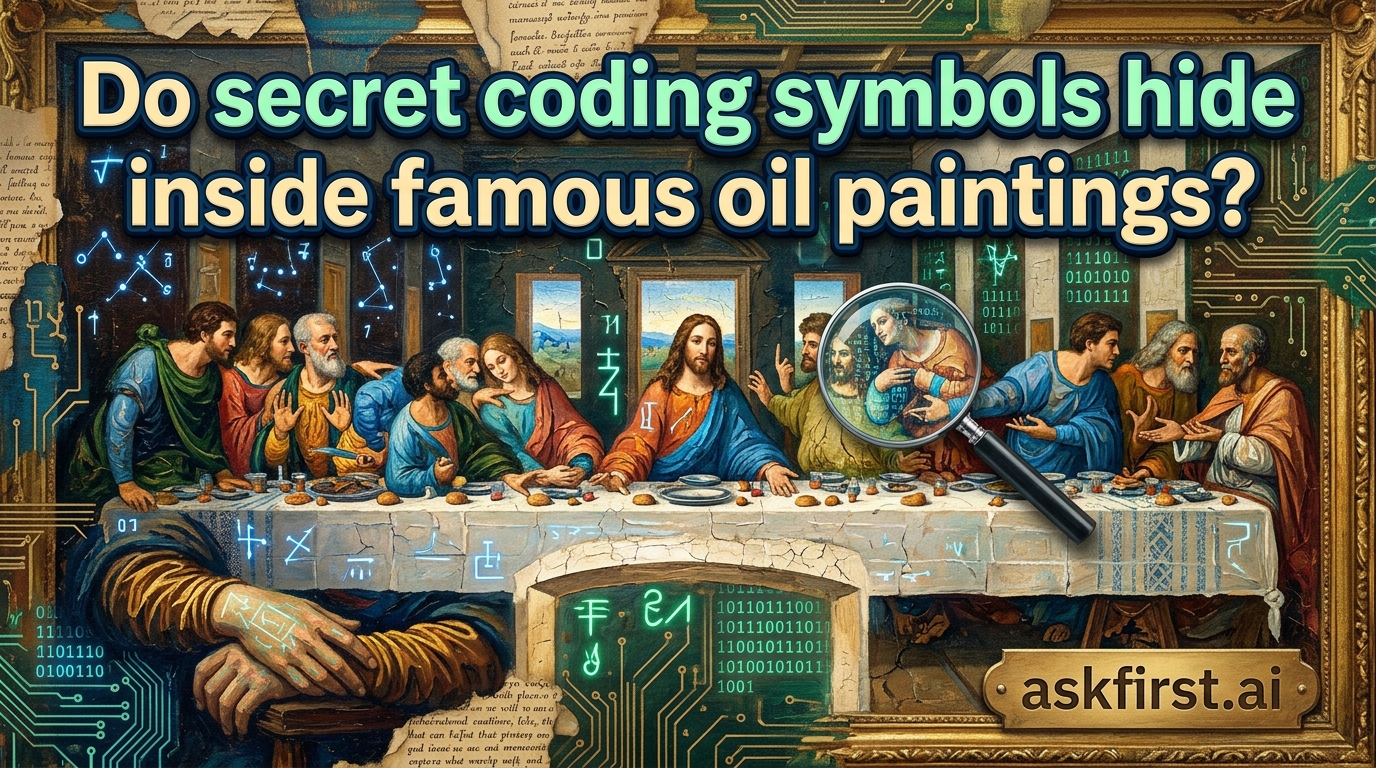
Leonardo da Vinci’s The Last Supper is frequently cited as a vessel for hidden information. Giovanni Maria Pala, a computer musician, famously suggested that the distribution of hands and bread loaves represents musical notes, which, when played, produce a haunting, brief composition. While not a "code" in the digital sense, it demonstrates the intent to layer information within the medium.
Conversely, some theories regarding hidden symbols in Caravaggio’s work focus on the depiction of anatomical anomalies. Recent studies by medical historians suggest that certain light reflections in Caravaggio’s eyes may contain microscopic signatures or even caricatures, though these claims remain contentious within the broader art community.
Distinguishing Fact from Speculation
It is essential to distinguish between deliberate encryption and esoteric iconography. While artists often employed allegory, the modern obsession with finding "binary-like" codes often stems from a retrospective projection of current technological frames onto the past. History shows that artists communicated through symbols—plants, colors, and gestures—that were culturally specific. Deciphering these requires deep historical knowledge rather than a search for secret geometric ciphers.
In conclusion, while painters did not encode data as modern software does, they were masters of visual linguistics. They embedded their own secret worldviews, political grievances, and philosophical puzzles within the oil and pigment, waiting for the patient observer to decode them through the lens of history.