The Quest for Transmutation: Did Ancient Alchemists Succeed?
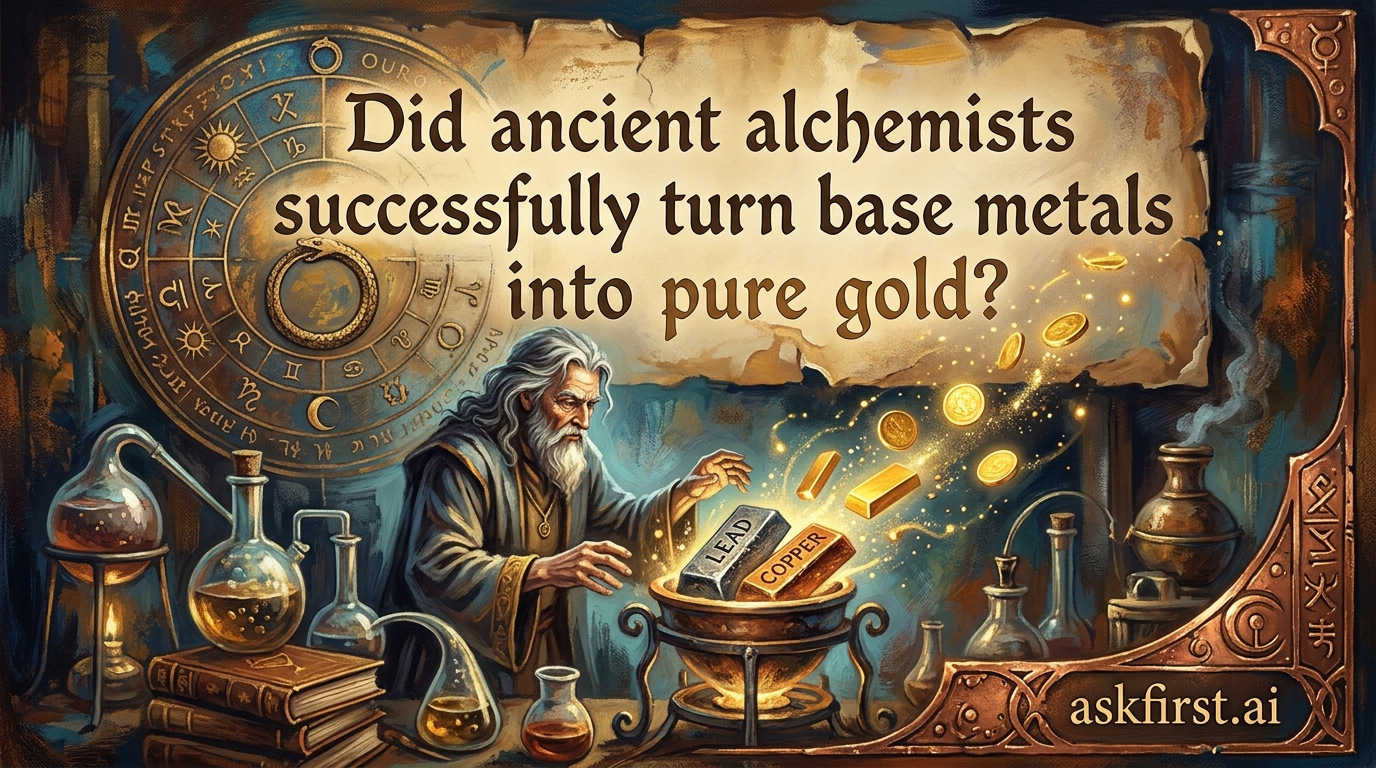
The short answer is no. Throughout the history of alchemy—spanning from Hellenistic Egypt and Islamic Spain to Medieval and Renaissance Europe—no alchemist ever successfully transformed base metals, such as lead, iron, or mercury, into pure gold (Au) through chemical or transmutation processes. Despite the persistence of the "Philosopher’s Stone" legend, the transmutation of base metals into gold remained an elusive, theoretical goal rather than a demonstrated scientific reality.
Historical Context and the "Philosopher’s Stone"
Alchemy was never merely a pursuit of wealth; it was a complex philosophical and proto-scientific system. The central objective was the discovery of the Philosopher’s Stone (lapis philosophorum), a legendary substance believed to possess the power to transmute base metals into gold or silver, cure all diseases, and grant immortality.
- Philosophical Roots: Alchemists believed in the Aristotelian theory of the four elements (earth, air, fire, and water). They theorized that if one could strip a metal of its "accidental" properties, one could reach the "prime matter" and re-mold it into the "perfect" metal: gold.
- Symbolism vs. Reality: Much of the alchemical literature is written in highly metaphorical, cryptic language. Scholars argue that many "transmutations" described in ancient texts were actually allegories for spiritual purification or chemical processes like gilding (coating a metal with gold) or creating brass (an alloy of copper and zinc that mimics gold’s appearance).
Practical Methods and Limitations
Ancient alchemists employed rigorous laboratory techniques that laid the foundation for modern chemistry, including distillation, sublimation, and crystallization. However, they were fundamentally limited by the Atomic Theory.
- Chemical vs. Nuclear Reactions: Alchemy is based on chemical reactions, which involve the rearrangement of electrons in the outer shells of atoms. Gold is a chemical element with an atomic number of 79. Lead (Pb), with an atomic number of 82, cannot be turned into gold through chemical means because the identity of an element is defined by the number of protons in its nucleus.
- The Energy Barrier: To turn lead into gold, one must remove three protons from the nucleus. This requires high-energy nuclear physics—such as particle accelerators or nuclear reactors—not the heating of ores in a crucible.
Pros, Cons, and the Scientific Legacy
While the primary objective failed, the "cons" of the failure were offset by the "pros" of the accidental discoveries:
- Pros: The pursuit led to the invention of laboratory apparatus, the discovery of mineral acids (like sulfuric and nitric acid), the refinement of metal alloys, and the development of pharmacology.
- Cons: Many alchemists suffered from mercury poisoning and respiratory illnesses due to the toxic fumes produced in their attempts to distill metals.
Future Trends and Modern Reality
In the 20th and 21st centuries, humanity finally achieved the alchemist's dream, albeit at a cost that makes it economically impossible. Using nuclear transmutation, scientists have successfully converted bismuth or lead into gold in particle accelerators. However, the process is incredibly expensive, requiring far more energy than the resulting gold is worth.
Today, alchemy has evolved into nuclear chemistry. While the ancient goal of "base metals into gold" was technically achieved via physics, it remains a testament to the fact that early alchemists were limited by their understanding of matter, yet they paved the path for the modern scientific revolution.