The Science of the Aurora Borealis
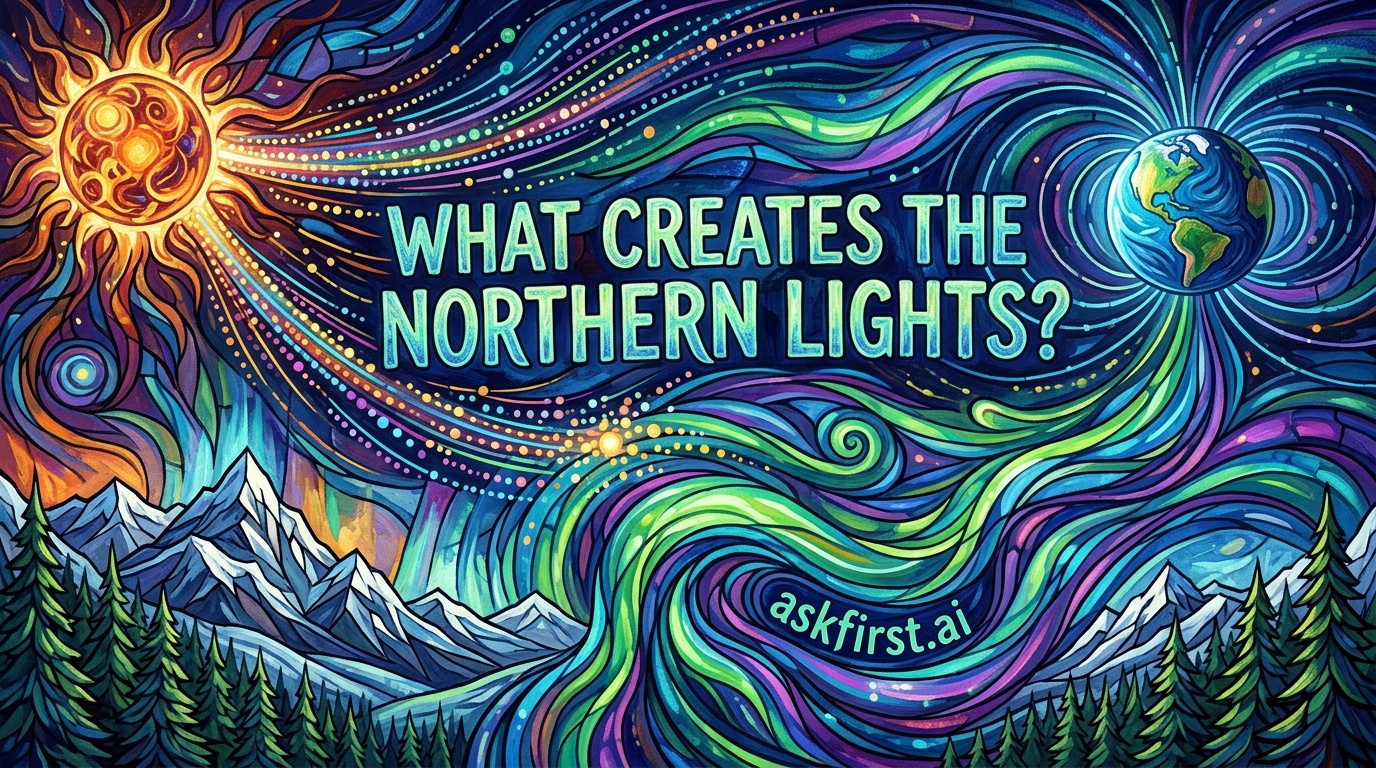
The Aurora Borealis, commonly referred to as the Northern Lights, is a spectacular natural light display predominantly seen in high-latitude regions around the Arctic. This atmospheric phenomenon is the visible manifestation of complex electromagnetic interactions between the Sun and Earth.
1. The Solar Origin: Solar Wind and Coronal Mass Ejections
The process begins approximately 93 million miles away on the surface of the Sun. The Sun constantly emits a stream of charged particles—primarily electrons and protons—known as the solar wind. Occasionally, the Sun experiences violent eruptions called Coronal Mass Ejections (CMEs), which launch massive clouds of plasma into space. When these particles travel toward Earth, they carry the Sun’s magnetic field with them.
2. Earth’s Magnetosphere: The Protective Shield
Earth is protected by the magnetosphere, a magnetic field generated by the planet's molten iron core. Under normal conditions, this field deflects the majority of the solar wind. However, when the solar wind is particularly intense, or when the magnetic polarity of the solar wind aligns in a way that allows it to "connect" with Earth’s magnetic field, particles are funneled toward the magnetic poles.
3. Atmospheric Excitation and Ionization
As these charged particles penetrate the upper atmosphere (specifically the thermosphere and ionosphere at altitudes of 80 to 300 kilometers), they collide with oxygen and nitrogen atoms.
- Energy Transfer: These collisions transfer energy to the atmospheric atoms, exciting them to a higher energy state.
- Photon Emission: As the atoms return to their stable ground state, they release the excess energy in the form of light (photons). This is the same principle that powers neon signs.
4. Color Variation and Chemical Composition
The specific colors observed in an aurora are determined by the type of gas involved and the altitude of the collision:
- Green: The most common color, produced by oxygen molecules colliding at altitudes of 100–150 km.
- Red: Produced by high-altitude oxygen (above 200 km). This is rarer and typically visible only during intense solar activity.
- Blue and Purple: Produced by ionized nitrogen molecules, typically at lower altitudes (below 100 km).
5. Practical Guide to Viewing
To witness this phenomenon, observers must prioritize three factors:
- Latitude: Travel to the "Auroral Oval," a ring-shaped region centered on the magnetic North Pole. Prime locations include Tromsø (Norway), Fairbanks (Alaska), and Yellowknife (Canada).
- Darkness: Light pollution is the enemy of the aurora. Viewing must occur during the darkest hours of the night, ideally during the winter months when the polar night provides extended darkness.
- Solar Activity: Monitor the Kp-index, a scale from 0 to 9 that measures geomagnetic activity. A Kp-index of 5 or higher indicates a geomagnetic storm, significantly increasing the probability of a brilliant display.
Future Trends and Conclusion
Recent advancements in heliophysics, such as NASA’s Parker Solar Probe, are providing unprecedented data on solar wind acceleration. As we move closer to the solar maximum in the late 2020s, the frequency and intensity of the Northern Lights are expected to increase, offering more opportunities for scientific study and public observation of this breathtaking interplay between our planet and its star.