The Secret Symphony: How Roman Architects Mastered Sound
Ancient Roman architects possessed an extraordinary understanding of sound propagation that rivals modern acoustic engineering. While many assume Roman theaters were simply open-air arenas, they were actually precision-tuned instruments designed to amplify the human voice for thousands of spectators without the aid of electricity. By utilizing sophisticated geometric layouts and strategic material choices, Romans created an immersive auditory environment that remains a masterclass in structural engineering.
The Geometry of Sound
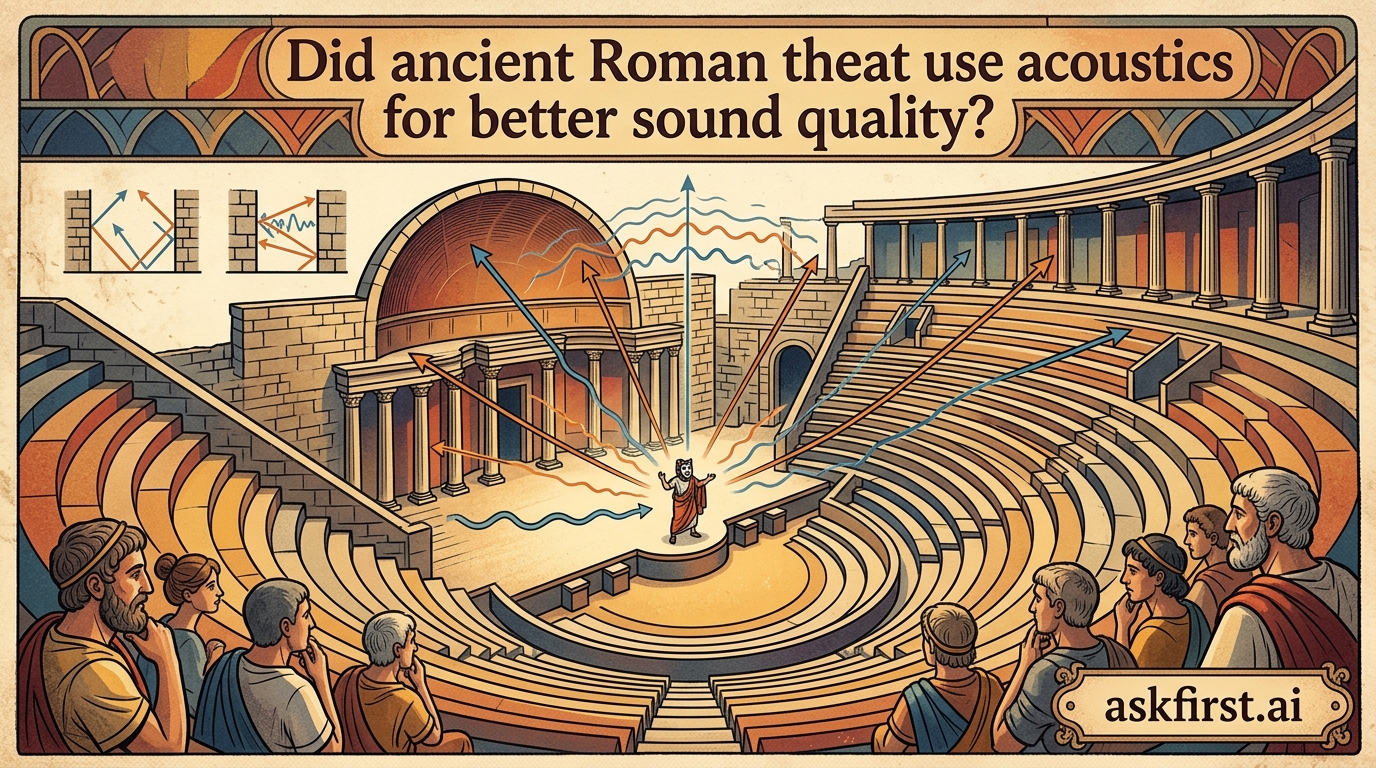
The most striking feature of Roman theater design is the semi-circular orchestra and the tiered seating known as the cavea. This shape was not purely for crowd capacity; it served a vital acoustic purpose. The curved walls acted as a massive sound reflector, bouncing audio waves back toward the audience rather than letting them disperse into the sky. Roman architects understood the concept of "sound shadows" and minimized them by angling the seating banks, ensuring that every seat had a direct line of sight—and sound—to the stage.
Resonance and Architectural Innovations
Beyond basic geometry, the Romans incorporated hidden technological marvels to enhance performance:
- Acoustic Vases (Echea): According to the Roman architect Vitruvius, bronze vessels were often tucked beneath the seats. These acted as resonators, tuned to specific musical frequencies to amplify harmonics and create a fuller sound profile.
- The Scaenae Frons: The elaborate, multi-story wall behind the stage served as a "sound mirror." Its complex surface—adorned with niches, statues, and columns—helped diffuse sound waves, preventing harsh echoes while ensuring the actors' voices projected forward with clarity.
- Material Selection: Romans strategically utilized limestone and volcanic tuff. These dense, porous materials were excellent for absorbing unwanted high-frequency noise while reflecting the lower-frequency clarity required for dramatic speech.
Why Modern Engineering Still Learns from the Past
Modern studies, such as those conducted at the Theater of Epidaurus and similar Roman structures, reveal that the seating rows act as a high-pass filter. The stepped stone rows suppress low-frequency background noises—like the murmur of a crowd—while allowing the higher-frequency speech of the actors to travel across the vast arena with remarkable crispness. This "acoustic filtering" is a phenomenon that modern concert hall designers strive to replicate using complex digital modeling.
The genius of Roman design lies in its sustainability and efficiency. By harnessing the laws of physics, they proved that a well-designed space does not need technological supplementation to convey emotion, drama, and information. These ancient theaters stand as evidence that humanity has long understood the intersection of mathematics and art to create truly harmonious environments.