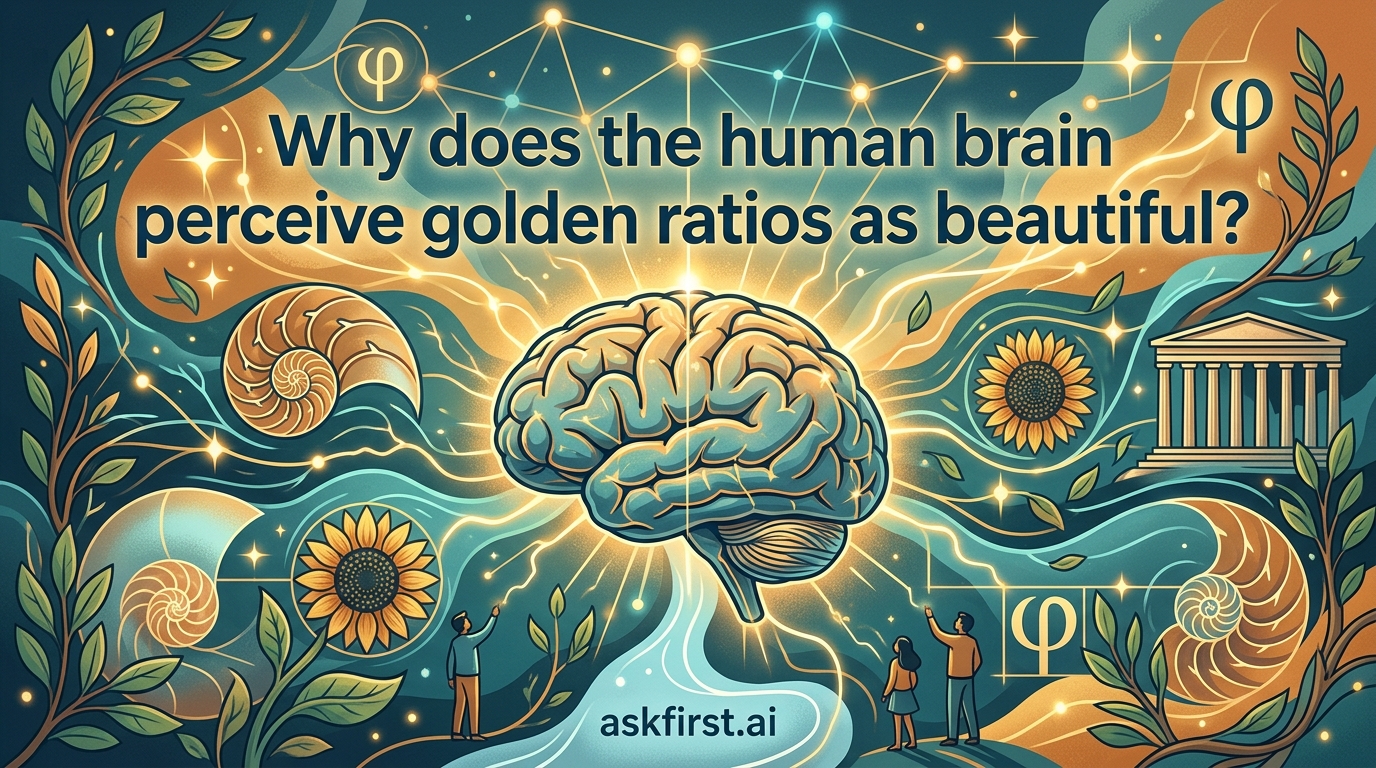
The Geometry of Beauty: Why Our Brains Crave the Golden Ratio
The perception of beauty is rarely accidental; it is deeply rooted in the architecture of the human mind and its interaction with the physical world. The golden ratio, denoted by the Greek letter phi (φ), approximately 1.618, is a mathematical proportion that has captivated architects, artists, and mathematicians for millennia. When encountered, this ratio frequently triggers a sensation of aesthetic harmony, but why does the brain interpret this specific number as "beautiful"?
Evolutionary Efficiency and Pattern Recognition
At the core of this perception lies the brain’s need for efficient processing. The human visual system has evolved to prioritize patterns that convey information rapidly. Because phi appears repeatedly in the natural world—from the spiral of galaxies to the arrangement of seeds in a sunflower—the human brain has developed a heuristic bias toward it.
- Processing Fluency: Psychologists suggest that the golden ratio allows for higher processing fluency. When an object matches a pattern already encoded within our neural pathways, the brain expends less cognitive energy to perceive and understand it. This ease of processing is often registered by the conscious mind as a feeling of pleasure or beauty.
- Biological Familiarity: By preferring these proportions, humans align themselves with the fundamental growth patterns of nature. Evolutionary psychologists argue that individuals who identified and appreciated healthy, symmetrical growth patterns (which often adhere to phi) were better equipped to recognize vitality, reproductive fitness, and resource availability in their environments.
The Neuro-Aesthetic Connection
Neuro-aesthetics is the field that investigates the neural basis of aesthetic experiences. Research indicates that when we view images containing golden ratios, specific areas of the brain, including the orbitofrontal cortex, show heightened activity. This region is linked to reward systems and emotional regulation.
Unlike abstract, chaotic shapes that require significant analytical effort to decode, golden ratio compositions provide a balanced distribution of spatial information. This balance facilitates an intuitive "wholeness" that the brain finds inherently satisfying. Furthermore, in facial aesthetics, scholars have noted that faces approaching these proportions are often rated as more attractive. This is not merely cultural preference but a deep-seated biological drive to favor structural symmetry and mathematical order.
Conclusion: A Universal Language
While personal taste varies, the golden ratio serves as a universal anchor for aesthetic appeal. By bridging the gap between mathematical precision and sensory perception, phi allows the brain to experience harmony in a complex, disordered world. This mathematical affinity represents a profound intersection where the rigors of geometry meet the intuitive nature of human desire, ensuring that beauty remains both measurable and eternally captivating.