The Cognitive Architect: How Coding Reshapes Human Problem-Solving
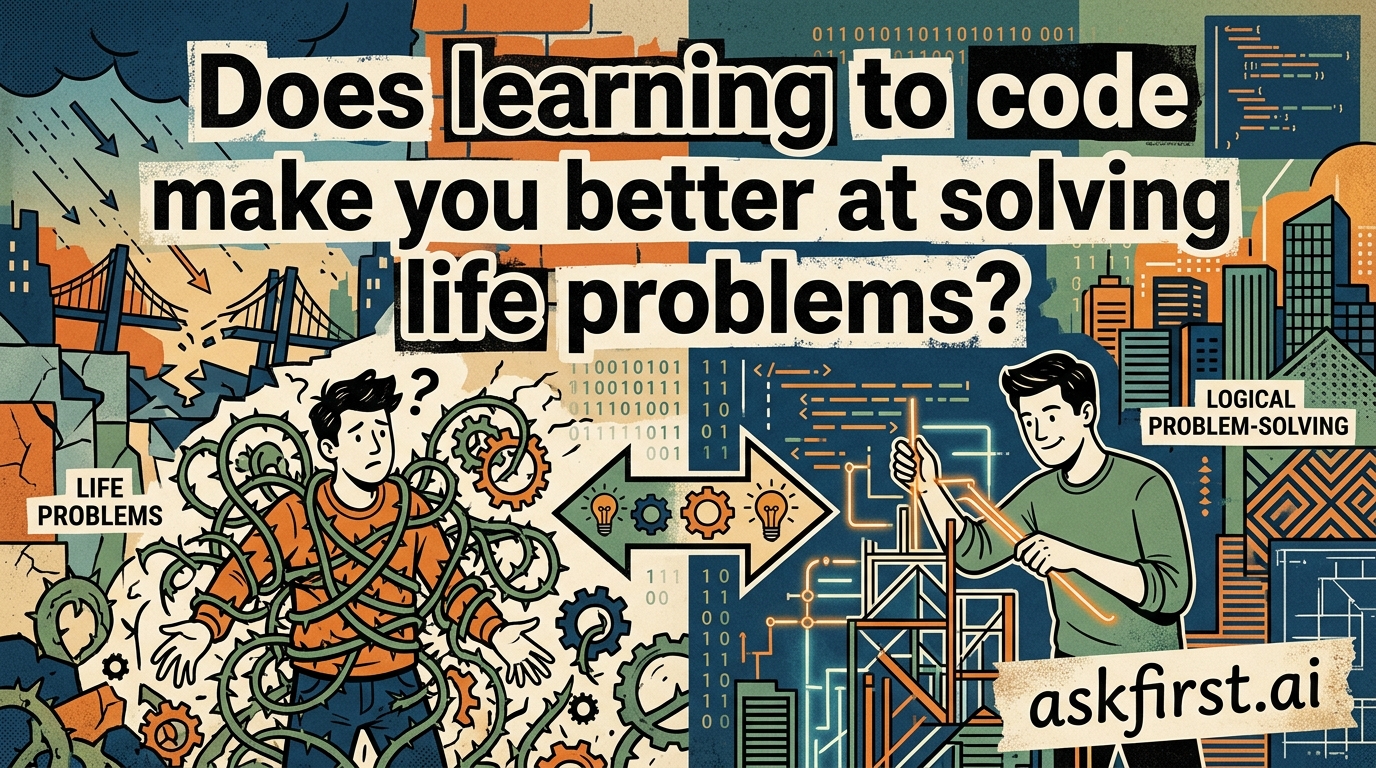
Learning to code is frequently misconstrued as a process of merely memorizing syntax or mastering specific software tools. However, the true essence of computer programming lies in the cultivation of computational thinking—a robust mental framework that transcends the digital screen. When an individual engages with programming, they are effectively training their brain to decompose complex systems, identify patterns, and implement logical sequences. This cognitive restructuring has profound implications for solving everyday life problems, turning abstract chaos into manageable, ordered outcomes.
The Art of Decomposition
At the core of software engineering is the principle of decomposition: taking a massive, monolithic problem and breaking it down into smaller, digestible components. In life, overwhelming challenges—such as career transitions, complex financial planning, or personal relationship conflicts—often paralyze the human mind because they appear as singular, insurmountable mountains. A programmer approaches these tasks by isolating variables. By applying this methodology, life stressors are categorized into manageable sub-tasks. When a person adopts this architectural approach, they cease to be victims of a situation and become designers of a solution.
Debugging Your Life
One of the most valuable paradigms in coding is the concept of the 'bug.' In software, a bug is not a failure of character; it is a signal of a logical discrepancy. Developers do not panic when code fails; they look for the 'traceback' to identify where the logic diverged from the intended outcome. Applying this to personal life creates a powerful feedback loop. When a goal is not met or an interpersonal misunderstanding occurs, a programmer-mindset prompts an analytical inquiry rather than an emotional reaction. Instead of asking 'What is wrong with me?', the mind learns to ask, 'What variable in this process led to this specific result?' This emotional detachment allows for objective correction, turning every failure into a high-value data point.
The Power of Abstraction
Abstraction is the process of hiding complex implementation details to focus on higher-level functionality. This is a critical life skill. We are constantly inundated with noise—bureaucracy, societal expectations, and digital distraction. Learning to code teaches the brain to filter out irrelevant information and focus on the inputs and outputs that truly matter. This efficiency allows people to prioritize their energy, focusing only on the mechanisms that produce the desired impact while ignoring the ‘background noise’ of life. Those who learn to prioritize by applying abstract logic find themselves with more time, lower stress levels, and greater clarity.
Iteration: The Growth Mindset Manifested
'Refactoring' is the act of improving existing code without changing its external behavior. It is a commitment to continuous improvement. Similarly, life is a constant process of optimization. The coding mindset encourages the understanding that nothing is ever truly finished—it is merely ready for the next iteration. This perspective destroys the paralysis of perfectionism. If one accepts that they are in a permanent state of ‘Version 1.0,’ the pressure to be perfect immediately vanishes. The focus shifts from achieving an impossible static state to a dynamic state of constant growth and refined efficiency.
Logic vs. Heuristics
While intuition is valuable, it is often prone to cognitive biases. Coding demands a reliance on hard logic. By practicing programming, the brain gets accustomed to checking assumptions against reality. Many life problems persist because humans operate on faulty heuristics—mental shortcuts that are often incorrect. A coder asks: 'Does the evidence support this assumption?' This empirical approach to decision-making acts as a filter against misinformation and poor judgment, ensuring that actions are grounded in logical consistency rather than fleeting impulses.
Summary of Benefits
- Enhanced Resilience: Viewing obstacles as 'bugs' reduces the emotional sting of setbacks.
- Analytical Clarity: Breaking down challenges prevents the paralysis of feeling overwhelmed.
- Strategic Prioritization: Utilizing abstraction techniques leads to better time and energy management.
- Continuous Improvement: The philosophy of iteration fosters a lifelong commitment to self-optimization.
In conclusion, learning to code is not about the job market or building applications; it is about installing a powerful operating system within the human mind. The strategies used to build the digital world—systematic inquiry, structural design, and iterative improvement—are universally applicable. By adopting the habits of a software developer, one gains a toolkit for managing the volatility of human experience. It is perhaps the most practical form of self-improvement available in the modern age, offering a clear, reproducible methodology for navigating the complexity of life with confidence and precision.