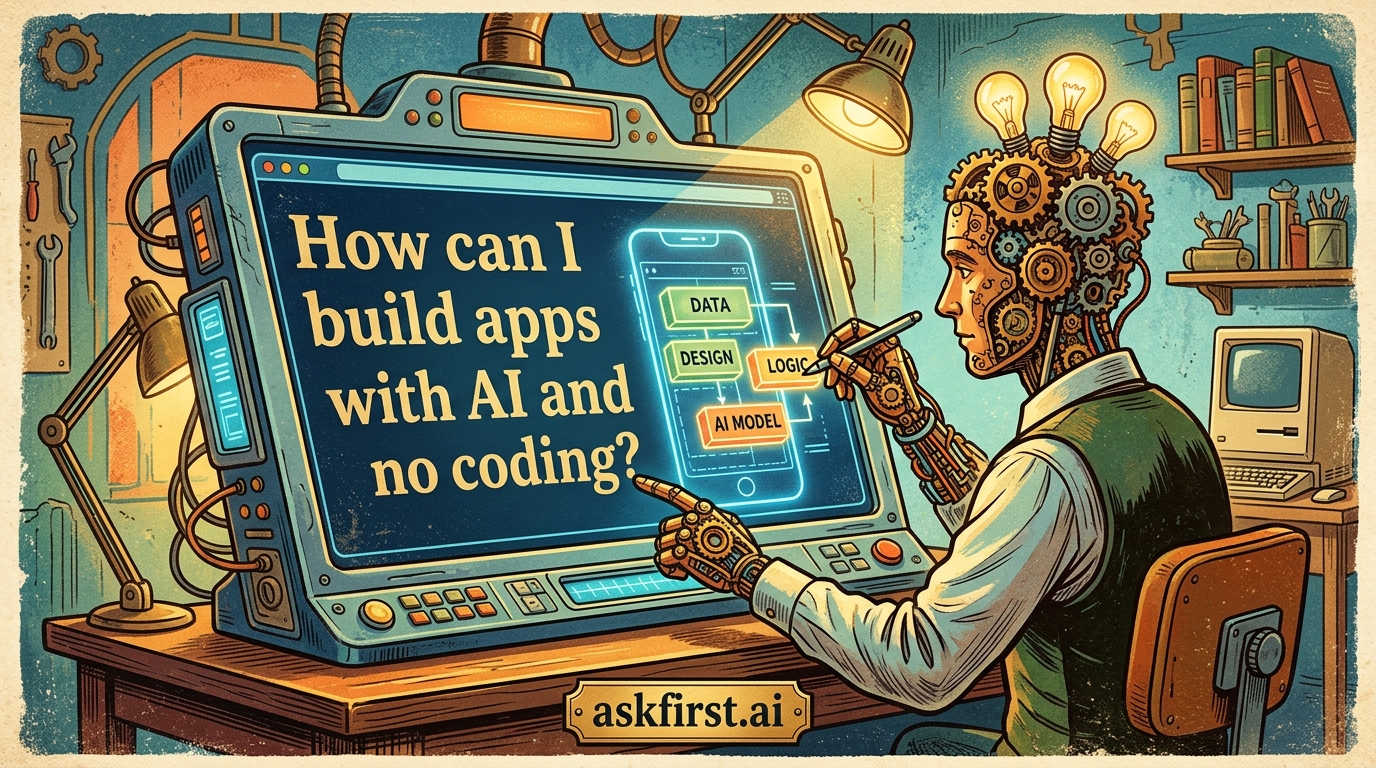
The Era of No-Code AI: Democratizing Software Development
The landscape of software development has undergone a seismic shift. For decades, building functional applications was the exclusive domain of those who mastered complex syntax, memory management, and algorithmic logic. Today, the rise of "No-Code" and "Low-Code" platforms, integrated with powerful Large Language Models (LLMs), has dismantled these barriers. Building AI-driven applications is no longer about writing lines of Python or C++; it is about architecting logic, managing data flows, and leveraging pre-built API integrations.
By utilizing modular interfaces, entrepreneurs, domain experts, and creative thinkers can now deploy sophisticated software that utilizes artificial intelligence for automation, content generation, and predictive analytics.
The Foundational Architecture of No-Code AI
To build an AI application without code, you must view the software as a series of interconnected blocks. In his seminal work, The Second Machine Age, Erik Brynjolfsson and Andrew McAfee highlight how digital technologies are becoming general-purpose tools that anyone can apply. When building an app without coding, you are essentially acting as an orchestrator of these tools.
Most no-code AI stacks rely on three core components:
- The Interface (Frontend): Where the user interacts with your app.
- The Logic Layer (The "Brain"): Where the AI processes information.
- The Database (Memory): Where your application stores user inputs and outputs.
Tools like Bubble.io or FlutterFlow serve as the canvas for your interface. These platforms allow for drag-and-drop design, ensuring that your application looks professional without requiring a single line of CSS or HTML.
Integrating AI: The Role of APIs and Connectors
The "AI" part of your application usually comes from external providers. Instead of building your own neural network—a task requiring massive computational resources—you connect your no-code tool to an existing engine.
OpenAI’s API (the engine behind GPT-4) or Anthropic’s Claude API are the industry standards for text generation. Using middleware platforms like Make.com (formerly Integromat) or Zapier, you can create automated workflows.
Example:
Imagine you want to build a "Market Research Assistant."
- Trigger: A user submits a company name via a form on your Bubble.io app.
- Action: Make.com catches that input, sends it to the OpenAI API with a prompt like "Summarize the competitive landscape of [Company Name]," and receives the response.
- Storage: The response is sent back to your Airtable database, which then displays the information instantly on the user’s dashboard.
This entire pipeline is built through visual mapping, not scripting. As noted by Ryan Hoover, founder of Product Hunt, the ability to "glue" these services together is the most valuable skill in the current no-code economy.
Choosing the Right Tooling Stack
To successfully launch an AI app, you must select tools that communicate well with one another. Below is a recommended stack for beginners:
- For the Interface: Bubble.io is the gold standard for full-stack web applications. It handles user authentication, database management, and complex workflows.
- For Workflow Automation: Make.com is superior to Zapier for AI applications because it allows for more complex "if/then" logic and iterative processing, which is often needed when refining AI prompts.
- For Data Management: Airtable acts as a relational database that is as easy to use as a spreadsheet but powerful enough to serve as the backend for thousands of records.
- For AI Connectivity: Utilize OpenRouter or LangChain’s no-code wrappers to switch between different AI models (like Gemini, Claude, or GPT) without changing your application architecture.
Strategic Considerations: Prompt Engineering as Coding
When you remove code, the "logic" of your application shifts to Prompt Engineering. In the book Prompt Engineering for Generative AI by James Phoenix and Mike Taylor, the authors argue that the prompt is the new source code.
If you are building an app that summarizes legal documents, your success depends entirely on how you instruct the AI within your workflow. You must define:
- Persona: "You are an expert legal analyst."
- Constraint: "Provide only bullet points, strictly citing the provided text."
- Output Format: "Return the data in JSON format so the app can parse it."
By treating the prompt as a piece of code, you ensure that your application behaves predictably, even when the underlying AI model is stochastic (variable).
Conclusion: From Concept to Deployment
Building AI apps without code is a process of curation. It requires a deep understanding of the problem you are solving, rather than the syntax of the language you are using. By leveraging robust platforms like Bubble, Make, and Airtable, you can transform a conceptual idea into a scalable, AI-powered product in a matter of days.
The barrier to entry has vanished. Whether you are building a tool to automate customer service inquiries, generate personalized marketing copy, or analyze financial datasets, the infrastructure exists to support your vision. The most successful developers in the no-code space are not those who know the most about technology, but those who best understand how to integrate these powerful AI modules into a seamless user experience. Start small, iterate often, and remember that in the no-code world, your ability to think logically is your greatest asset.