The Software Supremacy Bias: A Cognitive Perspective
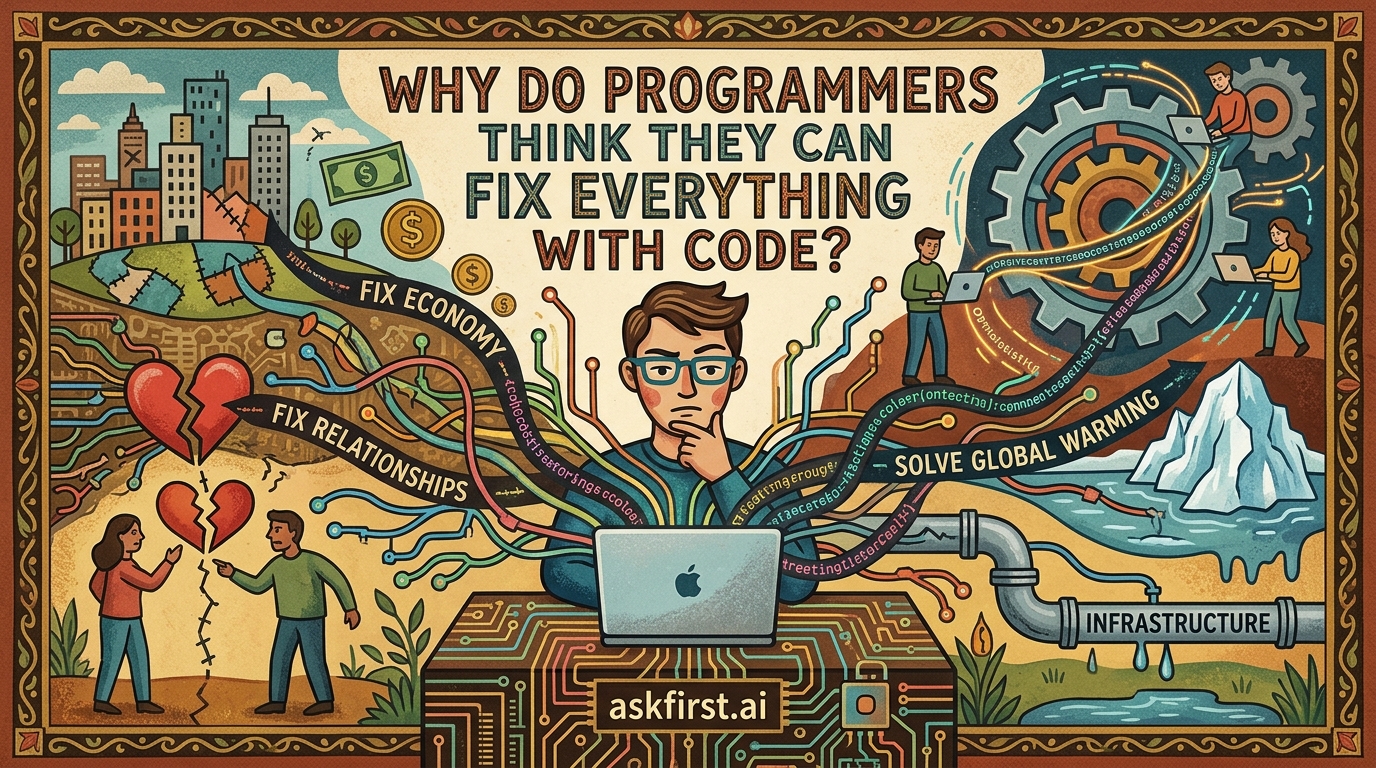
The perception that code is a universal panacea stems from the inherent architecture of the digital world. Programmers operate within systems governed by binary logic, where every problem is essentially a logical knot waiting to be untied. When a programmer stares at a screen, they do not just see text; they see an abstraction of the universe. This cognitive framework leads to the 'Software Supremacy Bias'—the belief that if a problem can be decomposed into discrete, logical instructions, it can be optimized, scaled, and ultimately solved through algorithmic intervention.
The Allure of Deterministic Systems
Unlike the messy, unpredictable reality of human social dynamics, code offers a rare commodity: determinism. In a codebase, if a function is given the same input, it produces the same output. This predictability is seductive. When a programmer encounters a challenge in the real world—such as supply chain inefficiencies or social coordination gaps—they naturally lean toward the tools they trust most. By translating ambiguous real-world phenomena into formal models, they attempt to force the chaotic nature of existence into a predictable, binary flow. The desire to 'fix everything' is less an ego-driven power trip and more an existential pursuit of order in a state of high entropy.
The Power of Abstraction and Scalability
One of the most potent drivers of this mindset is the phenomenon of scalability. In traditional craftsmanship, fixing a problem once usually requires fixing it every subsequent time the problem arises. In software, once a 'fix' is written as an automated script or a microservice, that fix becomes a permanent, infinitely replicable asset. This creates a psychological feedback loop. Once a programmer successfully solves a small, nagging issue (like automating an email response) with a few lines of code, the brain releases a reward signal. This creates an addictive pattern: If I can fix this with code, I can fix everything else with code. This is the birth of the 'Engineering-First' culture, where social, systemic, and human challenges are viewed as 'bugs' that just haven't been patched yet.
The Limitations of the Algorithmic Approach
Despite the enthusiasm, this perspective frequently brushes against the 'Reality Wall.' The primary danger of believing that code is the answer to every problem is the reductionist fallacy. By simplifying complex human issues into logic gates, the nuances of morality, emotion, and cultural context are often lost. For example:
- Complexity vs. Complicatedness: A complex system (like a forest ecosystem) cannot be fully modeled by a complicated system (code). Even with advanced machine learning, the emergent properties of human society often defy linear prediction.
- The Moral Dimension: Software lacks the capacity for ethical reasoning. When programmers attempt to 'fix' judicial sentencing or hiring through code, they often inadvertently bake existing biases into the logic, creating a systemic 'technical debt' that is far harder to debug than traditional software.
Reframing the Programmer's Role
To move beyond this bias, the industry is increasingly embracing systems thinking. This perspective acknowledges that while code is a powerful lever, it is merely one component of a broader societal mechanism. Effective problem-solving now requires 'Sociotechnical Systems Thinking,' which integrates deep software engineering expertise with human-centric fields like sociology, psychology, and ethics.
Instead of asking 'How can I solve this with code?', the most effective problem-solvers in the future will ask: 'How does my code fit into the existing human ecosystem without disrupting the necessary chaos that creates true innovation?' The transition from a 'coder' to an 'architect of systems' marks the evolution from wanting to fix the world to wanting to build tools that help the world fix itself.
Conclusion: The Future of Problem-Solving
Code remains the most powerful language humanity has ever developed for restructuring the environment. The urge to fix everything with code is a testament to the immense confidence engineers have in the power of structured thought. As we look toward 2030 and beyond, the goal should not be to suppress this creative drive but to broaden its scope. By recognizing the boundaries between the algorithmic and the human, programmers can move from being simple 'patch writers' to being architects of a more efficient, yet deeply human-respecting, reality.