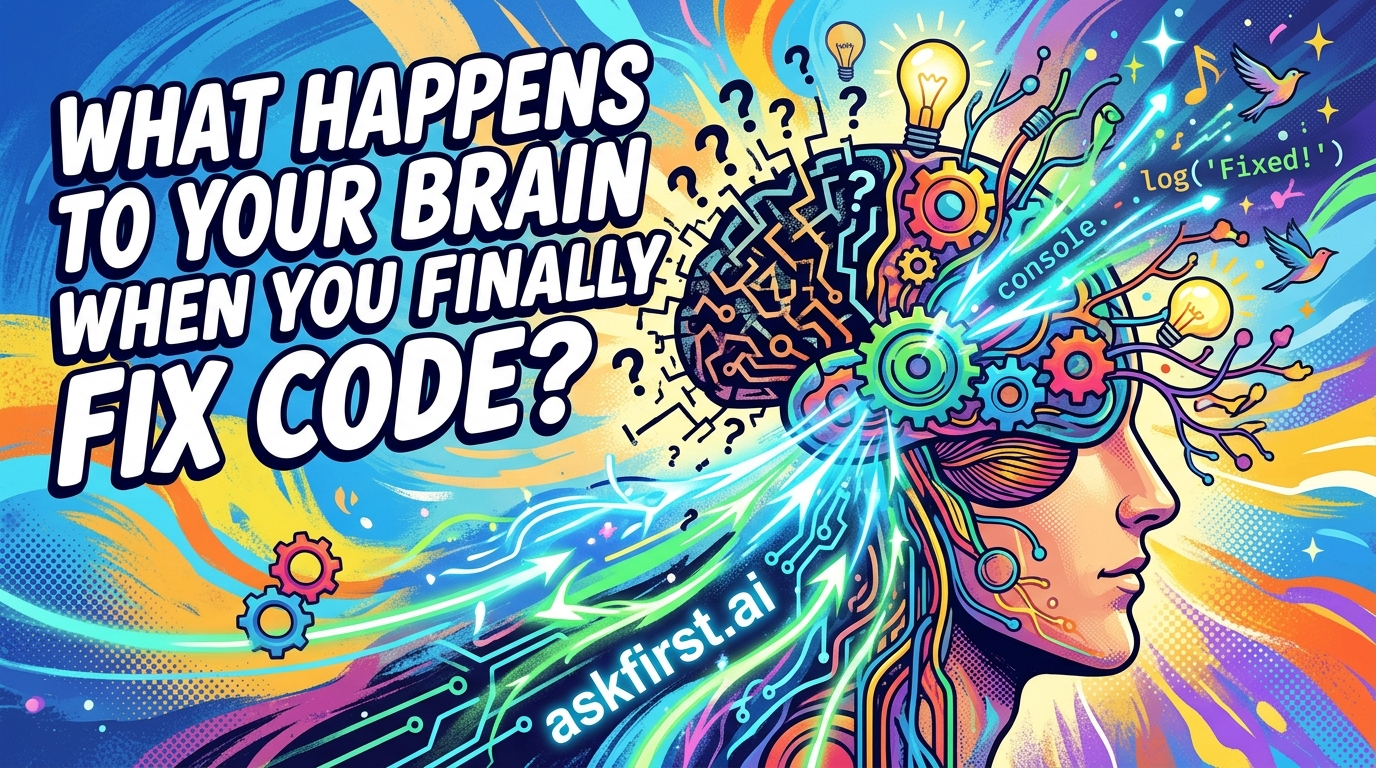
The Neurobiology of the 'Aha!' Moment
When a programmer stares at a complex, broken codebase for hours, the brain enters a state of high-intensity cognitive load. The prefrontal cortex, responsible for executive function and working memory, works overtime to simulate potential logical paths and identify syntax discrepancies. However, the moment the final semicolon is placed or the logic error is corrected, a cascade of neurochemical events occurs, transforming frustration into profound satisfaction. This process is fundamentally grounded in the reward circuitry of the brain, specifically the mesolimbic dopamine pathway.
The Dopamine Reward Loop
Fixing a bug is effectively a victory in a game of mental chess. Upon solving a difficult problem, the ventral tegmental area (VTA) releases a significant burst of dopamine into the nucleus accumbens. This neurotransmitter is the brain's internal currency for motivation and reward. Because the resolution of a coding error is often preceded by a 'curiosity gap'—the painful delta between what the code is doing and what it should be doing—the brain registers the successful outcome as a survival-level win. This is why software engineering is inherently addictive; the cycle of problem-solving provides consistent, predictable hits of neurochemical validation.
Cognitive Shift and Neural Plasticity
Beyond the immediate dopamine surge, the brain undergoes a structural transformation during the 'aha!' moment. This is described as 'insight-driven learning.' Research suggests that moments of sudden clarity are associated with a burst of gamma-band activity in the right hemisphere of the brain, particularly in the anterior superior temporal gyrus. This high-frequency electrical activity facilitates the synthesis of disparate pieces of information, effectively creating a new neural pathway. In the long term, this repetitive practice of diagnosing and repairing logic contributes to enhanced neuroplasticity, allowing the brain to improve its pattern recognition capabilities.
The Role of Flow State
Often, the act of fixing code is synonymous with entering a 'Flow State' or 'The Zone.' In this psychological state, characterized by psychologist Mihaly Csikszentmihalyi, the brain minimizes activity in the dorsolateral prefrontal cortex—the area responsible for self-monitoring and temporal awareness. This allows the individual to operate with intense focus, filtering out peripheral distractions. When the bug is fixed, the transition out of this state acts as a 'cognitive relief,' where the brain lowers its internal tension levels, resulting in a feeling of calm and intellectual mastery.
Structural Benefits of Debugging
Engaging in systematic problem-solving offers several neurological advantages:
- Increased Working Memory Capacity: The brain learns to juggle more complex variable dependencies.
- Improved Executive Function: Constant logical evaluation trains the brain to inhibit impulsive decisions.
- Pattern Matching Excellence: The hippocampus becomes more adept at retrieving similar bug scenarios from past experiences, making future troubleshooting faster.
Dealing with the 'Negative' Contrast
It is essential to understand the negative state preceding the fix. During the debugging phase, the brain often experiences elevated levels of cortisol, the primary stress hormone. This creates a state of 'cognitive tunnel vision,' where the ability to see the broader architecture of the system is hindered. The act of finally fixing the code does more than just produce dopamine; it effectively neutralizes the cortisol spike. This physiological 'reset' is why developers often feel a massive sense of physical and mental weightlessness immediately after committing a successful patch.
Conclusion: The Architecture of Intelligence
In summary, the brain is not merely functioning when fixing code; it is restructuring itself. The combination of intense analytical load followed by the release of dopamine creates a powerful loop of cognitive reinforcement. This biological mechanism ensures that developers remain perpetually challenged and continuously evolving. By mastering the art of the fix, one is not just improving the software—they are actively sculpting a more resilient, pattern-aware, and logically agile brain. The persistent pursuit of the 'green checkmark' in a test suite is a sophisticated form of neuro-enhancement that keeps the mind sharp, engaged, and infinitely curious about the logical structures of the world.