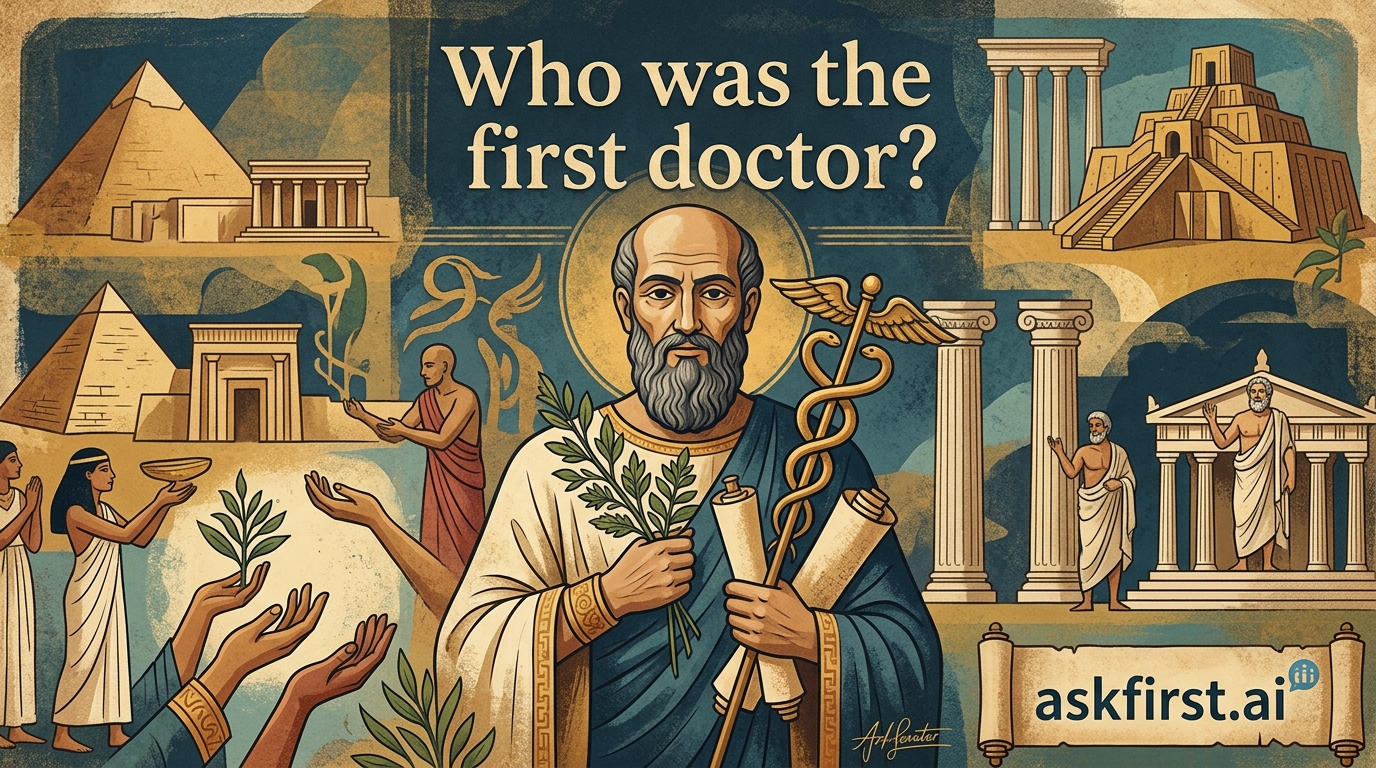
Unveiling the True Story of the World's First Doctor
The Historical Origins of Medicine: Identifying the World’s First Physician
The quest to identify the "first doctor" in human history is a complex inquiry that bridges archaeology, mythology, and the dawn of recorded civilization. While the concept of a dedicated medical professional evolved over millennia, historians generally look to Ancient Egypt to find the earliest documented physician whose name has survived the passage of time.
Imhotep: The First Recorded Physician
Most scholars identify Imhotep (c. 2650 BCE) as the world’s first known physician. A polymath serving under the Pharaoh Djoser during the Third Dynasty of the Old Kingdom of Egypt, Imhotep was not only a doctor but also an architect, vizier, and engineer.
- Medical Contributions: Unlike his contemporaries who relied solely on spiritual incantations, Imhotep is credited with introducing a more systematic, observational approach to medicine. He is traditionally associated with the Edwin Smith Papyrus, a groundbreaking medical text that describes anatomical observations, examinations, diagnoses, and treatments for various injuries, largely devoid of magical thinking.
- Legacy: After his death, Imhotep was deified as a god of healing. The Greeks later identified him with their own god of medicine, Asclepius. His transition from a mortal healer to a divine figure underscores the immense reverence ancient cultures held for those who mastered the healing arts.
The Evolution of Early Healing Practices
Before the emergence of named physicians, healing was a communal and spiritual endeavor. The transition from "shaman" to "doctor" was defined by several key shifts:
- Empirical Observation: Early healers began documenting the relationship between specific symptoms and outcomes.
- Specialization: As societies became more complex, individuals began focusing specifically on trauma, surgery, or internal ailments rather than general tribal spiritualism.
- Written Records: The invention of writing allowed for the transmission of medical knowledge across generations, moving medicine from an oral tradition to a formal science.
Notable Early Medical Pioneers
While Imhotep holds the title of the earliest named physician, other figures were instrumental in the development of global medical practices:
- Hesy-Ra: Often cited as the "first dentist" in history, Hesy-Ra was an Egyptian official contemporary to Imhotep. His tomb contains a wooden panel identifying him as "Chief of Dentists and Physicians."
- Hippocrates (c. 460–370 BCE): Often called the "Father of Medicine," Hippocrates revolutionized the field in Ancient Greece by separating medicine from religion. He established the ethical foundations of the profession, including the famous Hippocratic Oath, which still influences medical ethics today.
- Sushruta (c. 600 BCE): An ancient Indian physician known as the "Father of Surgery." His work, the Sushruta Samhita, details complex surgical procedures, including rhinoplasty and cataract surgery, centuries before similar techniques were adopted in the West.
Pros and Cons of Early Medical History
- Pros: Early physicians laid the bedrock for scientific inquiry, moving humanity away from pure superstition and toward anatomical understanding and pharmacology.
- Cons: Early medicine was often limited by a lack of germ theory, rudimentary surgical tools, and the absence of anesthesia, making even minor procedures dangerous and painful.
Future Trends in Medical History
Modern medicine is currently in a "Post-Hippocratic" era, shifting from generalized practice to Precision Medicine. By utilizing genomic data and artificial intelligence, we are moving toward a future where, much like the first healers who observed the individual, we can tailor treatments to the unique biological signature of every patient. The journey from Imhotep’s papyrus to digital AI diagnostics represents the most significant evolution in human knowledge.