The Profound Impact of Micro-Interactions
The Butterfly Effect of Human Connection
Human interaction is governed by an invisible architecture of influence. While most people perceive their daily lives as a series of isolated events, social psychology suggests that even the most fleeting gestures—often dismissed as inconsequential—possess the power to alter the trajectory of a stranger's existence. A random act of kindness acts as a catalyst, triggering a cascade of biological, psychological, and social shifts that ripple far beyond the immediate moment.
The Science of the 'Helper's High'
When an individual performs an act of kindness, the brain undergoes a neurochemical transformation. Research indicates that such behaviors stimulate the production of oxytocin, often referred to as the 'bonding hormone,' which reduces stress and fosters feelings of trust. Furthermore, the release of dopamine creates a phenomenon known as the 'helper's high.' This internal reward system reinforces altruistic behavior, creating a feedback loop of positivity. When this energy is projected toward a stranger, it disrupts their existing cognitive state. If that stranger is experiencing a moment of struggle, doubt, or isolation, a sudden intervention of kindness can serve as a 'cognitive interrupt,' forcing a reassessment of their current reality.
The Anatomy of Behavioral Change
How does a small act—such as paying for a coffee, holding a door, or offering a sincere compliment—actually change a life? It functions through several psychological mechanisms:
- Cognitive Re-framing: A stranger in a state of 'learned helplessness' may view the world as indifferent or hostile. An unexpected kindness shatters this assumption, forcing the brain to acknowledge that there is still goodness present in the environment.
- Social Capital Reinvestment: By modeling kindness, the initiator provides a template for future behavior. This phenomenon is known as the 'pay it forward' effect, where the recipient is statistically more likely to perform their own act of kindness, creating a self-sustaining cycle of social cohesion.
- Self-Efficacy Boost: For the receiver, being the subject of someone else’s voluntary generosity can restore a sense of personal value. It signals that one is 'seen' and 'worthy,' which is a potent antidote to feelings of invisibility or insignificance.
Documented Case Studies and Observational Data
History and social research provide compelling evidence for the 'ripple effect.' For instance, studies conducted on workplace environments show that when one employee is treated with unexpected kindness by a colleague, productivity and creativity metrics increase across the entire team. This demonstrates that kindness is not merely a social lubricant but an economic driver. In urban settings, sociologists have observed that public spaces where 'micro-acts' are common experience lower rates of petty crime and higher levels of civic engagement. This is because kindness cultivates a sense of communal belonging, effectively turning a group of strangers into a functioning social collective.
Breaking the Myth of Insignificance
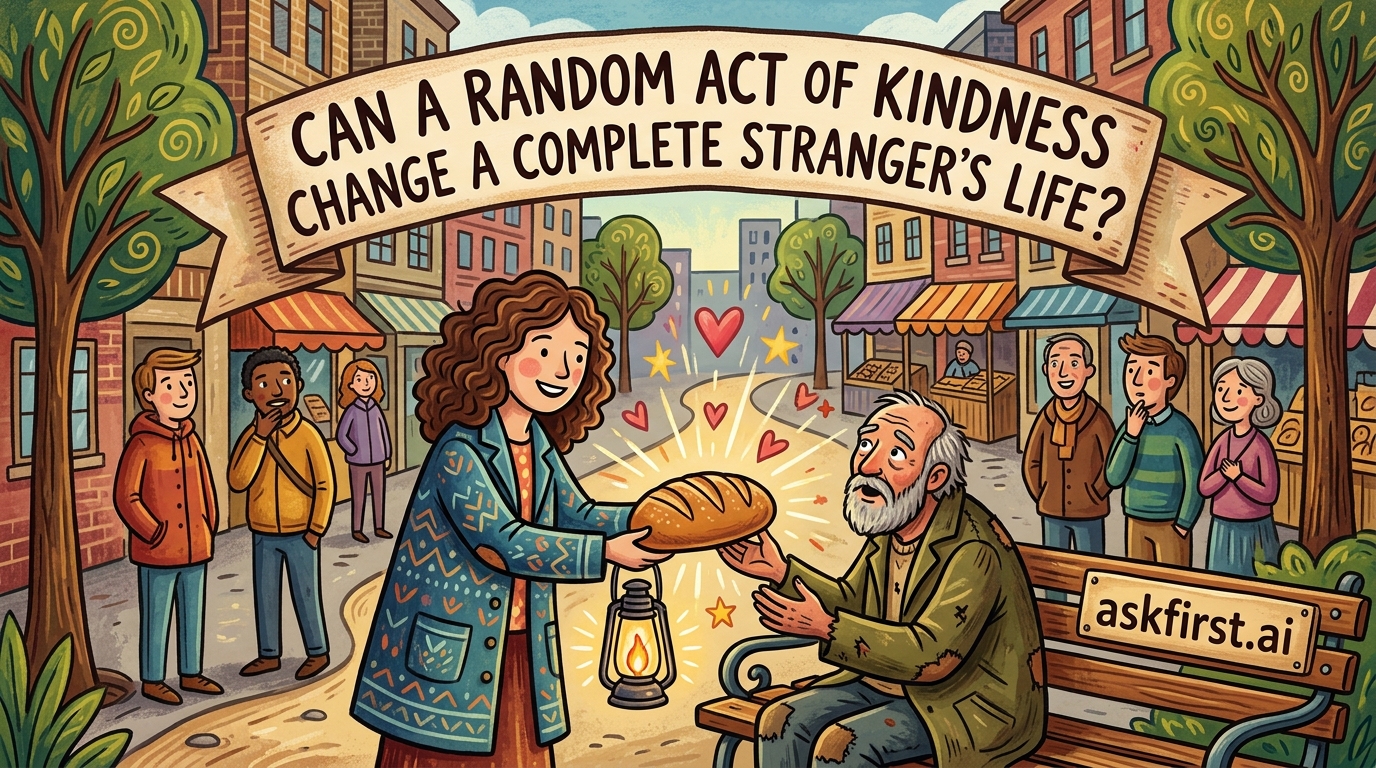
Many individuals refrain from acting kindly because they believe their influence is too small to matter in a world of billions. This is a cognitive bias known as the 'fallacy of impact,' which erroneously posits that only large, monumental actions result in change. In reality, the most profound changes in the human condition occur through the accumulation of small, consistent inputs. Consider the stranger who, on the verge of making a life-altering negative decision, is stopped by a simple, warm conversation. The action itself is brief, but the systemic outcome is life-saving. The randomness of the act is precisely what makes it powerful; it is unconditional and detached from expectations, which increases its authenticity.
Implementing Kindness as a Daily Strategy
To maximize the potential of these interactions, one must approach kindness with intentionality:
- Notice the Unnoticed: Pay attention to individuals who are often overlooked in the hustle of daily life—service workers, elderly pedestrians, or those navigating difficult public transitions.
- Lower the Barrier: Small, low-cost acts are often more impactful because they carry no 'strings attached.' They demonstrate that kindness is a standard operating procedure rather than a transaction.
- Maintain Authenticity: The goal is to acknowledge the humanity in another person. Even a brief, genuine eye contact coupled with a smile can recalibrate a person’s nervous system from a state of 'fight or flight' to one of 'rest and digest.'
The Cumulative Future
As we look toward 2030 and beyond, the role of human connection will only become more critical. In an era dominated by digital algorithms and automated interactions, physical, in-person kindness acts as a radical assertion of human relevance. Every act of kindness is an investment in the collective psychological health of the global population. By choosing to step into the life of a stranger, one is not just performing a task; one is acting as a sculptor of the social fabric. The ripple created by a single smile can travel through networks of people, touching lives in ways the original actor will never fully perceive. The capacity to change a life is not a power reserved for the influential or the wealthy; it is a fundamental human capability inherent in every interaction, waiting to be unleashed.