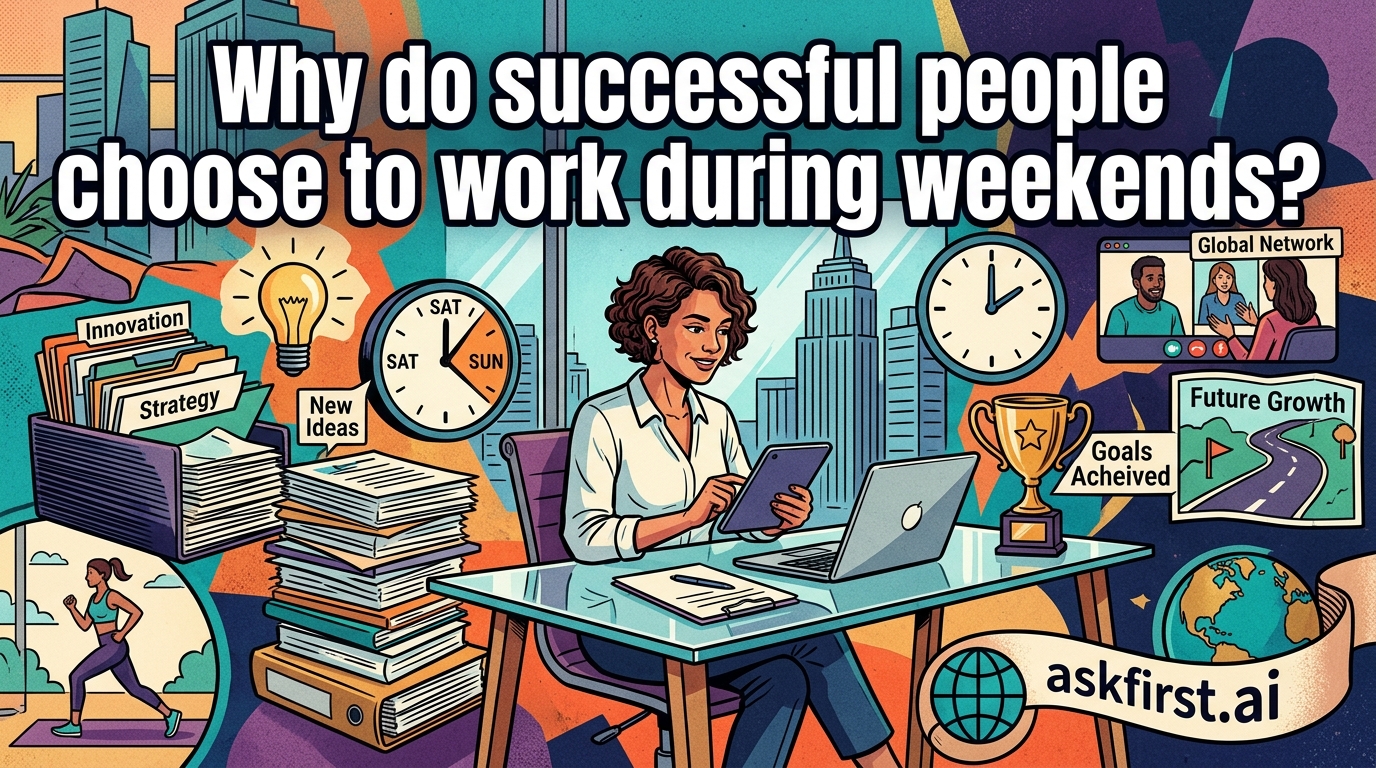
The Competitive Advantage of Weekend Productivity
Many high-achievers have decoded a secret that remains hidden to the masses: the concept of asymmetrical time allocation. While the general population views weekends as a strictly recreational sanctuary, successful individuals often utilize this period to gain a significant strategic advantage. Working on weekends is not about an inability to relax or a lack of personal life; rather, it is about intentional, high-leverage activity that occurs during a quiet, interruption-free environment. This phenomenon can be analyzed through several psychological and strategic lenses.
1. The Power of Absolute Focus and Flow States
During standard business hours, professional environments are plagued by a constant stream of emails, meetings, urgent phone calls, and interpersonal office dynamics. Research into the 'flow state'—a mental condition identified by psychologist Mihaly Csikszentmihalyi—suggests that optimal performance occurs when an individual is fully immersed in an activity. On weekends, the digital noise floor drops significantly. When the rest of the world stops communicating, the window for deep, undistracted work opens. This allows high-performers to tackle complex strategic problems that require hours of sustained concentration, something rarely achievable on a Tuesday afternoon amidst a calendar full of interruptions.
2. The Asymmetrical Leverage of Free Time
Economic theory suggests that if one performs a task when others are not, one captures the 'first-mover' advantage in creative thinking. Successful entrepreneurs like Elon Musk or leaders in various high-pressure industries often speak about the concept of 'the extra day.' If one spends three hours on a Saturday morning planning the week ahead, they essentially start their Monday at a level of preparation that peers cannot match. By Monday morning, while others are scrambling to respond to urgent issues, the disciplined individual has already set the trajectory for the entire week. This creates a cycle where they remain ahead of the curve, constantly dictating the agenda rather than reacting to it.
3. The Psychology of Cognitive Quietude
There is a profound difference between working out of panic and working out of creative freedom. Many successful people use the weekend not to perform administrative drudgery, but for 'thought work'—visionary planning, learning new skills, or conceptualizing long-term projects. Because the pressure of daily deadlines is absent, the brain transitions from a reactive, short-term survival mode to a proactive, long-term creative mode. This cognitive shift is where breakthroughs happen. By dedicating time to non-urgent but high-importance tasks, individuals expand their intellectual capital.
4. Busting the Myth of 'Work-Life Balance'
Conventional advice pushes the rigid boundary of a five-day work week. However, the most successful individuals often prefer 'work-life integration.' They do not view their professional efforts as a tax on their life but as an extension of their creative output. When the work is aligned with a deep sense of purpose, the distinction between 'working' and 'living' dissolves. For these individuals, solving a complex problem on a Sunday is just as intellectually stimulating as pursuing a hobby. They have rejected the binary choice between productivity and leisure, opting instead for a fluid existence where high-level work happens whenever the mind is most alert.
5. Leveraging the 'Silence Gap'
In business, communication is often the biggest drain on productivity. Most emails and Slack messages are sent between Monday and Friday. By working on a weekend, one can send important communications or finalize drafts while others are offline. This results in a 'silence gap'—a period where one can operate without feedback loops, politics, or the need to compromise on ideas. It is the ultimate sandbox for experimentation. Once the rest of the professional world arrives on Monday, the successful person has already stress-tested their theories, finalized their documentation, and is ready for execution.
Strategic Implementation Tips:
- Prioritize Deep Work: Use the weekend for tasks that require massive cognitive load, not for checking emails.
- Limit the Scope: Do not treat Saturday as an extension of a ten-hour workday. Keep it to a specific, high-leverage block of time to avoid burnout.
- Maintain Rhythms: Ensure that weekend work does not come at the expense of sleep or physical health, as recovery is a performance requirement.
Conclusion
The choice to work during the weekend is a calculated move to optimize performance in a world where attention is the most valuable currency. By bypassing the collective noise and entering a space of quiet concentration, successful people build an impenetrable barrier against mediocrity. It is not about doing more work, but about doing the right work, at the right time, when no one else is watching.