The Romantic Fallacy: Why Love Is a Foundation, Not the Entire Structure
In popular culture, literature, and cinema, the narrative of "love conquering all" remains the dominant paradigm. From Shakespeare’s tragic sonnets to the modern blockbuster, we are conditioned to believe that if two people love each other deeply enough, the relationship will inevitably survive any external or internal pressure. However, practitioners of clinical psychology and seasoned family therapists often observe a starkly different reality. While love is undeniably the essential spark that ignites a partnership, it is rarely sufficient to sustain a long-term, healthy, and evolving connection. To understand why, we must dissect the distinction between romantic affection and the structural integrity of a partnership.
The Distinction Between Passion and Compatibility
Love is an emotional state, often characterized by neurochemical surges—dopamine, oxytocin, and norepinephrine—that facilitate attachment. However, relationships are social and logistical contracts as much as they are emotional unions. Dr. John Gottman, co-founder of The Gottman Institute and author of The Seven Principles for Making Marriage Work, highlights that successful relationships are built on "a sound relationship house." This house requires more than just affection; it requires shared meaning, trust, and the ability to manage conflict effectively.
Consider the example of a couple deeply in love who hold diametrically opposed views on financial management, child-rearing, or geographical stability. Love does not mitigate the friction caused by these divergent values. When a couple lacks a common vision, love often becomes the very thing that makes the inevitable breakup more painful, as it blinds the partners to the fundamental incompatibility of their lives.
The Pillars of Relational Sustainability
For a relationship to endure, it requires a foundation built on several non-negotiable pillars that go beyond the feeling of love:
- Shared Values and Goals: In The Road Less Traveled, M. Scott Peck defines love as "the will to extend one's self for the purpose of nurturing one's own or another's spiritual growth." This implies that partners must be moving in the same direction. If one partner prioritizes career advancement and urban living while the other seeks a quiet, agrarian lifestyle, the "love" they feel will eventually be eroded by the constant tension of their divergent life paths.
- Conflict Resolution Skills: Esther Perel, in her seminal work Mating in Captivity, argues that the biggest threat to long-term relationships is not a lack of love, but the inability to navigate the paradox between the need for security and the need for novelty. Love cannot solve a fight; communication techniques, empathy, and the ability to "repair" after an argument (a concept championed by the Gottman Institute) are what determine survival.
- Mutual Respect and Trust: Love can exist alongside disrespect, but a relationship cannot. If one partner views the other as an inferior or fails to prioritize their well-being, the love will eventually curdle into resentment. Trust, earned through consistent, reliable behavior over time, is the bedrock upon which the emotional house stands.
The Role of Practicality and "The Work"
Relationships are essentially a series of negotiations. Every day, partners negotiate time, money, household labor, and emotional energy. When love is the only tool in the toolbox, these negotiations often fail because they are treated as tests of the relationship’s strength rather than as logistical hurdles.
For instance, a couple may love each other dearly, but if they cannot communicate effectively about the division of domestic labor, the "mental load" will eventually lead to burnout for one partner. This isn't a failure of affection; it is a failure of partnership management. As sociologist Dr. Pepper Schwartz notes in her research on peer marriages, the happiest couples are those who treat their relationship as a collaborative project, where love is the motivation, but intentional effort is the method.
When Love Becomes a Trap
There is a dangerous tendency to use love as an excuse to remain in toxic or stagnant situations. By asserting that "love is enough," individuals often ignore red flags such as emotional abuse, gaslighting, or a total lack of intimacy. In these instances, love serves as a psychological anchor that prevents growth. Recognizing that love is not enough is actually a liberating realization; it grants the individual permission to demand more from their partner—more respect, more support, and more alignment—rather than settling for a feeling that, while powerful, is not a substitute for a healthy dynamic.
Conclusion
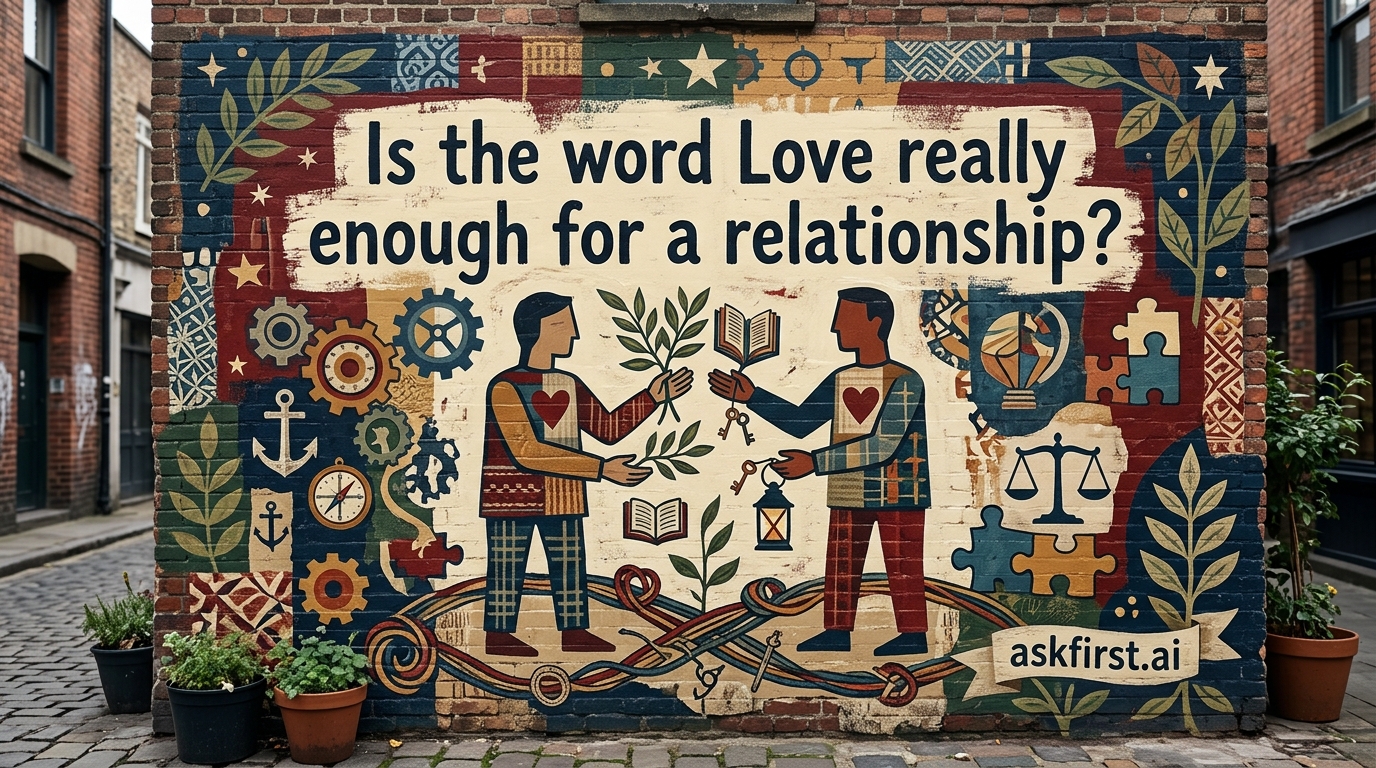
Is love enough? The answer is a definitive "no." Love is the fuel, but it is not the vehicle. A relationship is a complex, living system that requires maintenance, alignment, and a sophisticated set of interpersonal skills to function correctly. By shifting our perspective from viewing love as a magical solution to viewing it as a necessary starting point, we empower ourselves to build more resilient, fulfilling, and sustainable partnerships. Love provides the "why," but it is our commitment, our communication, and our compatibility that provide the "how." When we stop expecting love to do all the heavy lifting, we finally begin the actual work of building a life with another person.