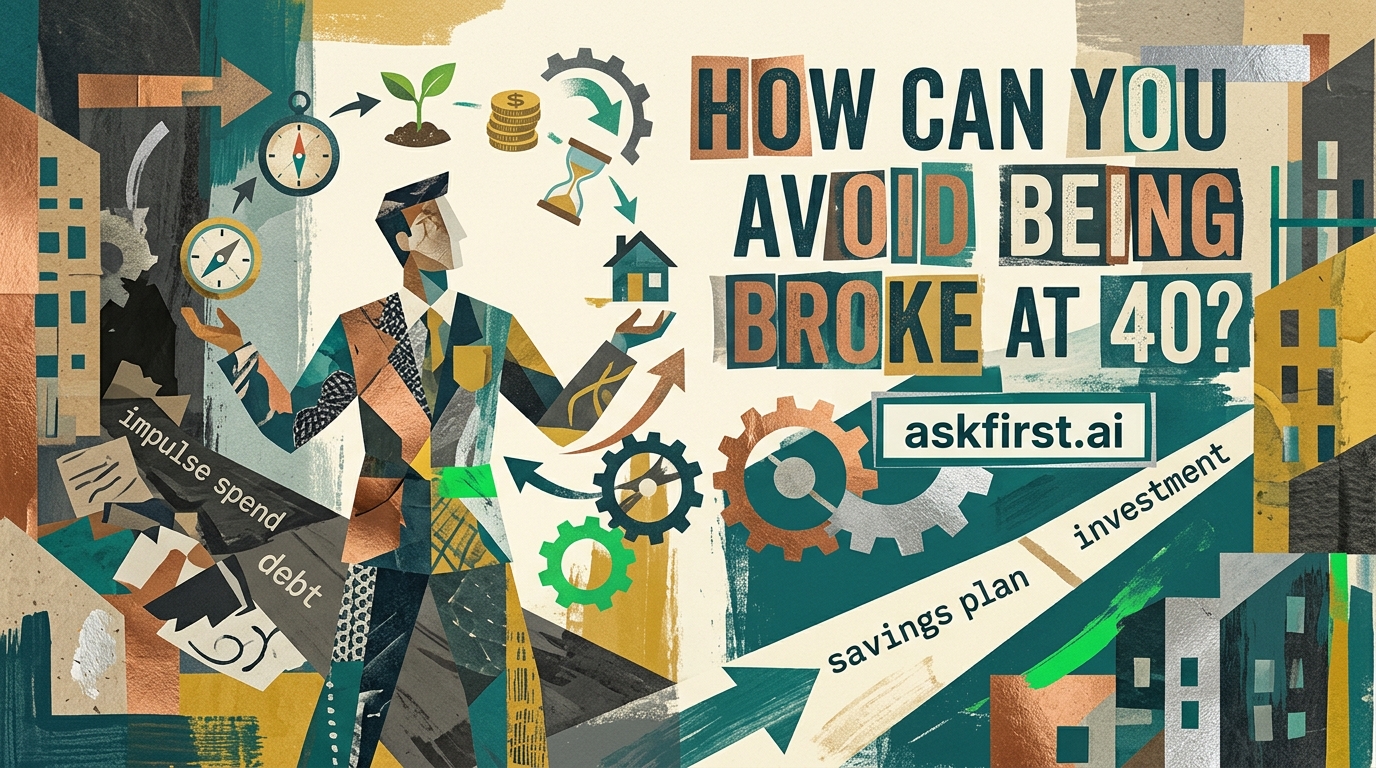
Achieving financial stability by the age of 40 is not a matter of luck or inherited wealth; it is the result of deliberate, compounding behavioral changes initiated in one’s twenties and thirties. To avoid being "broke" at 40, one must move beyond the common narrative of mere budgeting and enter the realm of strategic wealth engineering. This requires a fundamental shift in how you view your relationship with capital, risk, and time.
The Mathematics of Compounding and Early Action
The most potent weapon in your arsenal is the time value of money. As noted by Morgan Housel in his seminal work The Psychology of Money, the difference between starting an investment portfolio at age 22 versus age 32 is not just a decade of savings—it is the difference of hundreds of thousands of dollars in terminal value due to the exponential nature of compound interest.
To avoid financial insolvency by 40, you must automate your savings. By the time you reach middle age, your savings rate should ideally be between 15% and 25% of your gross income. If you are not seeing your savings account grow automatically on payday, you are relying on willpower, which is a finite resource. David Bach, in his book The Automatic Millionaire, argues that the "pay yourself first" methodology is the only way to ensure that your future self is protected from the spending impulses of your present self.
Cultivating Multiple Streams of Income
In the modern economic landscape, relying on a single salary is a structural vulnerability. At 40, the most "broke" individuals are often those who experienced a single point of failure—a layoff, a sector downturn, or an industry disruption—and had no secondary income to bridge the gap.
Building a diversified income portfolio involves three distinct tiers:
- Primary Income: Your career, which should be aggressively optimized for skill acquisition and leverage.
- Side Ventures: Freelancing, consulting, or small-scale e-commerce that utilizes your professional expertise.
- Passive Income: Dividends from index funds, interest from high-yield savings, or rental income from real estate.
By the time you hit your late thirties, your passive income should ideally cover at least your basic living expenses. This is the definition of "financial independence" (FI). If you can cover your rent, groceries, and utilities through passive sources, you are essentially "un-breakable."
Debt Management: The Silent Wealth Destroyer
Debt is the primary reason people reach age 40 with a net worth of zero or less. Specifically, high-interest consumer debt (credit cards, personal loans) acts as a reverse compound interest engine that eats your future capacity.
Dave Ramsey, in The Total Money Makeover, advocates for the "Debt Snowball" method—paying off the smallest debts first to build psychological momentum. However, from a purely mathematical standpoint, the "Debt Avalanche" (tackling the highest interest rate first) is more efficient. Regardless of the method, the goal is the same: eliminate non-mortgage debt by age 35. If you are carrying credit card balances into your forties, you are not just paying for consumer goods; you are paying for the privilege of working longer and harder than necessary.
The Lifestyle Creep Trap
Lifestyle creep is the phenomenon where your spending rises in lockstep with your income. If you receive a promotion and immediately upgrade your car, your apartment, and your dining habits, you remain perpetually broke despite making more money.
To avoid this, implement the "50/50 Rule": whenever you receive a raise or a bonus, commit to saving or investing 50% of the increase immediately. This allows you to improve your quality of life incrementally while ensuring that your savings rate accelerates in parallel. It is a psychological compromise that keeps your long-term goals on track without forcing you to live like a hermit.
Investing in Human Capital
Finally, remember that your greatest asset in your thirties is your own earning capacity. Investing in certifications, advanced degrees, or specialized workshops can yield a return on investment (ROI) that far exceeds the stock market. If you can increase your annual salary by $20,000 through a strategic career move, that is equivalent to the interest generated by a $400,000 investment portfolio (assuming a 5% withdrawal rate).
Conclusion
Avoiding financial disaster by age 40 is a process of subtraction as much as addition. It requires subtracting unnecessary debt, eliminating lifestyle inflation, and removing the reliance on a single income stream. By prioritizing high-yield skill acquisition, automating your investments, and maintaining a disciplined savings rate, you ensure that when you reach your fourth decade, you are not worried about basic survival, but are instead focused on wealth preservation and legacy. Financial stability is a deliberate construction; start laying the foundation today.