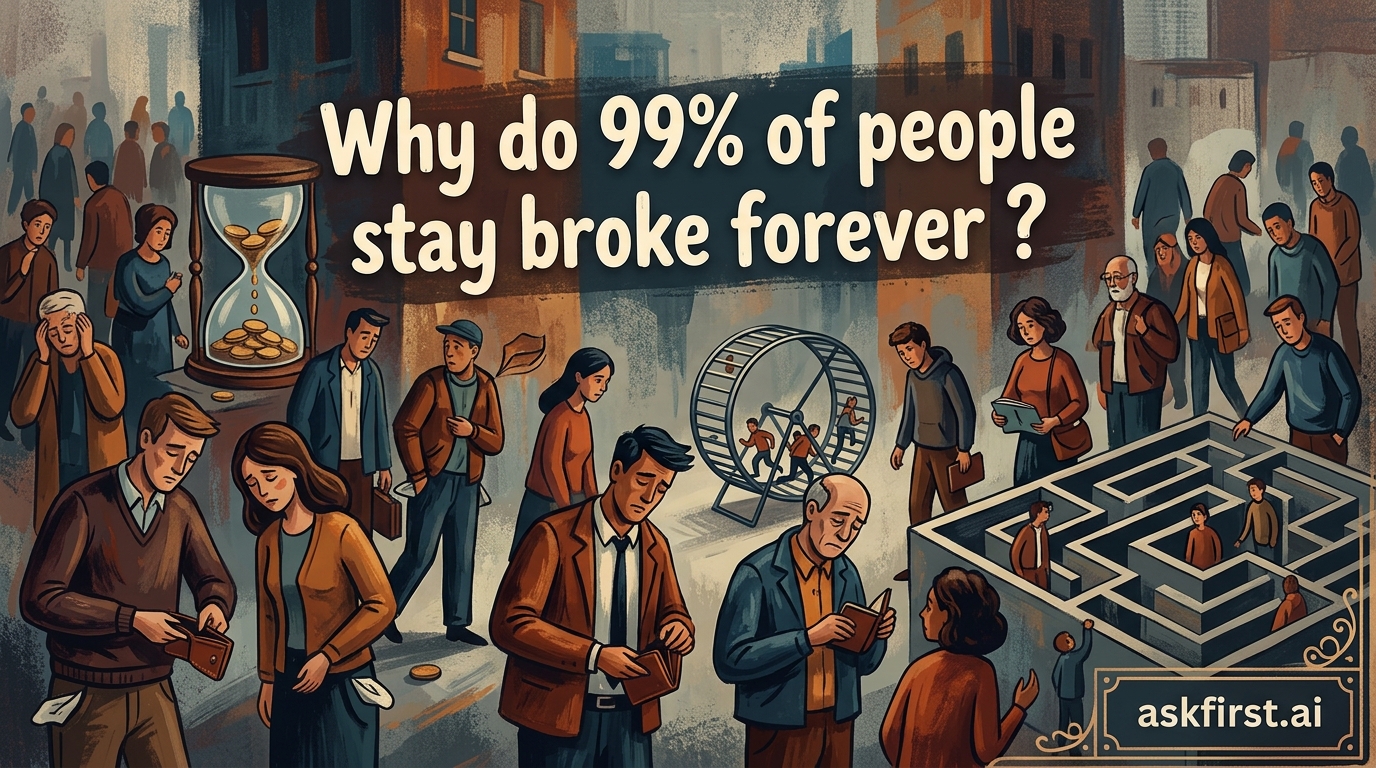
The question of why the overwhelming majority of the global population remains in a state of perpetual financial stagnation is one of the most studied subjects in behavioral economics, sociology, and psychology. While many attribute this phenomenon to systemic inequality or lack of opportunity, experts in wealth management and behavioral science suggest that the root cause is often a combination of cognitive biases, cultural conditioning, and a fundamental misunderstanding of how capital functions.
The Psychology of Scarcity and Present Bias
One of the primary reasons people remain broke is the "scarcity mindset," a concept extensively documented by Sendhil Mullainathan and Eldar Shafir in their seminal work, Scarcity: Why Having Too Little Means So Much. When an individual is constantly focused on immediate survival—paying rent, buying groceries, or covering debt interest—their cognitive bandwidth is severely restricted. This "tunneling" effect forces the brain to prioritize immediate relief over long-term planning.
For example, a person living paycheck to paycheck may choose to spend $50 on a luxury item or a night out because it provides an immediate dopamine hit, effectively "paying" for a temporary escape from their financial stress. This is a manifestation of "present bias," where the human brain discounts future rewards in favor of immediate gratification. Over a lifetime, this habit prevents the accumulation of the compound interest necessary to build substantial wealth.
The Failure to Distinguish Between Assets and Liabilities
Robert Kiyosaki, in his foundational book Rich Dad Poor Dad, highlights a critical error in financial education: the inability to distinguish between assets and liabilities. The vast majority of people operate under the illusion that their home or their car is an asset. However, in strict accounting terms, an asset is something that puts money into your pocket, while a liability takes money out.
Most people spend their entire working lives acquiring liabilities—depreciating vehicles, high-interest consumer debt, and expensive lifestyle upgrades—while neglecting to acquire income-generating assets like stocks, real estate, or business equity. Because they never shift their focus from "working for money" to "having money work for them," they remain trapped in the "rat race," forever trading time for currency that loses its purchasing power due to inflation.
The Trap of Lifestyle Inflation
"Lifestyle inflation" is the silent killer of wealth. As individuals receive raises or promotions, their spending habits scale upward in direct proportion to their earnings. This phenomenon is known as the "Hedonic Treadmill," a term popularized by psychologists Brickman and Campbell. Humans possess a remarkable ability to adapt to new levels of luxury; once a person starts flying business class or dining at high-end restaurants, those experiences become their new "baseline."
When income increases, the desire to maintain a specific social status often overrides the desire for financial freedom. If an individual earns $100,000 but spends $99,000 to maintain a lifestyle that signals success to their peers, they are effectively no wealthier than someone earning $30,000. True wealth is rarely what is seen; it is the invisible accumulation of assets that remains after the bills are paid.
Cultural Conditioning and the "Employee Mindset"
For over a century, the global education system has been designed to produce reliable employees rather than entrepreneurs or investors. This cultural conditioning instills the belief that security comes from a steady paycheck and a pension. However, in the modern economy, true security comes from the ability to generate value independently of a single employer.
Napoleon Hill, in his classic Think and Grow Rich, emphasizes that wealth begins as a state of mind. Those who remain broke often lack the "definiteness of purpose" required to navigate the risks associated with building wealth. They are conditioned to fear failure, whereas wealth accumulation is almost always a byproduct of calculated risk-taking and the ability to absorb short-term losses for long-term gains.
The Power of Compound Interest Ignored
Perhaps the most mathematical reason for perpetual poverty is the lack of understanding of exponential growth. Albert Einstein is often credited with calling compound interest the "eighth wonder of the world." Many people wait until they are "comfortable" to start investing, not realizing that the most critical variable in the compound interest formula is time.
If an individual starts investing $500 a month at age 25 with an 8% return, they will have over $1.7 million by age 65. If they wait until age 40 to start the same regimen, they will have less than $350,000. By the time most people realize they need to save for the future, they have already lost the most valuable asset they owned: time.
Conclusion
The 99% remain broke not necessarily because they lack the capacity to earn, but because they are trapped in a cycle of immediate gratification, consumerism, and a lack of financial literacy. Breaking this cycle requires a radical shift in perspective: moving from a mindset of consumption to one of production, resisting the urge to inflate one’s lifestyle, and prioritizing the acquisition of income-generating assets over status-signaling liabilities. Wealth is rarely the result of a single "big break"; it is the result of thousands of small, disciplined decisions made over decades. To escape the trap, one must first recognize that the systems of modern society are designed for the consumer, and only those who step out of that role can realistically expect to achieve lasting financial independence.