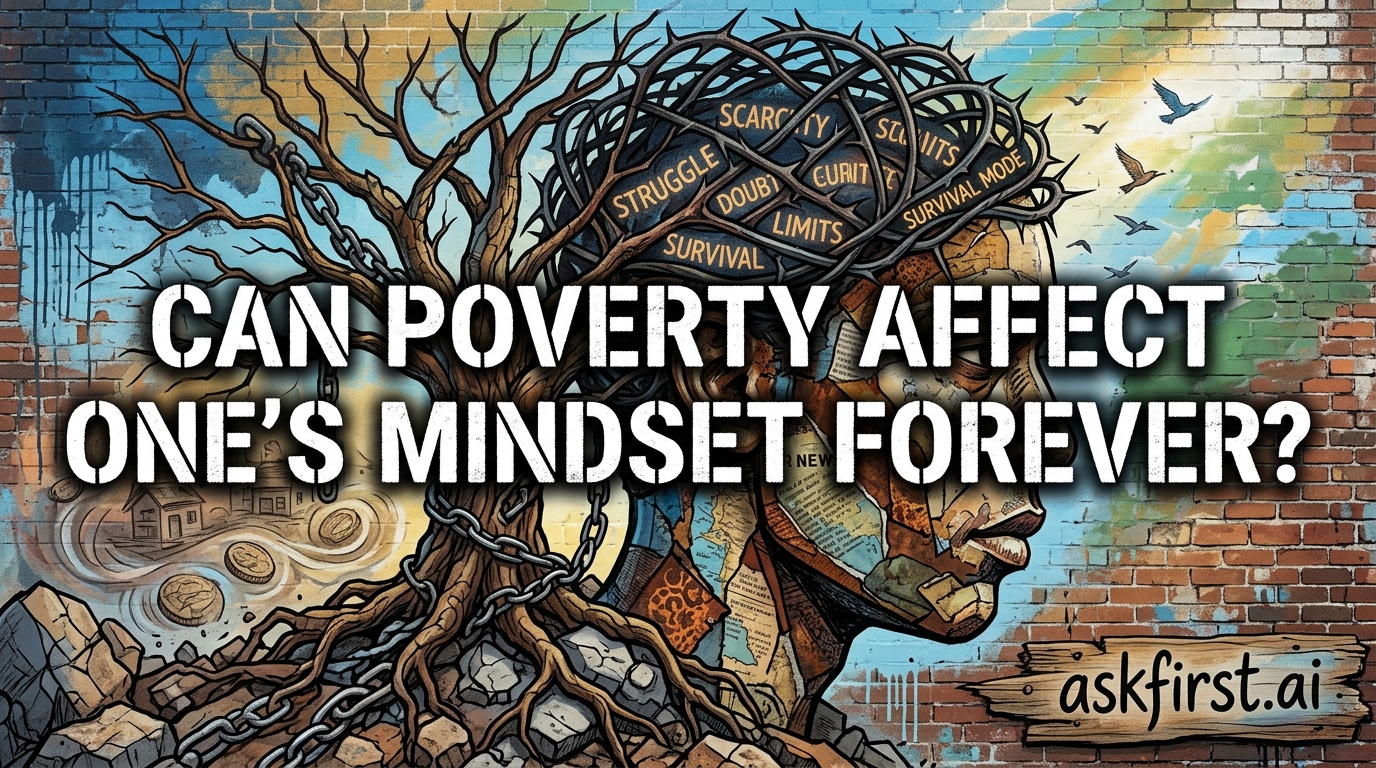
The Enduring Psychological Imprint of Poverty: A Comprehensive Analysis
The question of whether poverty acts as a permanent architect of the human mindset is one of the most profound inquiries in developmental psychology, sociology, and behavioral economics. While the human brain possesses remarkable neuroplasticity, the experience of chronic scarcity during formative years creates a complex tapestry of cognitive, emotional, and behavioral adaptations. These adaptations—often survival-oriented—can persist long into adulthood, even after the material conditions of poverty have been rectified.
The Cognitive Tax: Bandwidth and Scarcity
One of the most compelling frameworks for understanding this phenomenon is the "Scarcity Mindset," a concept pioneered by Sendhil Mullainathan and Eldar Shafir in their seminal book, Scarcity: Why Having Too Little Means So Much. According to their research, poverty imposes a "cognitive tax" on the brain. When an individual is preoccupied with immediate survival—paying rent, securing food, or navigating debt—their mental bandwidth is severely restricted.
This is not a failure of character; it is a mechanical consequence of how the brain prioritizes information. When the mind is constantly occupied by the "bandwidth-hungry" problem of scarcity, it becomes less efficient at long-term planning, impulse control, and complex decision-making. Over time, this constant state of cognitive load can lead to a "tunneling" effect, where the individual focuses exclusively on immediate, short-term relief at the expense of long-term stability. If this state persists throughout childhood, the brain’s executive functions—the command center for attention and planning—may develop differently, creating a baseline of high-alertness that persists even when financial resources increase.
The Neurobiology of Chronic Stress
Poverty is fundamentally a chronic stressor. Research published by neuroscientists like Robert Sapolsky in Why Zebras Don’t Get Ulcers demonstrates that prolonged exposure to high levels of cortisol—the body's primary stress hormone—can physically alter the brain’s architecture.
In environments of persistent poverty, the amygdala (the brain’s fear center) often becomes hypersensitive. This is a survival mechanism: in a dangerous or unpredictable environment, the ability to rapidly detect threats is an evolutionary advantage. However, this "hyper-vigilance" can become a permanent fixture of one's personality. As an adult, an individual who grew up in poverty may continue to view neutral situations through a lens of potential threat or instability. This manifests as a perpetual state of "fight or flight," which makes it difficult to engage in the relaxed, long-term strategic thinking required for wealth accumulation or career advancement in more stable environments.
The Psychology of Learned Helplessness and Risk Aversion
The influence of poverty on mindset also extends to the perception of agency. Martin Seligman, the psychologist who coined the term "learned helplessness," noted that when individuals are repeatedly exposed to uncontrollable negative stimuli, they eventually cease attempting to change their circumstances, even when opportunities for change arise.
If a child experiences repeated cycles of instability where hard work does not lead to predictable outcomes, they may internalize an "external locus of control." They may come to believe that their life is governed by luck or external forces rather than their own actions. This mindset can act as a self-fulfilling prophecy. For instance, an adult who grew up in poverty might avoid a promising but risky career move, not because they lack ability, but because their internal model of the world suggests that "the floor will eventually fall out." They prioritize safety over growth, a rational choice in a precarious childhood, but a limiting one in a more stable adult landscape.
The "Poverty Trap" in Socialization
Beyond the neurological and cognitive impacts, there is the sociological dimension of the "habitus," a term famously developed by the French sociologist Pierre Bourdieu in The Logic of Practice. Bourdieu argued that our social environment shapes our "dispositions"—our deeply ingrained habits, tastes, and expectations.
If an individual is raised in an environment where resources are scarce, their "habitus" may be calibrated for scarcity. This influences everything from how one approaches social networks to how one treats money. For example, individuals from impoverished backgrounds may feel a deep-seated pressure to share resources immediately with family or friends to maintain social capital, a practice known as the "kin tax." While this strengthens communal bonds, it can inhibit the individual’s ability to accumulate personal savings, trapping them in a cycle of poverty despite their best efforts to break free.
Conclusion: Is the Change Permanent?
Does poverty affect one's mindset forever? The answer is nuanced. While the pathways created by early life experience are deeply ingrained, they are not necessarily immutable. Neuroplasticity allows the brain to reorganize itself throughout the lifespan. However, recognizing the "poverty mindset" is the first step toward overcoming it.
The impacts of poverty are not a permanent scar, but rather a set of specialized, survival-oriented tools that have become outdated for the individual’s current environment. By understanding that behaviors like risk aversion, hyper-vigilance, and a focus on short-term gain are rational responses to a past reality, individuals can begin to consciously rewire their decision-making processes. Through environmental changes, intentional habit formation, and sometimes professional psychological support, the cognitive and emotional architecture formed by poverty can be reshaped to better serve the ambitions of the present. Poverty leaves a footprint, but that footprint does not have to dictate the direction of the entire journey.