The Psychology of Social Validation
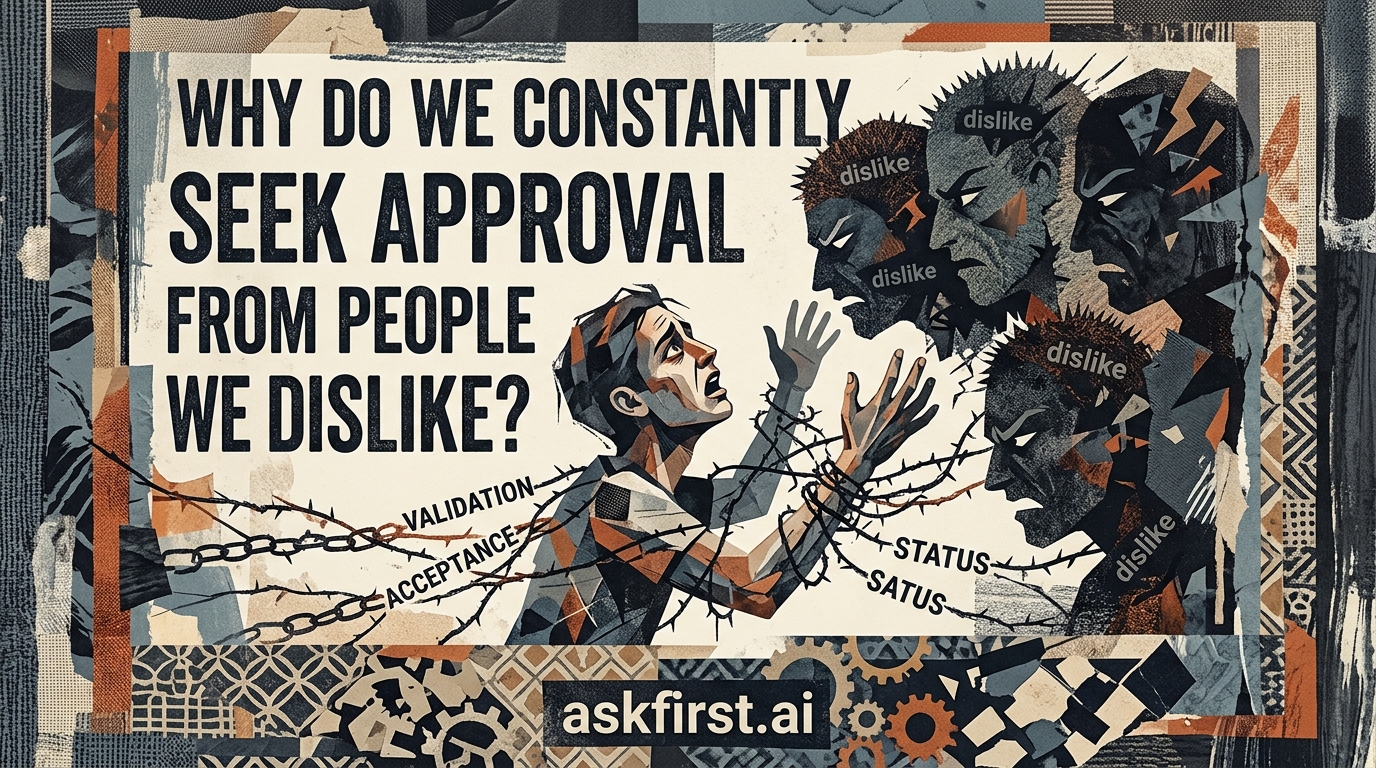
The phenomenon of seeking approval from individuals whom one actively dislikes or fundamentally disagrees with is a classic psychological paradox. This behavior, often perceived as irrational, is deeply rooted in evolutionary biology, social psychology, and early childhood developmental patterns. To understand why humans yearn for validation from those they disdain, one must look at the brain not as an individual entity, but as a social survival machine designed to navigate hierarchical structures.
Evolutionary Foundations: The Need for Belonging
From an evolutionary standpoint, human survival historically depended on group cohesion. Being ostracized from a tribe meant certain death. Therefore, the brain evolved a hyper-vigilant system to monitor social status and acceptance. This 'social monitoring system' operates even when the evaluator is perceived negatively. The brain often prioritizes the avoidance of exclusion over the individual preference for liking a specific peer. When a person seeks approval from a detested individual, they are often responding to an ancient, hardwired impulse that views 'social rejection' as a threat to survival, regardless of the source of that rejection.
Cognitive Dissonance and the Need for Mastery
Psychologist Leon Festinger introduced the theory of cognitive dissonance, which describes the mental discomfort experienced when holding conflicting beliefs or perceptions. When an individual seeks approval from someone they dislike, a conflict arises: the person hates the evaluator, yet desperately wants their validation. To resolve this, the mind often rationalizes the pursuit. The brain may conclude that if it can win over a 'hateful' or 'unlikable' figure, it proves one's own superiority, charm, or undeniable competence. This transforms approval-seeking into a game of mastery rather than a request for affection. It is a psychological defense mechanism where gaining validation becomes a trophy of successful social maneuvering.
Childhood Conditioning and Internalized Expectations
Much of this behavior originates in early developmental phases. If a child grew up with critical or emotionally distant parents, they might learn that approval is a scarce resource that must be earned from 'difficult' figures. This pattern creates a subconscious blueprint where the person continues to seek approval from 'the difficult figure' in adulthood—such as a hostile boss or a passive-aggressive acquaintance. The brain recreates these early relational dynamics, attempting to 'fix' or 'win' the approval that was once denied by primary caregivers. This is known in psychoanalysis as repetition compulsion.
The Role of Self-Esteem and External Validation
For many, the baseline of self-worth is inherently unstable, causing a heavy reliance on external metrics. When self-esteem is contingent upon how others view us, the objective quality of the other person—whether we like them or not—becomes secondary to the raw data of their acceptance. If a person views themselves through the lens of external validation, then an 'unlikable' person’s praise carries significant weight because it serves as an external confirmation of status.
- Key drivers of this behavior include:
- Status Anxiety: The fear that even disliked people hold power or influence over one’s social standing.
- Defensive Narcissism: The desire to be validated even by enemies to neutralize potential threats.
- Ambivalence: The complicated human capacity to simultaneously reject someone’s character while craving their acknowledgment of one's intellect or skills.
Strategies to Mitigate Approval Seeking
Breaking the cycle of seeking validation from the 'wrong' people requires intentional cognitive reframing.
- Identify the Source: Ask whether the desire for approval stems from a genuine respect for their opinion or from a primal fear of being misunderstood or judged.
- Shift to Internal Metrics: Move from external evaluation to self-evaluation. Track personal progress and value judgments rather than relying on external feedback.
- Radical Acceptance of Dislike: Acknowledge that it is perfectly normal for others to dislike you, and for you to dislike others. Disagreement and even animosity are natural facets of the human experience that do not negate individual worth.
In conclusion, seeking approval from people we dislike is not a sign of weakness, but rather a misfiring of a sophisticated evolutionary survival mechanism. By recognizing that this behavior is a relic of our social evolution and a byproduct of our childhood conditioning, we gain the autonomy to choose whose opinions truly define our internal reality. Focusing on internal validation leads to a more stable, confident, and authentic existence.