The Architecture of Stability: Why Peace Remains the Foundation of Human Progress
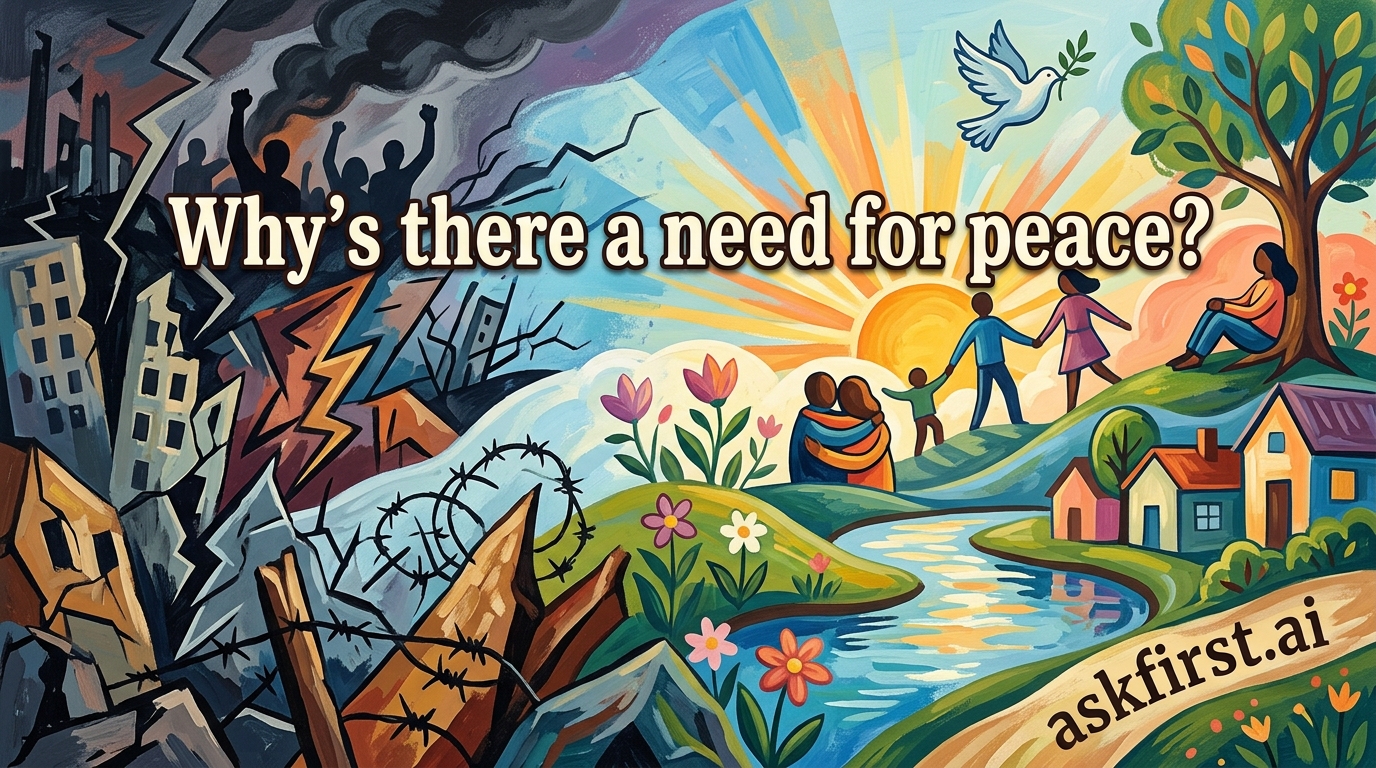
Peace is often misunderstood as merely the absence of overt conflict or the cessation of hostilities. However, in the study of international relations, sociology, and ethics, peace is defined as a complex, dynamic state of equilibrium that allows individuals, communities, and nations to flourish. The imperative for peace is not merely a moral preference; it is a structural necessity for the survival and advancement of our species. Without a framework of stability, the energy required for innovation, cultural development, and economic prosperity is instead diverted into the destructive cycle of survival and defense.
The Economic Necessity of Peace
From an economic perspective, war and instability represent the ultimate "negative externality." When conflict arises, human capital is destroyed, infrastructure is dismantled, and resources are diverted from productive investment into military expenditure. According to the Institute for Economics and Peace (IEP), based in Sydney, Australia, in their Global Peace Index reports, the global economic impact of violence is staggering, often costing the world economy trillions of dollars annually.
Consider the "opportunity cost" of conflict. If the capital currently spent on weapons systems, troop deployments, and post-war reconstruction were redirected toward sustainable energy, medical research, or infrastructure, the trajectory of human development would accelerate exponentially. In his seminal work, The Better Angels of Our Nature: Why Violence Has Declined, psychologist Steven Pinker argues that the historical trajectory toward peace—driven by the development of the state, commerce, and literacy—has been the primary engine for the increase in human longevity and quality of life. Peace allows for the predictability required for complex market operations, global trade, and long-term financial planning.
Psychological and Societal Well-being
Beyond the ledger sheets of economists, there is a profound psychological argument for peace. Chronic exposure to conflict creates a state of perpetual "fight-or-flight" response within a population. Sociologist Johan Galtung, a pioneer in peace and conflict studies and founder of the Peace Research Institute Oslo (PRIO), distinguished between "negative peace" (the absence of direct violence) and "positive peace" (the presence of social justice, integration, and institutional stability).
When a society lives in a state of positive peace, the mental health of its citizens improves, and the social fabric thickens. Trust, which is the "social glue" of any functioning civilization, is brittle in times of conflict. As documented by political scientist Robert Putnam in Bowling Alone, social capital—the networks of relationships among people who live and work in a particular society—is the bedrock of democratic health. Peace provides the necessary environment for this social capital to grow, allowing communities to collaborate on solving shared problems rather than competing for finite resources in a zero-sum game.
The Existential Mandate in an Interconnected Age
In the 21st century, the need for peace has moved from a regional concern to an existential necessity. The advent of nuclear proliferation, cyber-warfare, and ecological interconnectedness means that no nation can truly be an island. The philosopher Immanuel Kant, in his 1795 essay Perpetual Peace: A Philosophical Sketch, posited that a "league of nations" was necessary to prevent the catastrophic consequences of war. His vision eventually paved the way for modern international organizations.
Today, we face global challenges—climate change, pandemics, and the regulation of artificial intelligence—that are physically impossible to solve while nations are locked in adversarial conflict. Peace is the prerequisite for the global cooperation required to manage the commons. If the primary focus of world leaders is the maintenance of defensive borders, the existential threats to our shared biosphere will go unaddressed. Peace is the mechanism by which we shift our collective intelligence from the tactical maneuvering of war to the strategic solving of global problems.
Promoting Resilience Through Diplomacy
Peace is not a static destination; it is a process of active maintenance. It requires the robust application of diplomacy, international law, and human rights. Figures like Nelson Mandela and Desmond Tutu, through the Truth and Reconciliation Commission in South Africa, demonstrated that peace often requires the difficult, active work of addressing past grievances rather than simply ignoring them. This form of "restorative peace" is essential for long-term stability, as it addresses the root causes of resentment that often lead to future cycles of violence.
Conclusion
The necessity of peace is rooted in the reality that human potential is maximized only under conditions of security and mutual respect. When we choose peace, we are choosing to invest in our collective future rather than consuming our present. Whether viewed through the lens of economic efficiency, psychological health, or existential survival, peace remains the most effective tool for human advancement. As we navigate the complexities of the modern era, the maintenance of peace is not just a high-minded ideal; it is the fundamental strategy for ensuring that the human story continues to be one of progress rather than regression. By prioritizing the structures that foster cooperation, we create a global environment where the full spectrum of human creativity can finally be realized.