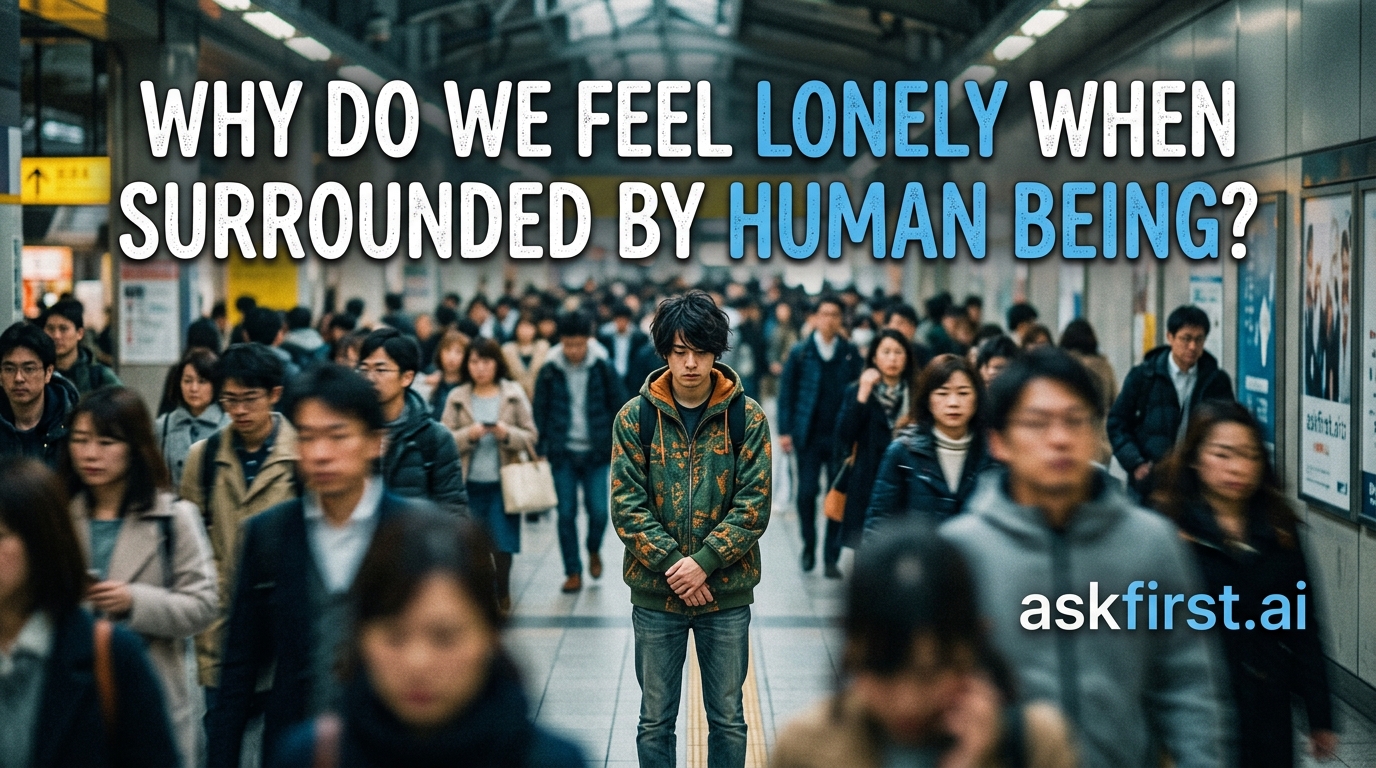
The experience of feeling lonely while surrounded by others is known as social or emotional isolation, a phenomenon where an individual perceives a lack of meaningful connection despite being in a crowded environment. This state is governed by psychological, neurological, and social factors rather than physical proximity.
1. Discrepancy Between Desired and Actual Connection
Loneliness is fundamentally a subjective state. It is defined by the gap between the social connections a person desires and the quality of the connections they currently possess. If an individual feels that their interactions are superficial, performative, or lack emotional intimacy, they will experience loneliness regardless of how many people are physically present.
2. Lack of "Social Synchrony"
Human beings rely on social synchrony—the alignment of emotions, non-verbal cues, and shared experiences—to feel truly connected. When surrounded by people with whom one does not share common values, interests, or emotional wavelengths, the brain perceives a lack of "social safety." This can lead to a feeling of being an outsider or an observer rather than a participant.
3. Psychological Barriers
Several internal factors can prevent a person from feeling connected to a crowd:
- Social Anxiety: The fear of judgment or rejection can cause an individual to withdraw mentally, creating a psychological barrier that prevents the formation of genuine bonds even in social settings.
- Depression: Clinical depression can distort the perception of social interactions, making neutral or positive social cues seem negative or hollow, thereby reinforcing feelings of isolation.
- Low Self-Esteem: Individuals who struggle with self-worth may feel they do not "belong" in a group, leading to self-imposed isolation as a protective mechanism.
4. Evolutionary Biology
From an evolutionary perspective, loneliness is an adaptive signal. Just as hunger signals a need for food, loneliness is a biological alarm intended to motivate an individual to seek out protective social bonds. When someone is in a crowd but feels "unseen" or "unheard," the brain continues to broadcast this signal because the fundamental requirement for secure attachment has not been met.
5. The "Superficiality" of Modern Interaction
In contemporary society, many social environments are characterized by transactional or superficial interactions. Engaging in settings where conversation is limited to small talk or where individuals are distracted by digital devices prevents the release of oxytocin—the hormone responsible for bonding and trust. Without this chemical reinforcement, the brain fails to register the environment as a source of social fulfillment.
Summary
Feeling lonely in a crowd is not a failure of social opportunity, but a misalignment of needs. It indicates that the individual is craving deeper, more authentic, or more empathetic engagement that the current environment is failing to provide.