The Essential Skill for the Next Decade: Adaptive Computational Literacy
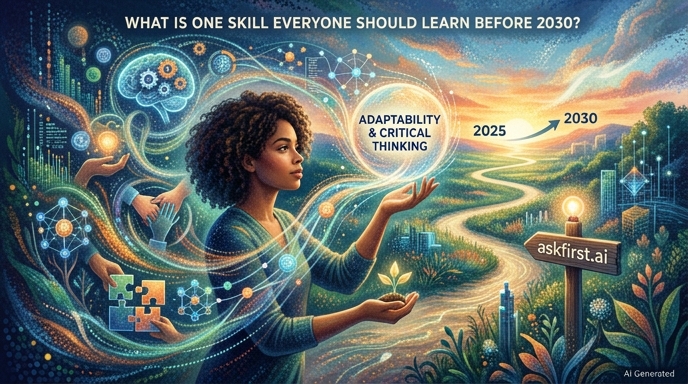
As we approach the turn of the decade in 2030, the global landscape of work, communication, and problem-solving is undergoing a seismic shift. While technical skills like coding or data analysis have long been touted as the "languages of the future," the true essential skill for every individual, regardless of their profession, is Adaptive Computational Literacy. This is not merely the ability to operate a computer or understand software; rather, it is the sophisticated capacity to orchestrate, audit, and synthesize output from autonomous systems to solve complex, real-world problems.
Defining Adaptive Computational Literacy
Adaptive Computational Literacy (ACL) is the hybrid marriage of critical thinking, prompt engineering, and algorithmic intuition. In an era where generative models and autonomous agents handle the "heavy lifting" of data processing and content creation, the bottleneck for success is no longer the ability to do the work, but the ability to direct the work.
To possess ACL is to understand the underlying logic of the tools you utilize. It involves recognizing the limitations of large language models, understanding the ethics of automated decision-making, and maintaining the ability to verify information in an age of synthetic media. It is the transition from being a passive user of technology to being a conductor of a digital ensemble.
Why This Skill is Non-Negotiable by 2030
The rapid integration of artificial intelligence into every sector—from healthcare diagnostics and legal analysis to creative arts and manufacturing—means that traditional "manual" cognitive tasks are being automated at an unprecedented rate. By 2030, the value of an employee or an entrepreneur will be measured by their "Agency-to-Automation Ratio."
- The Decline of Routine Intellectual Labor: Tasks that involve repetitive analysis, basic drafting, or standard research will be handled by background autonomous agents. If your primary value lies in these areas, your relevance will diminish.
- The Rise of Systemic Oversight: As autonomous systems handle the granular details, the human role shifts toward architecture and strategy. You must be able to design workflows where AI agents interact to produce a specific outcome.
- The Verification Crisis: By 2030, the volume of synthetic data and AI-generated misinformation will reach a critical threshold. ACL provides the necessary skepticism and technical methodology to audit information, identify hallucinations, and ensure that the foundations of your work remain grounded in reality.
How to Cultivate Adaptive Computational Literacy
To master this skill, you must move beyond superficial interactions with technology. Here is a structural approach to developing ACL:
- Master the Art of Contextual Prompting: Learn to build "context-rich" environments for your digital tools. Instead of asking a simple question, learn to provide the tool with the constraints, the persona, the desired output format, and the necessary background data. This is the new form of "executive delegation."
- Develop Algorithmic Intuition: You do not need to be a software engineer, but you must understand how algorithms prioritize information. Learn the basics of how data sets function, how bias is introduced into systems, and how to spot when an automated process is beginning to drift from its intended objective.
- Cultivate "Human-in-the-Loop" Discipline: Never fully delegate a high-stakes decision to an autonomous system without a verification layer. Develop the habit of auditing outputs. Use the "three-source rule": verify automated insights against diverse, trusted, and independent data streams.
- Embrace Iterative Design: Treat your interaction with technology as an ongoing conversation rather than a one-time transaction. Learn to refine your inputs based on the feedback the system provides. This iterative process is the hallmark of a high-level operator.
The Philosophical Shift
Learning Adaptive Computational Literacy is as much a psychological shift as it is a technical one. It requires letting go of the ego-attachment to being the "sole creator" of your work. Instead, you must embrace the role of the Creative Curator. By 2030, the most successful individuals will be those who can harness the massive, distributed intelligence of autonomous systems to amplify their own unique human perspective.
The barrier to entry is lowering, but the barrier to excellence is rising. Those who treat technology as a black box will be at the mercy of its errors and limitations. Those who master ACL will treat technology as a high-performance engine, steering it toward innovation, precision, and unprecedented creative output.
If you commit to learning this skill now, you are not just preparing for the job market of 2030; you are securing your agency in a world that is becoming increasingly automated. In the coming years, the ability to think computationally while acting humanely will be the ultimate competitive advantage. It is the bridge between the chaotic potential of the present and the structured, hyper-efficient reality of the next decade.