The Psychology of Interpersonal Friction
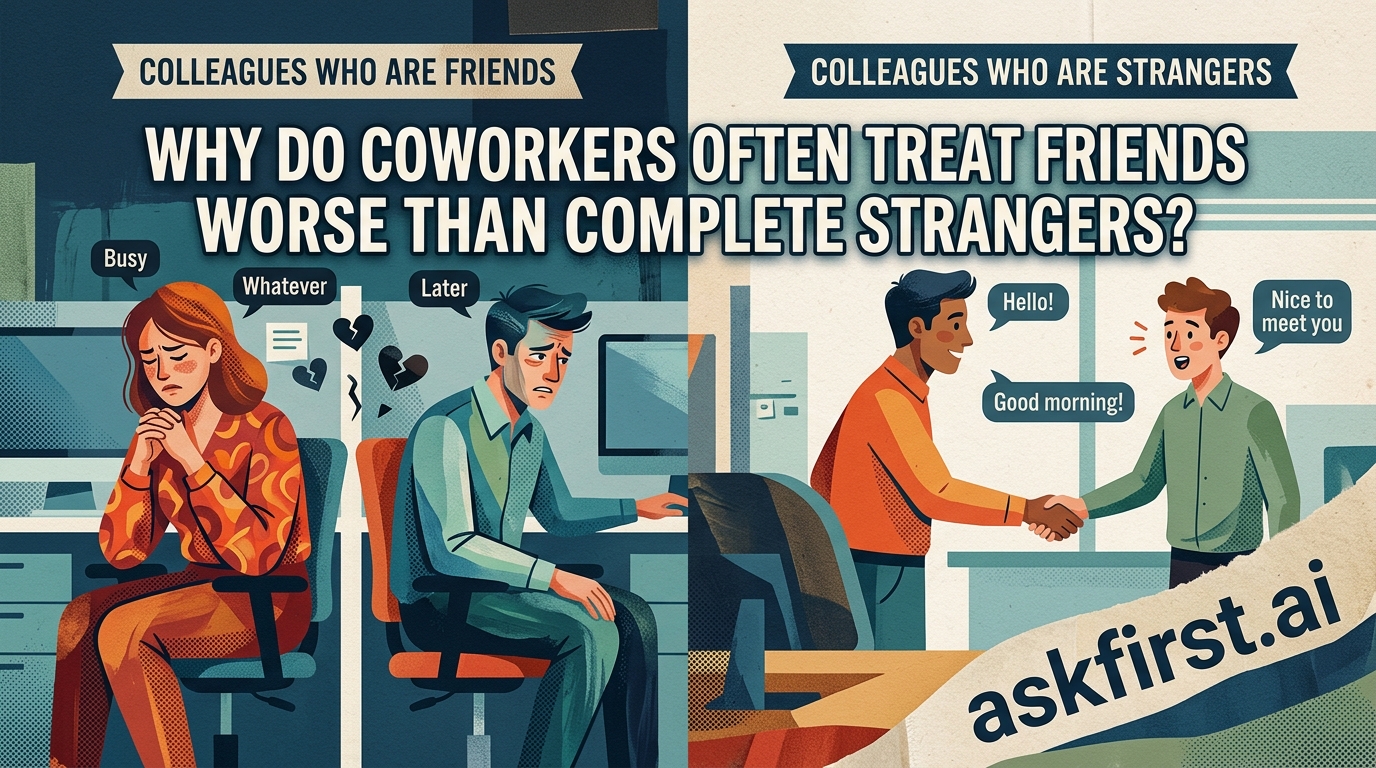
It is a common phenomenon in the professional world that individuals often treat their friends or close acquaintances with less patience, lower levels of professional courtesy, or higher expectations of emotional labor compared to complete strangers. This occurrence, frequently termed the 'familiarity trap,' is rooted in several foundational psychological principles. When an individual interacts with a complete stranger, they rely on social scripts—the formal, polite conventions of professional etiquette. Because there is no existing history, the brain defaults to a 'safety-first' heuristic, ensuring that actions remain within the boundaries of conventional professional norms. Conversely, interacting with a friend removes these buffers, leading to unique psychological dynamics.
The Expectation Mismatch
One primary driver of this dynamic is the divergence in psychological contracts. With strangers, expectations are clear and limited to professional performance. With friends, the boundary between professional obligations and personal loyalty becomes blurred. This often creates a 'hidden bill' where the subconscious expects friends to provide extra favors, emotional support, or patience during high-pressure moments. When a friend fails to meet these unspoken, elevated standards, the frustration is significantly more acute than it would be with a stranger. The social psychological theory known as 'Expectancy Violation Theory' suggests that when our expectations—formed by previous intimacy—are breached, we react with disproportionate negative affect, which often manifests as harsher treatment or uncharacteristic irritability.
The Illusion of Safety
Psychologically, humans feel a sense of security when interacting with friends, which paradoxically leads to the expression of 'the dark side of emotional regulation.' Because the relationship is perceived as stable and secure, people often feel they have 'permission' to vent frustration or lower their filters, assuming the friend will be forgiving. This is known as 'psychological safety gone awry.' When interacting with a stranger, one is constantly performing; when interacting with a friend, that performance drops. While this is intended to be a sign of trust, it frequently results in the friend becoming a target for misplaced stress. This phenomenon is often observed in high-pressure environments where the workplace acts as a crucible, testing the durability of personal bonds.
Cognitive Dissonance and Performance Anxiety
Another significant factor is the subconscious fear of being perceived as showing favoritism. To compensate for a close friendship, many professionals over-correct by holding their friends to even stricter standards than they would a stranger, in an attempt to maintain perceived impartiality. This is a manifestation of 'over-compensation bias.' Furthermore, working with friends can trigger unique forms of social comparison and ego threat. If a friend succeeds, the proximity of that success can create a subtle sense of competition that does not exist with a stranger. The stranger is an external entity, while the friend is an extension of one’s own social circle, making professional comparisons feel more personal and threatening to one's self-esteem.
Strategies for Professional Harmony
To mitigate these tensions and preserve friendships in the workplace, experts suggest several evidence-based strategies:
- Establish Explicit Professional Boundaries: Clearly separate professional discussions from personal ones. Maintaining a 'work-persona' even with friends can help reset the social script.
- Utilize 'Meta-Communication': If friction arises, it is vital to discuss the dynamic of the relationship itself rather than just the task at hand. Acknowledging that the workplace is placing stress on the friendship can diffuse the tension.
- Practice Conscious De-escalation: Recognize the 'familiarity trap' when it occurs. Before reacting sharply to a friend-colleague, take a moment to ask: 'Would I react this way if this person were a new professional acquaintance?'
- Separate Feedback from Sentiment: Ensure that professional critiques are structured purely around performance metrics and objectives, stripping away any emotional baggage or personal history.
Conclusion
The tendency to treat friends worse in professional settings is not inherently malicious; rather, it is a byproduct of complex social cognition and the friction between our personal lives and our professional performance metrics. By understanding these psychological triggers—ranging from expectation violation to the over-compensation bias—individuals can learn to navigate these relationships with greater maturity. Ultimately, the ability to maintain professional respect alongside personal intimacy is a hallmark of high emotional intelligence. By consciously choosing to extend the same 'stranger-level' courtesy to friends, one can avoid the pitfalls of misplaced frustration and foster a more sustainable, healthier professional environment.