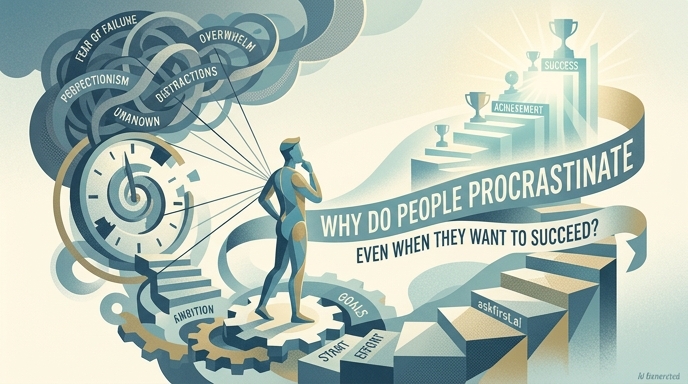
Procrastination is often misunderstood as a simple failure of time management or a lack of willpower. However, from a psychological and neurological perspective, it is far more complex. When an individual genuinely desires success yet finds themselves unable to initiate or complete tasks, they are likely trapped in a cycle driven by emotional regulation deficits rather than laziness. Understanding why this occurs requires looking at the interplay between the brain’s executive functions, emotional triggers, and the cognitive biases that govern human behavior.
The Biological Conflict: The Amygdala vs. The Prefrontal Cortex
At the core of procrastination lies a persistent struggle between two primary regions of the brain: the limbic system (specifically the amygdala) and the prefrontal cortex.
The prefrontal cortex is responsible for executive functions, including planning, goal setting, and long-term decision-making. It is the part of the brain that understands the value of success and the necessity of completing a project. In contrast, the limbic system is one of the most primitive parts of the brain; it operates on an immediate, instinctual level, seeking pleasure and avoiding discomfort.
When a task feels daunting, overwhelming, or carries the risk of failure, the limbic system perceives it as a threat. It prioritizes the immediate relief of avoiding that threat (the "fight or flight" response) over the long-term benefit of the reward. Procrastination, therefore, is the brain’s way of self-regulating its emotional state to escape the discomfort of a task, even when the person consciously knows that avoiding the task will lead to negative outcomes.
The Role of Perfectionism and Fear of Failure
Many high achievers who desire success are paradoxically the most prone to procrastination. This is frequently rooted in perfectionism. When an individual ties their self-worth to their output, the prospect of producing work that is less than perfect becomes psychologically terrifying.
If a task cannot be done perfectly, the brain may perceive it as a potential failure. To protect the ego from this perceived failure, the individual subconsciously delays starting the task. By procrastinating, they create a "safety net": if they fail, they can attribute it to a lack of time or effort rather than a lack of ability. This is a form of self-handicapping. It is easier to believe "I could have succeeded if I had started earlier" than to face the reality that one’s best effort might not meet their own impossibly high standards.
Emotional Regulation and Mood Repair
Procrastination is essentially a mood-repair strategy. When we are faced with a task that triggers anxiety, boredom, or self-doubt, our mood drops. To restore our sense of well-being, we shift our attention to something more enjoyable or less stressful. This provides an immediate "hit" of dopamine, reinforcing the habit of avoidance.
The problem is that this relief is temporary. Once the distraction ends, the original task remains, often accompanied by feelings of guilt, shame, and increased pressure. This shame cycle only serves to make the task feel even more threatening, which in turn leads to further procrastination. It is a feedback loop where the emotional cost of starting continues to climb the longer the delay persists.
Cognitive Biases: Present Bias and Temporal Discounting
Humans are biologically wired to prioritize the present over the future. This phenomenon is known as temporal discounting. We intuitively devalue rewards that are further away in time. The satisfaction of finishing a project for a promotion next month feels significantly less "real" and less urgent than the immediate comfort of scrolling through social media or cleaning one's workspace.
Because the human brain struggles to fully conceptualize the "future self," we often treat our future selves as strangers. We offload the burden of work onto the person we will be tomorrow, assuming—erroneously—that our future self will be more motivated, more energetic, and more capable of handling the stress than we are today. When tomorrow arrives, however, the future self has become the present self, and the cycle of displacement begins again.
Breaking the Cycle: Strategies for Action
To overcome this, one must shift the focus from "time management" to "emotion management." Strategies that prove effective include:
- The Two-Minute Rule: If a task takes less than two minutes, do it immediately. This prevents the accumulation of small, anxiety-inducing administrative burdens.
- Micro-Tasking: Break large projects into absurdly small, manageable steps. By lowering the "barrier to entry," you reduce the amygdala’s threat response.
- Self-Compassion: Research indicates that individuals who forgive themselves for procrastinating are actually less likely to procrastinate on future tasks. By reducing the shame associated with past delays, you decrease the emotional dread that triggers future avoidance.
- Environmental Design: Remove digital distractions that offer the "quick fix" of dopamine. By making the path of least resistance involve productive work rather than mindless consumption, you align your environment with your long-term goals.
In conclusion, procrastination is not a character flaw. It is a complex emotional reaction to the pressure of performance. By recognizing that the desire to succeed often triggers the very anxiety that causes delay, one can implement strategies that bypass the brain’s primitive avoidance mechanisms and allow for consistent, sustainable progress.