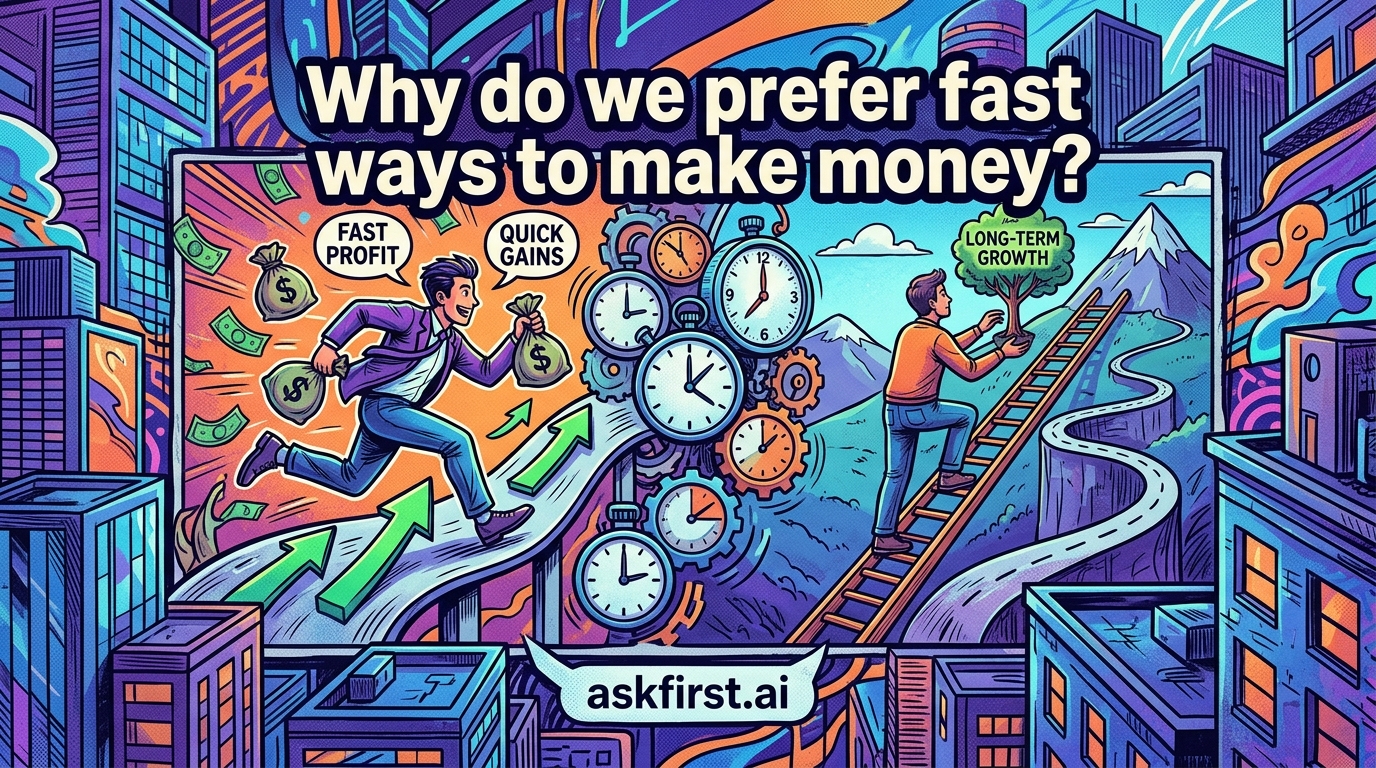
The human pursuit of rapid wealth accumulation is not merely a modern phenomenon driven by digital technology or social media influencers; it is a fundamental aspect of human psychology rooted in evolutionary biology, neurochemistry, and the specific socio-economic pressures of the 21st century. While the concept of "get rich quick" is often dismissed as irrational, understanding the underlying mechanisms reveals why the allure of fast money is so deeply ingrained in our decision-making processes.
The Evolutionary Imperative: The Biology of Impatience
To understand why we prioritize speed over sustainability, we must look at our evolutionary history. In The Evolution of Desire (1994), psychologist David Buss explains that for most of human history, resources were scarce and unpredictable. Our ancestors who prioritized immediate consumption over long-term investment were, in many environments, the ones who survived. This "present bias"—the tendency to value immediate rewards over larger, delayed rewards—is hardwired into our neural architecture.
When we consider the prospect of a "fast" financial windfall, our brains trigger the release of dopamine, the neurotransmitter associated with reward prediction. Neuroscientist Robert Sapolsky, in his seminal work Behave: The Biology of Humans at Our Best and Worst (2017), highlights that the anticipation of a reward can be more neurologically stimulating than the reward itself. The brain essentially prioritizes the "fast" path because it perceives a higher probability of immediate survival or status elevation, bypassing the slower, more deliberate executive functions of the prefrontal cortex.
The Impact of the "Attention Economy"
In the contemporary era, the structural environment of our daily lives has exacerbated this biological predisposition. We live in what author Cal Newport describes in Digital Minimalism (2019) as the "Attention Economy." In this ecosystem, our success and social standing are often measured by metrics that update in real-time: likes, shares, and follower counts.
This environment has conditioned us to expect immediate feedback loops. If a social media post can go viral in minutes, we naturally begin to apply that same logic to our financial goals. The rise of day trading platforms and high-frequency speculative assets—such as certain cryptocurrencies or "meme stocks"—has turned wealth accumulation into a gamified experience. By stripping away the friction of traditional investing (which usually requires patience, compounding, and time), these platforms feed the human desire for instant gratification. When we see peers or influencers displaying rapid wealth, the "fear of missing out" (FOMO) kicks in, further accelerating the desire to bypass traditional, slower methods like education or long-term career building.
Cognitive Biases and the Illusion of Control
A significant reason we prefer fast ways to make money is the "illusion of control" and the "optimism bias." In his classic text Thinking, Fast and Slow (2011), Nobel laureate Daniel Kahneman explores how our brains use heuristics—mental shortcuts—to make complex decisions. One such heuristic is the availability heuristic, where we judge the probability of an event by how easily we can recall similar instances.
Because the media highlights the "one-in-a-million" success stories of young entrepreneurs or lucky speculators, we overestimate our own chances of replicating those results quickly. We ignore the "survivorship bias"—the logical error of concentrating on the people or things that made it past some selection process and overlooking those that did not. By focusing on the winners, we create a cognitive blind spot that makes fast money seem like a statistical probability rather than a high-risk gamble. We convince ourselves that we possess unique insight or "hacks" that others have missed, which provides a false sense of security while pursuing high-risk financial endeavors.
Socio-Economic Pressures and the Erosion of Stability
Finally, we cannot ignore the macro-economic context. The erosion of traditional career stability, the rising cost of living, and the massive disparity in wealth have led many to view traditional, slow-growth financial paths as insufficient. As detailed in The Meritocracy Trap (2019) by Daniel Markovits, the barrier to entry for high-status, high-paying jobs has become increasingly difficult to scale.
For many, the "slow and steady" path—such as contributing to a 401(k) or climbing a corporate ladder—feels like a losing game when inflation and housing costs outpace wage growth. When the conventional route to financial security feels broken, the psychological incentive to seek "fast" alternatives increases exponentially. It is not necessarily a lack of character or patience, but a rational response to an environment where the traditional "rules" of economic mobility seem to be failing.
Conclusion
Our preference for fast ways to make money is a complex synthesis of deep-seated evolutionary survival instincts, the dopamine-driven feedback loops of our digital age, and a logical reaction to modern economic stagnation. While the cognitive biases of optimism and the illusion of control often lead us toward risky shortcuts, acknowledging these drivers is the first step toward better financial literacy. Understanding that our brains are not naturally designed for the patience required by compound interest allows us to consciously override our impulses, favoring sustainable growth over the ephemeral, and often illusory, promise of rapid wealth.