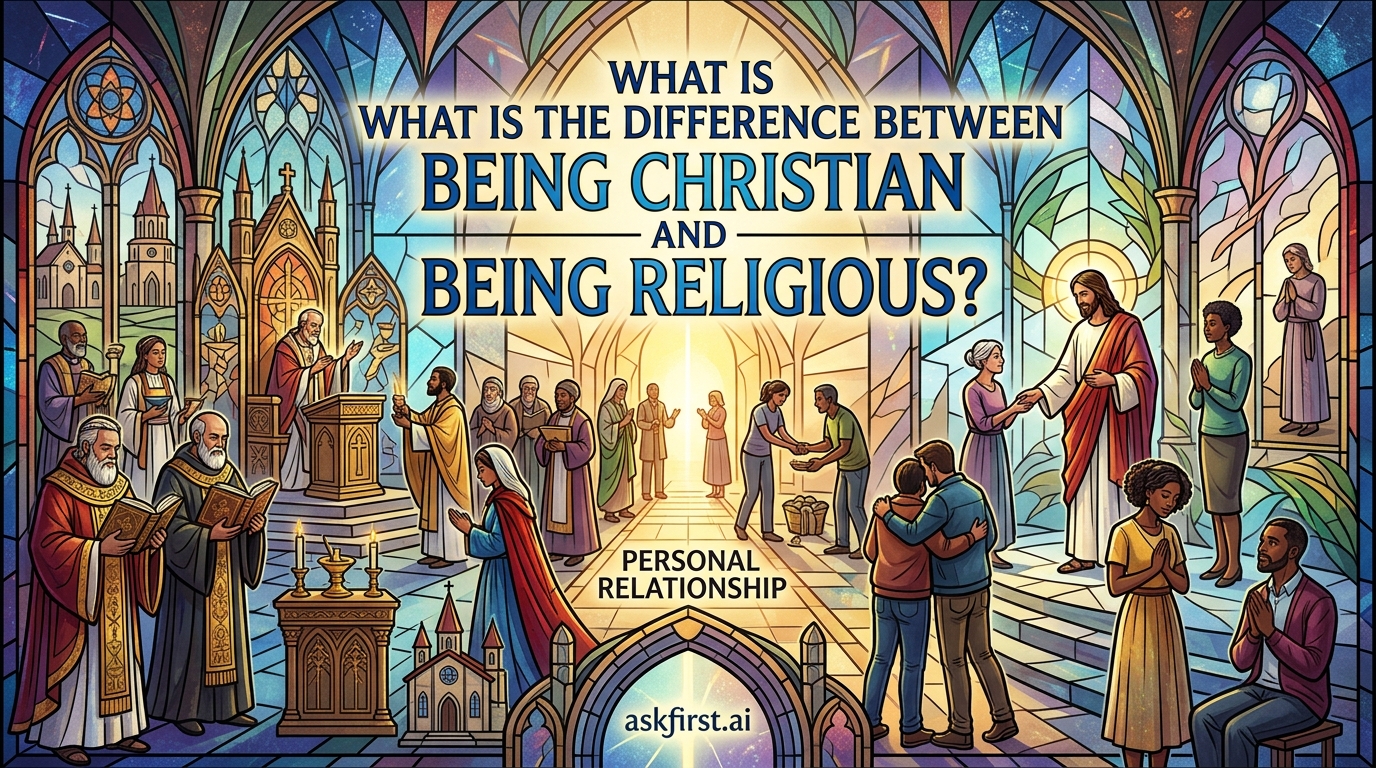
The Distinction Between Christianity and Religion
The distinction between being "Christian" and being "religious" is a subject of significant theological, sociological, and philosophical discourse. While the terms are often used interchangeably in casual conversation, they represent fundamentally different frameworks regarding human existence, divine interaction, and the nature of belief.
Defining "Religious"
Being religious refers to the adherence to a system of beliefs, rituals, and moral codes associated with a specific faith tradition. Sociologically, religion is often viewed as a cultural institution.
- Characteristics:
- Systematic Structure: Religion typically involves established hierarchies, codified doctrines, and specific liturgical calendars.
- Ritualistic Emphasis: Practice often centers on the performance of rites, pilgrimages, and adherence to dietary or behavioral laws.
- Human-Centric Pursuit: In many religious frameworks, the burden is placed on the individual to "reach up" to the divine through merit, good works, or enlightenment.
- Cultural Identity: Religion often functions as a social glue, providing community identity and shared history within a geographic or ethnic group.
Defining "Christian"
Historically and theologically, being Christian is defined not by the performance of religious ritual, but by the belief in the person and work of Jesus Christ. The core tenet of Christianity is that it is a "revealed" faith rather than a "constructed" one.
- The Theological Divergence:
- Grace vs. Works: A primary distinction is the concept of Sola Gratia (Grace Alone). Christianity posits that human nature is inherently flawed and cannot attain divinity through religious effort. Instead, it teaches that the divine has "reached down" to humanity through the incarnation, death, and resurrection of Jesus.
- Relationship vs. Rules: Christianity emphasizes a personal, restorative relationship with God through the Holy Spirit, viewing the "law" not as a path to salvation, but as a reflection of moral character.
- The Identity of the Believer: To be Christian is to identify as a "follower" or "disciple" of Jesus, which implies a transformative internal change rather than merely conforming to external cultural standards.
Key Comparative Metrics
| Feature | Religious Framework | Christian Framework |
|---|---|---|
| Primary Goal | Adherence to moral/legal code | Reconciliation with God |
| Mechanism | Human effort and ritual | Faith in Christ’s sacrifice |
| Authority | Tradition and institutional dogma | The Bible and the Holy Spirit |
| Nature | Often communal and outward | Personal and internal |
Pros and Cons
Religious Practice provides strong community cohesion and ethical stability. However, it risks becoming legalistic, where the "letter of the law" eclipses empathy or spiritual depth.
Christianity offers a promise of liberation from performance-based anxiety. The challenge, however, is that throughout history, Christianity has frequently institutionalized into "religion," leading to the very legalism it was intended to replace.
Future Trends
Modern society is witnessing a "de-religioning" trend, where individuals reject formal, institutional religion but maintain spiritual curiosity. We are seeing a rise in "post-religious" Christianity, which seeks to return to the original, simplified teachings of Jesus, stripping away centuries of cultural baggage, dogma, and political influence. This shift suggests that while formal "religion" may decline in influence, the personal, existential search for meaning—the core of the Christian narrative—remains a central pillar of the human experience.