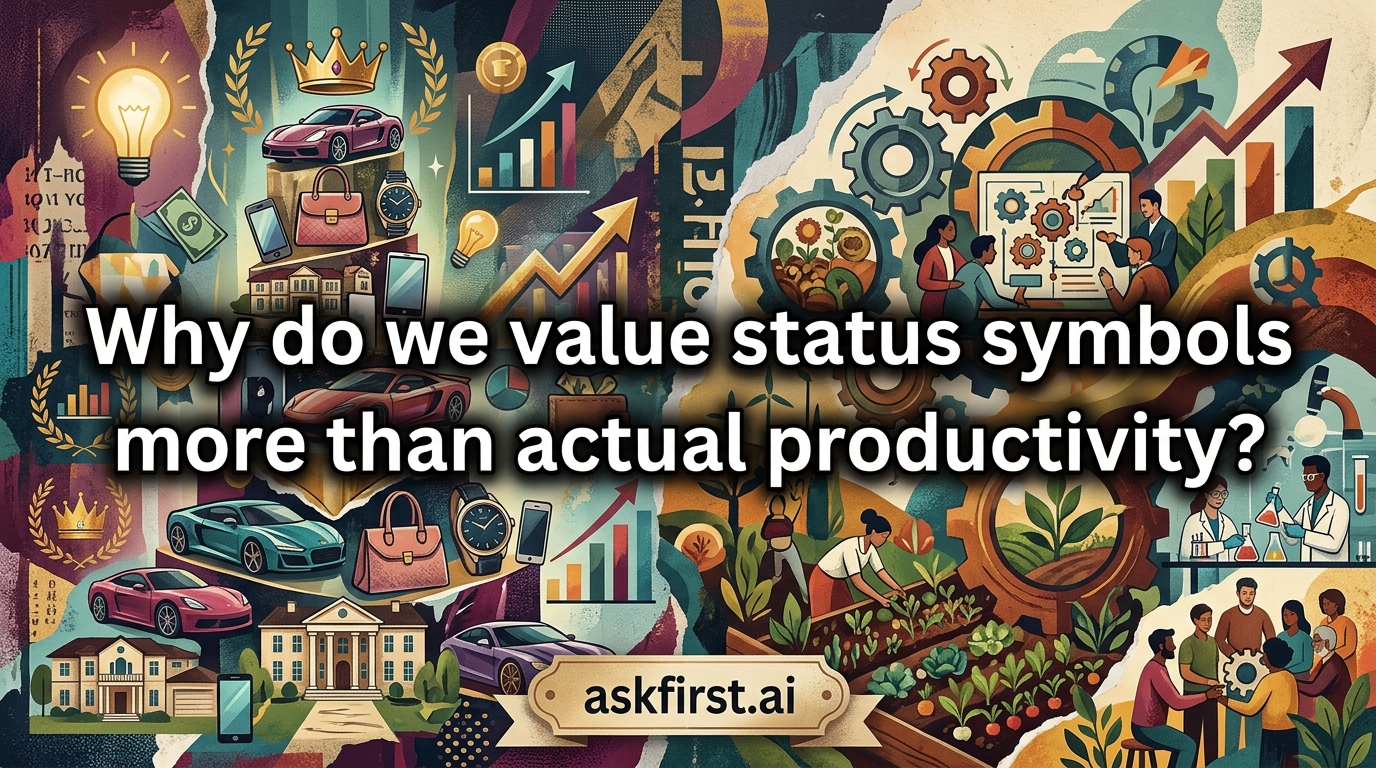
The Psychology of Prestige: Why Status Symbols Outshine Productivity
Human behavior often defies pure economic logic. While productivity generates measurable wealth and survival utility, society consistently demonstrates a stronger emotional and psychological affinity for status symbols. This phenomenon stems from deep-rooted evolutionary biology and the mechanics of social signaling.
The Evolutionary Root of Signaling
Evolutionary psychology suggests that human status is a proxy for fitness. Throughout history, individuals who displayed high status signaled better access to resources, protection, and genetic health. This is known as costly signaling theory, originally proposed by biologist Amotz Zahavi. The theory posits that for a signal to be reliable, it must be costly—such as the peacock's tail, which requires significant energy to maintain and makes the bird more vulnerable to predators, yet it effectively demonstrates health. Similarly, modern luxury goods function as "peacock tails." A branded watch or a high-end luxury vehicle acts as an unambiguous, high-cost signal of surplus resources that productivity alone might not communicate to a casual observer.
The Efficiency of Shortcuts
Productivity is often slow, private, and internal. It takes time for the results of high-quality work to manifest in a way that others can perceive. Conversely, status symbols are high-resolution, instant-read indicators. When evaluating a potential partner or professional peer, the brain seeks shortcuts. Status symbols provide a "heuristic" or mental shortcut, allowing observers to make rapid assumptions about an individual's competence and social standing without requiring a deep audit of their labor output. In a high-speed world, these visual cues act as a shorthand for social hierarchy.
Social Capital and Perception
Status symbols possess a unique property that productivity lacks: they are positional goods. Their value is derived almost entirely from their scarcity and the social recognition of that scarcity. While productivity can theoretically be infinite, status is a zero-sum game; to be "high status" requires that others be "lower status." Consequently, individuals are motivated to pursue visible markers that distinguish them from their peers. This desire to signal group membership or elite status often overrides the pragmatic benefit of simple efficiency. Research in social psychology shows that people are more likely to trust and comply with those displaying markers of prestige, a phenomenon known as the prestige bias. We view these symbols as external proof of success, often assuming that the individual possessing the symbol must have been exceptionally productive, even if the correlation is weak.
Conclusion: The Balanced Perspective
Ultimately, humans value status symbols because they are biologically hardwired to notice and respond to visible markers of success. While productivity is the engine of progress, status symbols serve as the visual language of the social hierarchy. Recognizing this dynamic allows individuals to navigate the landscape of influence more intentionally, balancing the need for genuine output with the undeniable reality of human perception.