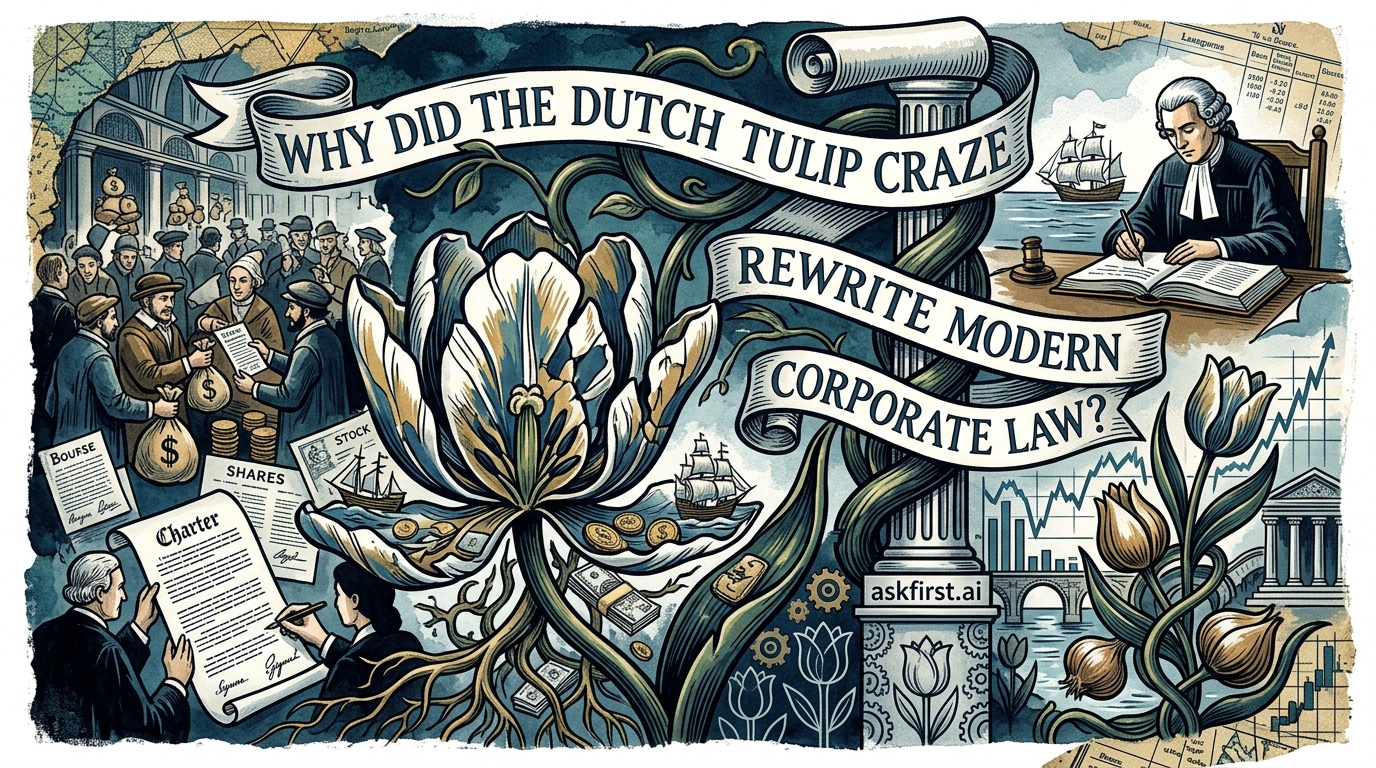
The Origins of Financial Regulation
The Dutch Tulip Mania of the 1630s is often misunderstood as merely a floral fashion statement. In reality, it was a pivotal moment in human history that laid the foundations for modern corporate law and financial derivatives. As the market for rare tulip bulbs escalated into a speculative frenzy, traders developed 'windhandel'—or 'trading in the wind'—which involved buying and selling bulbs that had not yet been harvested. This primitive form of futures contract effectively decoupled the physical asset from the financial transaction, creating a system of abstract value that defied medieval norms of commerce.
The Legal Consequence: Default and Contract
When the market inevitably crashed in February 1637, the Dutch legal system faced an unprecedented crisis. Thousands of contracts were suddenly rendered unenforceable because the underlying bulbs were worthless or non-existent. Courts were forced to decide whether these speculative contracts were binding under traditional Roman-Dutch law or whether they should be classified as gambling debts, which were typically unenforceable. This deliberation forced a transition from subjective 'fair value' assessments to the rigid enforcement of written contracts.
The Shift Toward Corporate Frameworks
- Formalization of Futures: The aftermath necessitated the standardization of contract enforcement, moving trade away from informal verbal agreements toward formalized legal documents that prioritized the sanctity of contract over moral fairness.
- Corporate Personality: The crisis accelerated the development of the joint-stock company. By pooling capital into a distinct legal entity rather than individual trade agreements, investors sought protection from personal liability, a direct response to the ruinous personal debts incurred during the tulip collapse.
- Risk Mitigation: Modern corporate law evolved to require transparency, disclosure, and the creation of clearinghouses to ensure that contract obligations would be honored regardless of market volatility.
A Legacy of Economic Stability
Legal historians note that the Dutch government's refusal to bail out the speculators was a watershed moment. By treating the tulip bubble as a private market failure rather than a systemic state collapse, the Dutch authorities established the principle of 'caveat emptor'—let the buyer beware—within the context of corporate law. This created a lasting precedent: investors must exercise due diligence, and contracts represent a firm legal tether that stands independent of the value of the underlying asset. The tulip craze was not just a chaotic episode of madness; it was the rigorous training ground where modern financial infrastructure and contract law were tested, forged, and eventually institutionalized for the global economy. Every time a contemporary firm enters into a futures contract or establishes a corporate charter, they are operating within the regulatory architecture born from the seventeenth-century tulip fields.