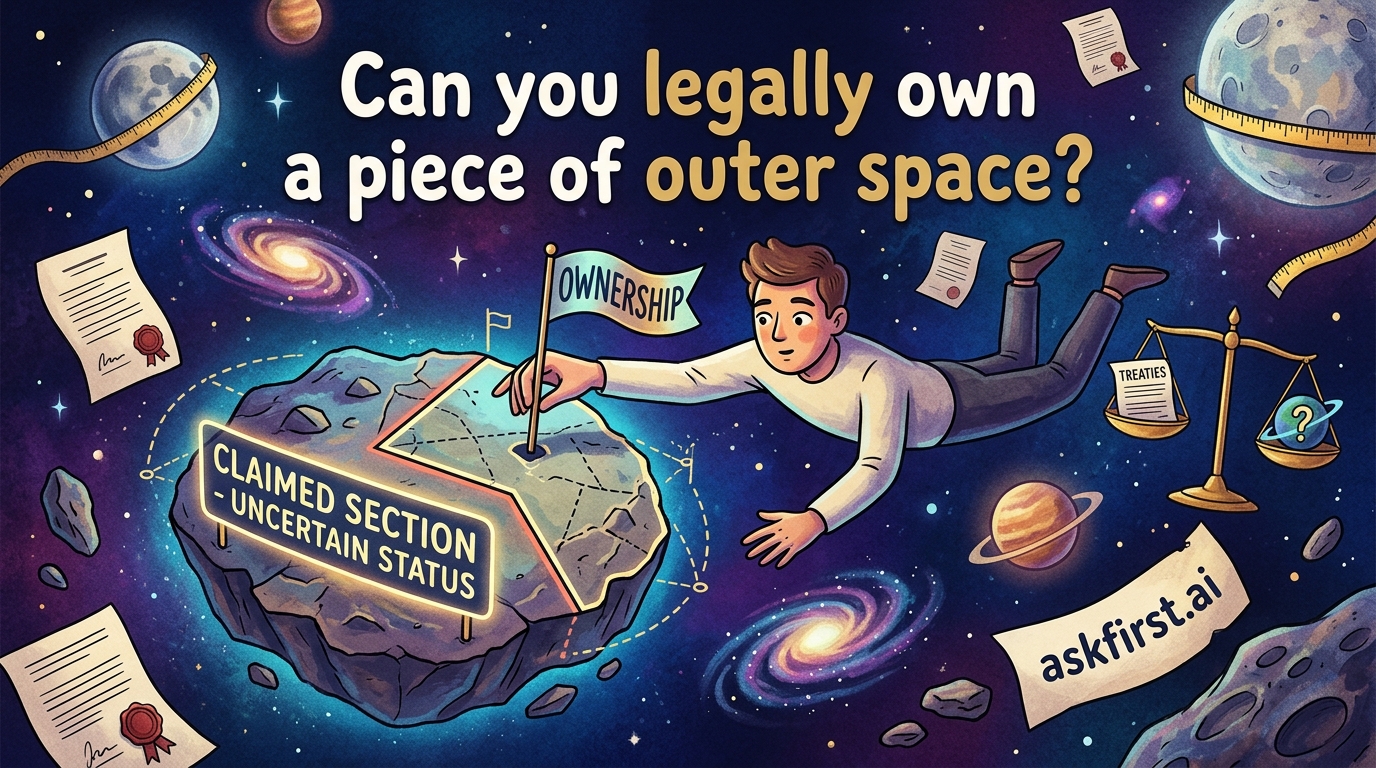
The Legal Status of Celestial Real Estate
The short answer is no. Under international law, it is impossible for an individual, corporation, or even a sovereign nation to own, purchase, or claim sovereignty over a celestial body, such as the Moon, Mars, or any asteroid. Despite numerous websites claiming to sell 'deeds' to lunar craters or Martian plains, these transactions are entirely symbolic, legally unenforceable, and carry no weight under the governance of terrestrial law.
The Treaty That Governs the Cosmos
The cornerstone of this prohibition is the Treaty on Principles Governing the Activities of States in the Exploration and Use of Outer Space, including the Moon and Other Celestial Bodies, commonly known as the Outer Space Treaty (OST) of 1967. Drafted at the height of the Space Race, this foundational document serves as the 'constitution' for space law. Article II of the OST explicitly states: 'Outer space, including the moon and other celestial bodies, is not subject to national appropriation by claim of sovereignty, by means of use or occupation, or by any other means.'
Because nations are barred from claiming territory, they cannot delegate such rights to private citizens or commercial entities. If a government cannot own a crater, it cannot grant a title deed to a citizen for that same crater.
Debunking the 'Moon Deed' Industry
There exist several commercial entities that sell 'lunar real estate' under the guise of novelty gifts. These businesses often cite clever loopholes, such as the claim that while the treaty forbids national appropriation, it does not explicitly ban private appropriation. This argument is fundamentally flawed for two reasons:
- State Responsibility: Article VI of the Outer Space Treaty stipulates that States Parties to the treaty bear international responsibility for national activities in outer space, whether carried out by governmental agencies or non-governmental entities. Consequently, if a private individual claims land, the country of their citizenship is responsible for their actions and must ensure they abide by the treaty, which forbids such claims.
- Lack of Recognition: Property ownership requires a legal system to recognize, record, and enforce the claim. No court in any sovereign nation recognizes deeds for outer space. If an individual purchased land on the moon and another person decided to build a structure there, the owner would have no legal recourse to evict the interloper.
The Economic Frontier: Resource Extraction
While real estate ownership is banned, the legal landscape regarding resource extraction is more nuanced. This is where the distinction between 'territory' and 'usufruct' (the right to use and enjoy the profits of property belonging to another) becomes critical.
Modern initiatives, such as the Artemis Accords, seek to establish frameworks for mining water ice and minerals on the moon. Proponents argue that harvesting resources is akin to fishing in international waters; you do not own the ocean, but you do own the fish you catch. This distinction is vital for the future of space-based industries, as it allows companies to operate and extract value without violating the core prohibition against owning the celestial body itself.
Future Implications and Challenges
As humanity approaches an era of permanent lunar bases and potential asteroid mining, the gaps in the 1967 treaty will become increasingly apparent. Issues regarding:
- Safety Zones: How far must one base be from another to prevent interference?
- Liability: Who is responsible for damage caused by private space mining operations?
- Environmental Stewardship: Should we allow for the total consumption of lunar resources, or must we protect the 'pristine' state of these bodies?
These questions remain at the forefront of modern space law (astro-law). Experts suggest that while we will never 'own' the stars or planets in the traditional sense, we will likely develop sophisticated multi-lateral agreements that treat outer space as a 'Global Common,' similar to the High Seas or Antarctica, where scientific research and commercial development coexist under shared rules.
Conclusion
Ownership of outer space remains a fantasy. The legal frameworks established in the 20th century were designed to prevent the expansion of terrestrial conflicts into the vacuum of space, prioritizing collective exploration over individual exploitation. While you might hold a piece of paper claiming you own a lunar plot, remember that in the eyes of international law, the universe remains a shared domain, belonging to no one and everyone simultaneously. Engaging with space is a matter of exploration and collaboration, not real estate acquisition.