The Legal Enforceability of Verbal Promises
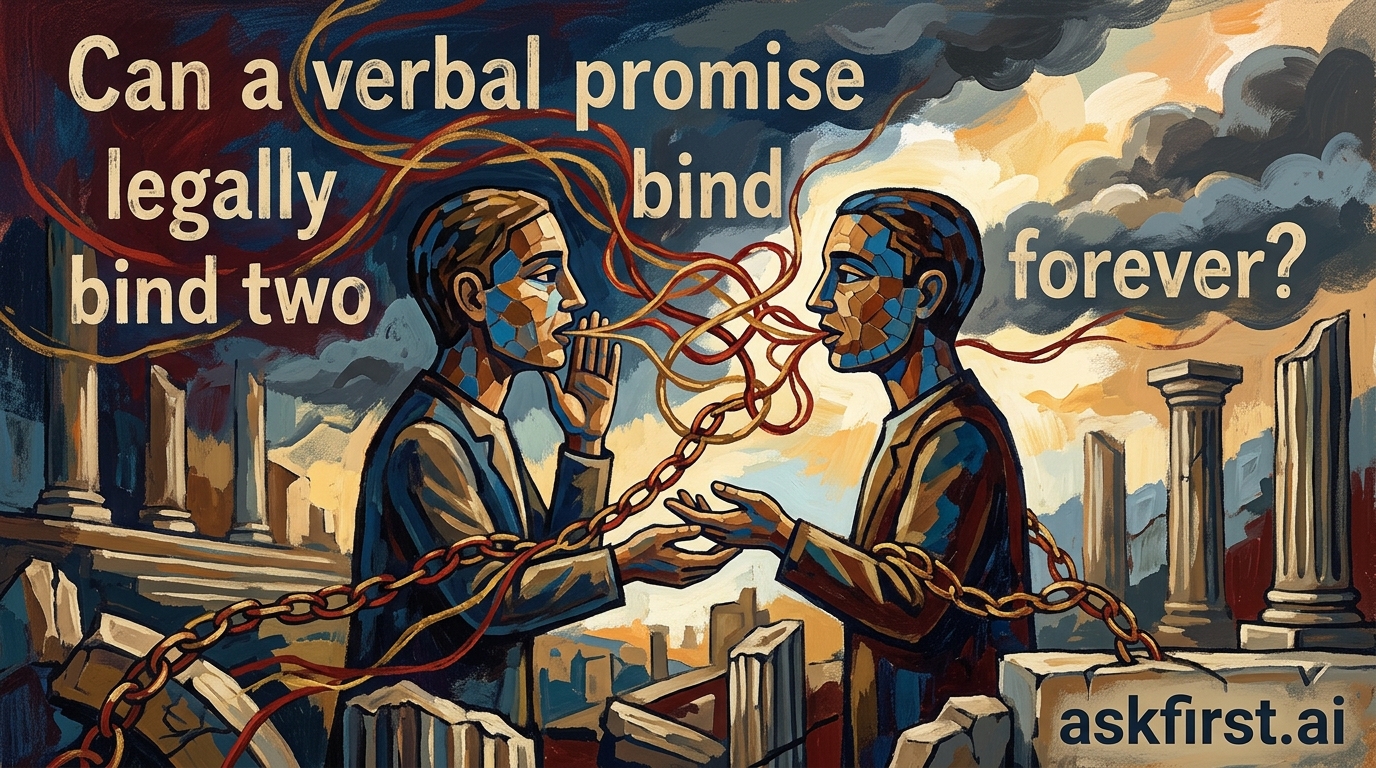
In the realm of contract law, the question of whether a verbal promise can bind two people "forever" is complex. While verbal agreements (often called "parol contracts") are technically valid in many jurisdictions, they rarely translate into a perpetual, legally enforceable obligation. The intersection of contract law, the Statute of Frauds, and the principle of public policy creates significant barriers to eternal enforcement.
1. The Legal Standing of Verbal Contracts
A verbal contract is a legally binding agreement made through spoken words rather than a written document. For a verbal promise to be enforceable, it must meet the fundamental requirements of any contract:
- Offer and Acceptance: A clear proposal by one party and an unequivocal agreement by the other.
- Consideration: Something of value must be exchanged (e.g., money, services, or a promise to act/refrain from acting).
- Mutuality: Both parties must intend to be bound by the agreement.
- Capacity: Both parties must be of sound mind and legal age.
The Statute of Frauds
The primary obstacle to enforcing verbal promises is the Statute of Frauds, a legal doctrine originating from 17th-century English law. It mandates that certain types of contracts must be in writing to be enforceable. These typically include:
- Contracts for the sale of real estate.
- Agreements that cannot be performed within one year.
- Contracts for the sale of goods exceeding a specific monetary threshold (often $500).
- Promises to pay the debt of another.
If a promise is meant to last "forever," it inherently cannot be performed within one year, making it almost universally unenforceable unless reduced to writing.
2. The Problem of "Forever"
Courts generally disfavor perpetual contracts. In modern jurisprudence, a contract that lacks a defined duration or a mechanism for termination is often viewed as "indefinite."
- Reasonable Time: If a contract does not specify a duration, courts often imply a "reasonable time" based on the context of the agreement, rather than allowing it to persist indefinitely.
- Public Policy: Courts are hesitant to enforce lifelong obligations because they resemble indentured servitude or unreasonable restraints on personal liberty.
3. Proving a Verbal Promise
The greatest practical challenge is evidentiary. Without a written record, proving the existence, scope, and terms of a verbal promise relies entirely on testimony. This leads to the "he-said, she-said" dilemma.
- Corroborating Evidence: To succeed in court, a claimant would need circumstantial evidence, such as bank records, emails, text messages, or witness testimony that supports the assertion that a promise was made.
- Statute of Limitations: Even if a promise is binding, the right to sue for its breach eventually expires. Most jurisdictions have statutory time limits for filing contract claims, meaning the "forever" nature of the promise is legally extinguished once the limitation period passes.
4. Conclusion and Future Trends
In summary, while a verbal promise can create a binding obligation, it cannot practically or legally bind two people "forever." The combination of the Statute of Frauds, the requirement for clear evidence, and judicial reluctance to uphold perpetual contracts makes such claims nearly impossible to enforce long-term. Parties seeking to create lasting obligations should always utilize formal written contracts, preferably drafted by legal counsel, to ensure clarity and enforceability.