The Legal Reality of Romantic Promises
Many individuals operate under the assumption that the solemn promises made at an altar or during a wedding ceremony constitute a binding contract. However, in the vast majority of legal jurisdictions globally, marriage vows are categorized as personal, social, or religious commitments rather than enforceable legal contracts. This distinction is critical because, while the act of marriage itself creates a specific legal status, the spoken words exchanged between partners do not hold weight in litigation regarding breach of contract. Understanding why this is the case requires an analysis of contract law, public policy, and the evolution of domestic relations.
The Absence of Mutual Assent to Contractual Terms
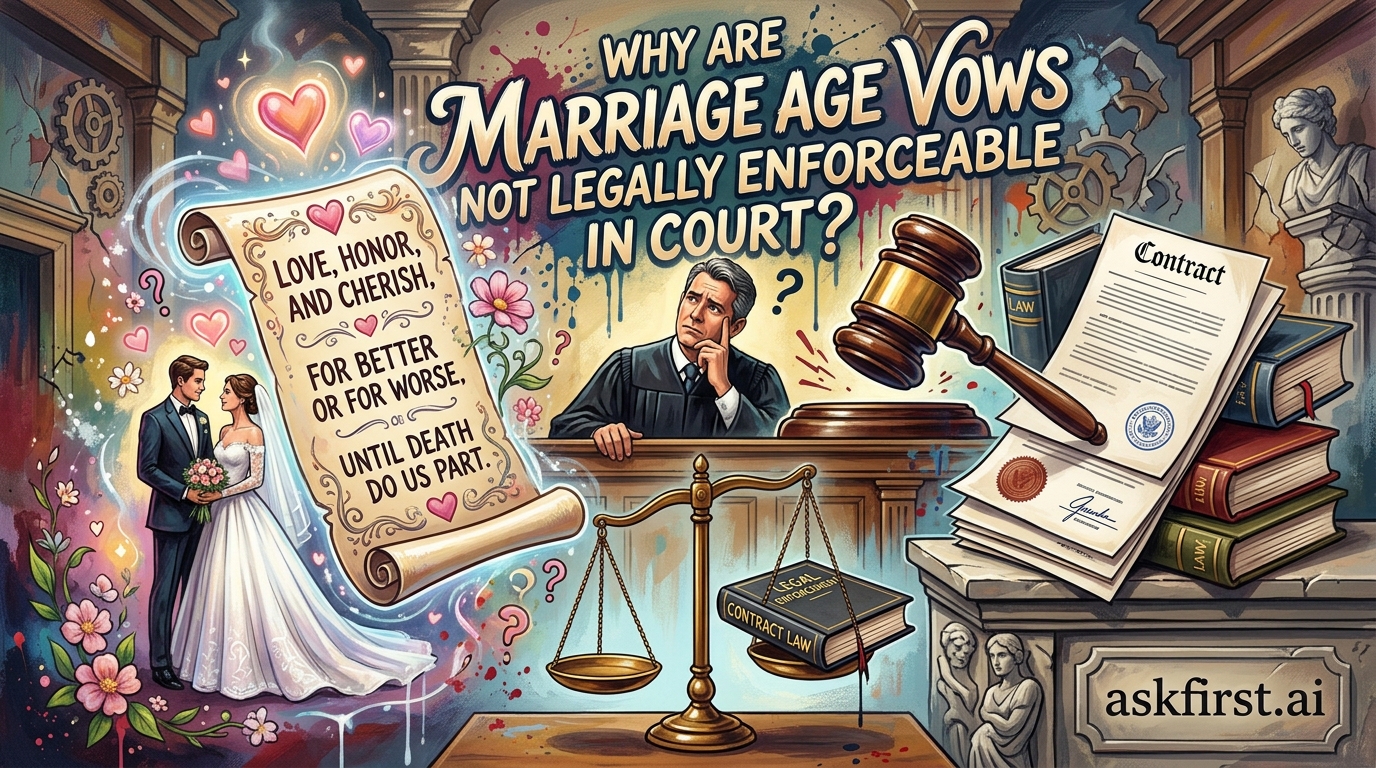
For a document or agreement to be legally enforceable in court, it must meet specific criteria: offer, acceptance, consideration, and a meeting of the minds regarding explicit terms. Marriage vows typically fail to meet these requirements. Vows like 'for better or worse' or 'until death do us part' are aspirational statements of intent rather than precise contractual clauses. Courts require quantifiable outcomes for breach of contract claims—for instance, a specific sum of money or a defined performance. Promises involving love, fidelity, or companionship are inherently subjective and impossible to define or measure in a court of law.
The Role of Public Policy
Courts historically maintain a doctrine that discourages state intervention into the private, intimate lives of citizens. If marriage vows were legally enforceable, the judicial system would be flooded with 'breach of vow' cases involving accusations of emotional neglect, infidelity, or failure to fulfill domestic expectations. This would fundamentally undermine the nature of the marital relationship. Public policy dictates that the law should provide a framework for the dissolution of the status of marriage—through divorce—but it should not police the internal daily conduct or romantic fulfillment of the partners involved. Legal systems strive to prevent the courtroom from becoming a theater for personal vendettas or psychological inquiries into private behavior.
Distinguishing Status from Contract
It is vital to distinguish between the 'status' of marriage and the 'contract' of marriage. By obtaining a marriage license, individuals enter into a state-regulated status. This status confers specific rights and responsibilities, such as tax benefits, inheritance rights, and medical decision-making authority. These are clearly defined by legislation and can be enforced in court. In contrast, the vows spoken during the ceremony are peripheral to the legal status. The law cares that you are married for the purposes of distributing assets or establishing parentage, but the law remains indifferent to whether or not you kept the promise to 'always be kind' or 'never stop going on dates.'
The Intersection with Premarital Agreements
One might ask why prenuptial agreements are enforceable if marriage vows are not. The answer lies in the clarity and intent of the document. A prenuptial agreement is a formal financial contract. It explicitly lists assets, debts, and the division of property in the event of divorce. These documents are drafted by legal professionals, signed with full disclosure, and often notarized. They meet all the legal tests for a binding contract. Vows, conversely, are typically spoken, unwritten, and lacking the requisite specificity regarding monetary or property consideration required for a contract. Therefore, the law views the prenuptial agreement as a business-like instrument, while vows are viewed as ceremony.
The Impact on Legal Efficiency and Privacy
If the judiciary were to enforce vows, it would necessitate an invasive level of monitoring into marital households. Judges would be tasked with deciding if a spouse was 'attentive enough' or if a 'bad day' constituted a breach of duty. This would infringe upon the fundamental right to privacy and the freedom of association. By keeping vows outside the realm of enforceable law, the justice system preserves the sanctity and the autonomy of the private sphere, allowing spouses to govern their emotional landscape without the constant shadow of potential litigation hanging over their daily interactions.
Conclusion
Marriage vows serve a profound social and psychological purpose, fostering unity and shared commitment. However, they remain legally unenforceable because they lack the necessary components of a contract, conflict with established public policy regarding judicial overreach, and remain fundamentally incompatible with the objective nature of the legal system. By separating the romantic ideal from the legal mechanism, society ensures that marriage remains a personal journey, while the legal framework remains a reliable instrument for governance and property protection.