The Validity of Verbal Contracts: A Legal Deep Dive
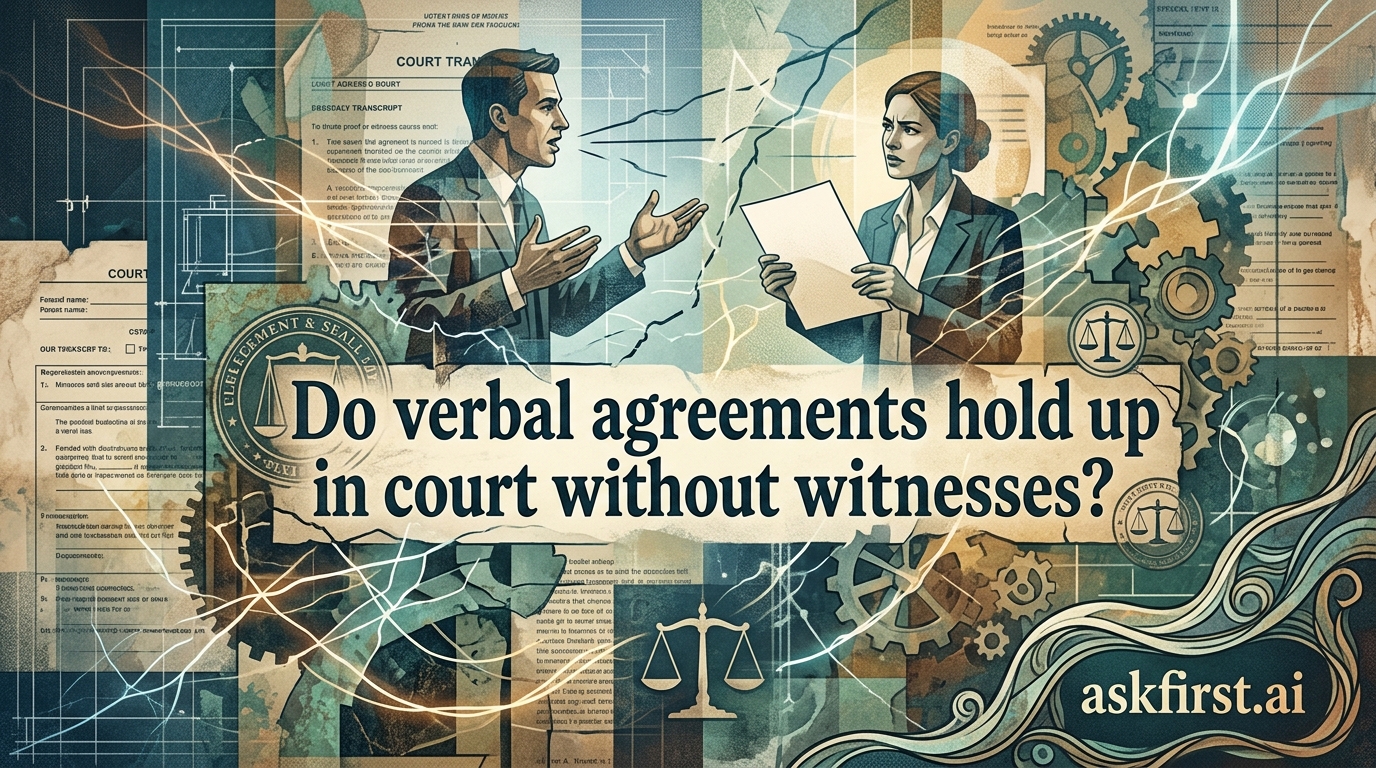
Many individuals operate under the common myth that a contract is only valid if it is signed, sealed, and documented on paper. In reality, the legal landscape is far more nuanced. A verbal agreement, also known as a parol contract, is fundamentally a binding arrangement. While evidentiary hurdles exist, the lack of a third-party witness does not automatically render an agreement void. Understanding how courts evaluate these 'he-said, she-said' scenarios is essential for protecting professional and personal interests.
The Core Principles of Contract Law
To be enforceable, any contract—verbal or written—must meet the fundamental pillars of contract law:
- Offer: One party clearly proposes a set of terms.
- Acceptance: The other party unequivocally agrees to those terms.
- Consideration: Something of value (money, services, or forbearance) must be exchanged between parties.
- Intent to Create Legal Relations: Both parties must intend for the agreement to have legal consequences.
- Capacity: Both parties must be of legal age and mental competence.
If these elements are present, a verbal agreement exists. The primary challenge is not the validity of the contract, but the evidentiary burden required to prove the terms of that agreement in court.
Overcoming the Witness Gap: Indirect Evidence
When no witnesses are present to attest to a conversation, a judge will look for 'corroborating evidence' to establish the existence and terms of the contract. Even without a bystander, the following forms of evidence are frequently utilized to turn the tide in litigation:
1. Conduct and Performance
If one party performed their side of the bargain and the other party accepted that performance, it serves as strong proof. For example, if a freelance designer delivers a website and the client begins using it, the client’s use acts as an implied acceptance of the agreement's terms, regardless of whether a formal document was signed.
2. The Paper Trail (Digital and Physical)
Emails, text messages, voicemails, and even social media direct messages serve as crucial artifacts. Even if these messages do not contain a full contract, they often confirm the ongoing existence of an agreement. A text from a client saying 'I am sending the payment for the work we discussed' is a powerful indicator that a binding verbal contract preceded the payment.
3. Financial Records
Bank transfers, partial payments, invoices, and receipts are perhaps the strongest pieces of evidence. If money changed hands, it serves as evidence of the 'consideration' element. Courts rarely believe that one person pays another large sums of money for no reason; such transactions suggest a pre-existing agreement.
4. Past Course of Dealing
If the two parties have worked together in the past using verbal agreements, a court may infer that a similar arrangement was intended in the current instance. Establishing a habitual way of working can be highly persuasive to a judge.
The 'Statute of Frauds' Barrier
While many verbal contracts are enforceable, there is a critical legal exception known as the Statute of Frauds. This doctrine requires certain types of contracts to be in writing to be legally binding. If your agreement falls into these categories, it will not hold up in court without a writing, witness or not. These typically include:
- Real Estate: Contracts for the sale of land or interests in real property.
- Long-term Obligations: Agreements that cannot, by their terms, be performed within one year.
- Suretyship: Promises to pay the debt of another person.
- Marriage: Contracts made in consideration of marriage.
- Goods over a certain value: Under the Uniform Commercial Code (UCC) in many jurisdictions, contracts for the sale of goods over $500 generally require a writing.
The Practical Reality of Litigation
Winning a case based on a verbal agreement is significantly more expensive and time-consuming than enforcing a written one. In a courtroom, it becomes a matter of credibility. A judge or jury will weigh the testimony of the plaintiff against that of the defendant. Factors such as who appears more reliable, whose version of events is more consistent, and who possesses the better circumstantial evidence will determine the outcome.
Recommendations for Protection
To mitigate risk in the absence of written contracts, individuals should adopt a 'follow-up' habit. Immediately after a verbal agreement is made, send a summary email: 'Just to confirm our conversation, I will provide X services by Y date for Z price.' If the other party does not object, their silence or subsequent performance creates a 'written record' of the verbal agreement. This practice serves as the best possible insurance policy.
In summary, while verbal agreements are legally valid, they are inherently risky. Without an impartial third-party witness, one must rely on digital crumbs and consistent conduct to build a case. Documentation is always the superior path to legal certainty.