The Validity of Oral Agreements: Legal Realities
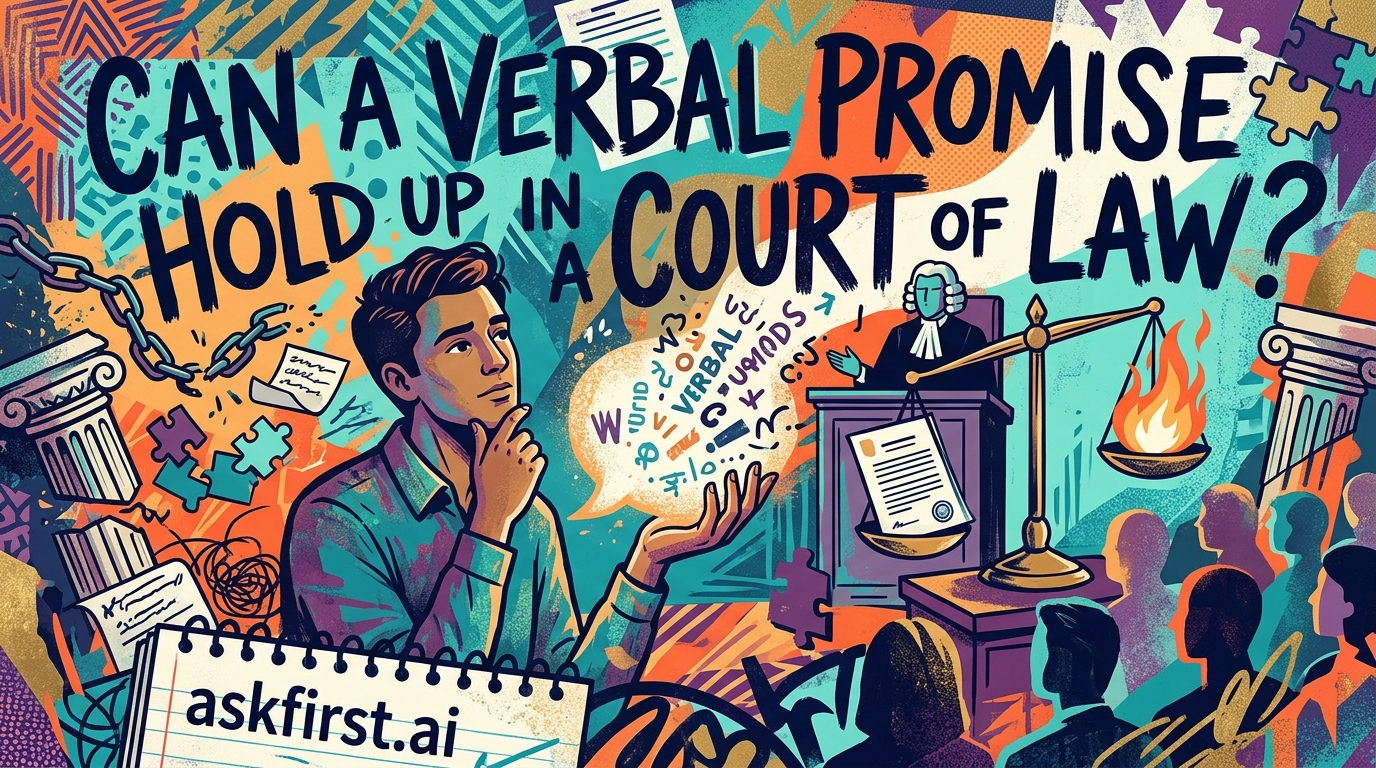
Many individuals operate under the common myth that only written contracts hold legal weight. However, the reality of contract law is far more nuanced. In many jurisdictions, a verbal agreement—often referred to as a parol contract—can indeed be legally binding and enforceable. Understanding the mechanics of these agreements is crucial for navigating professional and personal obligations without falling into avoidable traps.
The Core Requirements for a Binding Agreement
For any agreement to be enforceable, whether written or spoken, it must satisfy specific foundational elements of contract law. A verbal promise must demonstrate:
- Offer: One party clearly proposes specific terms.
- Acceptance: The other party unequivocally agrees to those exact terms.
- Consideration: Both parties must provide something of value. This could be money, services, goods, or even the promise to refrain from an action.
- Intent: Both parties must manifest a genuine intent to create a legally binding relationship rather than just a social or casual understanding.
- Capacity: All parties must have the legal capacity to enter the agreement (e.g., they must be of legal age and mentally sound).
If these elements are present, the law often views the arrangement as a valid contract, regardless of whether it was memorialized on paper.
The 'Statute of Frauds' Hurdle
While oral agreements are generally enforceable, there is a critical legal limitation known as the Statute of Frauds. This doctrine requires certain types of contracts to be in writing to be legally enforceable. If a contract falls under this category, a verbal promise will almost certainly fail in court. Common examples include:
- Real Estate Transactions: Contracts for the sale of land or interests in real property.
- Long-term Agreements: Contracts that, by their terms, cannot be performed within one year.
- Guarantees: Promises to pay the debt of another person (suretyship).
- Sale of Goods Over a Specific Threshold: Under the Uniform Commercial Code (UCC) in many regions, the sale of goods exceeding a certain dollar amount (often $500) requires a written document.
If the subject matter of the promise touches these areas, the absence of a writing acts as a total bar to enforcement.
The Challenge of Evidence and Proof
Even if a contract does not violate the Statute of Frauds, the primary challenge of a verbal agreement is the evidentiary burden. In court, it often becomes a matter of 'he-said, she-said.' Without a signed document, the court must rely on alternative forms of proof to ascertain the truth. This includes:
- Performance: Evidence that the parties acted as if the contract existed. For instance, if one party began paying for services, this behavior serves as circumstantial evidence of an agreement.
- Correspondence: Emails, text messages, voicemails, or social media threads that reference the existence of the agreement.
- Witnesses: Third parties who observed the meeting of the minds or heard the specific terms being discussed.
- Standard Industry Practices: Courts may look at how similar transactions are conducted in that specific trade to infer terms that were not explicitly stated.
Mitigation Strategies and Best Practices
Because of the inherent risks, relying on oral agreements is professionally discouraged. When an agreement is made verbally, parties should immediately take steps to strengthen their position should a dispute arise. Sending a follow-up email that outlines the agreed-upon terms, such as 'To confirm our conversation from earlier, we have agreed to X for the price of Y,' creates a paper trail that can serve as critical evidence.
Furthermore, the doctrine of Promissory Estoppel may sometimes provide a remedy if one party makes a promise, the other party reasonably relies on it to their detriment, and an injustice would occur if the promise were not enforced. This is a powerful equitable tool, but it is much harder to prove than a standard written contract.
Conclusion
While the law does not categorically forbid verbal agreements, the practicalities of litigation make them notoriously difficult to enforce. While the law might 'recognize' the promise, the lack of objective evidence often renders it hollow in the courtroom. To ensure security, reliability, and peace of mind, formalizing agreements in writing remains the gold standard of business and personal transactions. A signature on a document serves not just as a formality, but as a robust protection against the uncertainty of human memory.