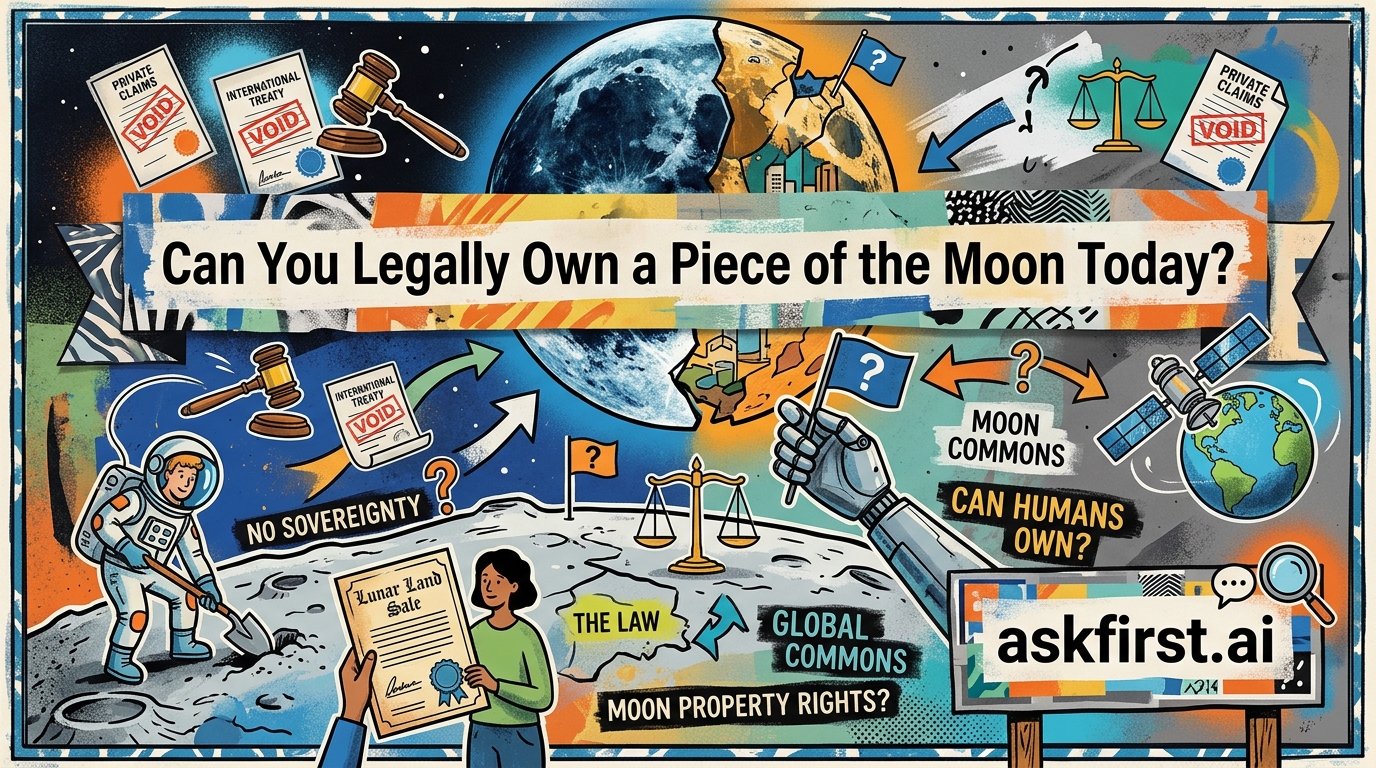
The Legal Landscape of Lunar Ownership
The question of whether an individual can legally own a piece of the Moon is a fascinating intersection of international law, historical philosophy, and space exploration reality. To understand the current status, one must look toward the Outer Space Treaty (OST) of 1967, the foundational document of space law developed under the United Nations. Article II of this treaty states clearly: "Outer space, including the moon and other celestial bodies, is not subject to national appropriation by claim of sovereignty, by means of use or occupation, or by any other means."
The Interpretation of 'National' vs. 'Private'
While the treaty prohibits nations from claiming the Moon as their territory, there has long been a debate regarding whether this restriction applies to private citizens or corporations. Legal experts generally argue that because nations are signatories, they are obligated to ensure that no national entity—be it a company or an individual—engages in activities that violate the treaty. Consequently, if a country cannot own the Moon, it cannot grant ownership of lunar territory to its citizens. Therefore, purchasing a 'deed' for a crater or a slice of lunar real estate is widely considered a legal fiction rather than a binding property title.
Why 'Lunar Deeds' Exist
Many companies sell 'lunar deeds' as novelty gifts. These businesses often operate on the loophole that the Outer Space Treaty only governs sovereign states. However, international law does not recognize these sales. When an individual purchases such a deed, they are effectively buying a souvenir or a novelty certificate, not legal land ownership that would hold up in a court of law. There is no international registry that recognizes private titles to extraterrestrial bodies. Owning a plot on the Moon is conceptually similar to someone selling a 'deed' to a star; it provides a sense of connection to the cosmos but confers no actual legal rights to the physical material.
The Status of Physical Lunar Material
While claiming land on the Moon is legally prohibited, the status of physical material—such as moon rocks or lunar dust—is distinct. Ownership of actual lunar samples returned to Earth by missions like Apollo or Luna is strictly controlled. Most lunar material currently held by humans is the property of the government that retrieved it. However, a small amount of material has been gifted to nations or sold in rare, legal auctions if it was classified as private property before specific international protocols were established.
- State-Owned Rocks: The vast majority of lunar samples are preserved for scientific research and are not for individual sale.
- Private Possession: If an individual somehow possessed a genuine moon rock, the legality of ownership would be challenged immediately by the nation that originally retrieved it.
- Meteorites: Interestingly, lunar meteorites—rocks blasted off the Moon by impacts that eventually landed on Earth—are treated differently. Because these samples were not retrieved via a government-sponsored mission, they are often treated as private property under common mineral rights laws, making them the only legitimate way for a private citizen to 'own' a piece of the Moon.
The Future of Space Resource Extraction
Looking toward the future, the Artemis Accords and various national legislations—such as the United States Commercial Space Launch Competitiveness Act of 2015—are beginning to clarify the rights of private entities regarding space resources. These laws distinguish between owning the land (which remains prohibited) and owning extracted resources (such as water ice or minerals). The legal consensus is shifting toward the idea that while you cannot own the lunar surface, you may eventually be able to own what you extract from it for commercial or scientific purposes.
Summary of Legal Reality
- Sovereignty: No country owns the Moon, and none can grant private titles to lunar land.
- Novelty Deeds: Any purchased 'lunar deed' is a novelty item with no legal standing or property rights.
- Physical Samples: Authentic lunar material is almost exclusively state-controlled, except for naturally occurring lunar meteorites, which can be held as private property.
In conclusion, while humanity looks to the stars with wonder, the Moon remains a global commons. You cannot legally purchase a plot of lunar soil, but you can certainly continue to dream of the day when space exploration opens new legal frontiers for all of mankind.