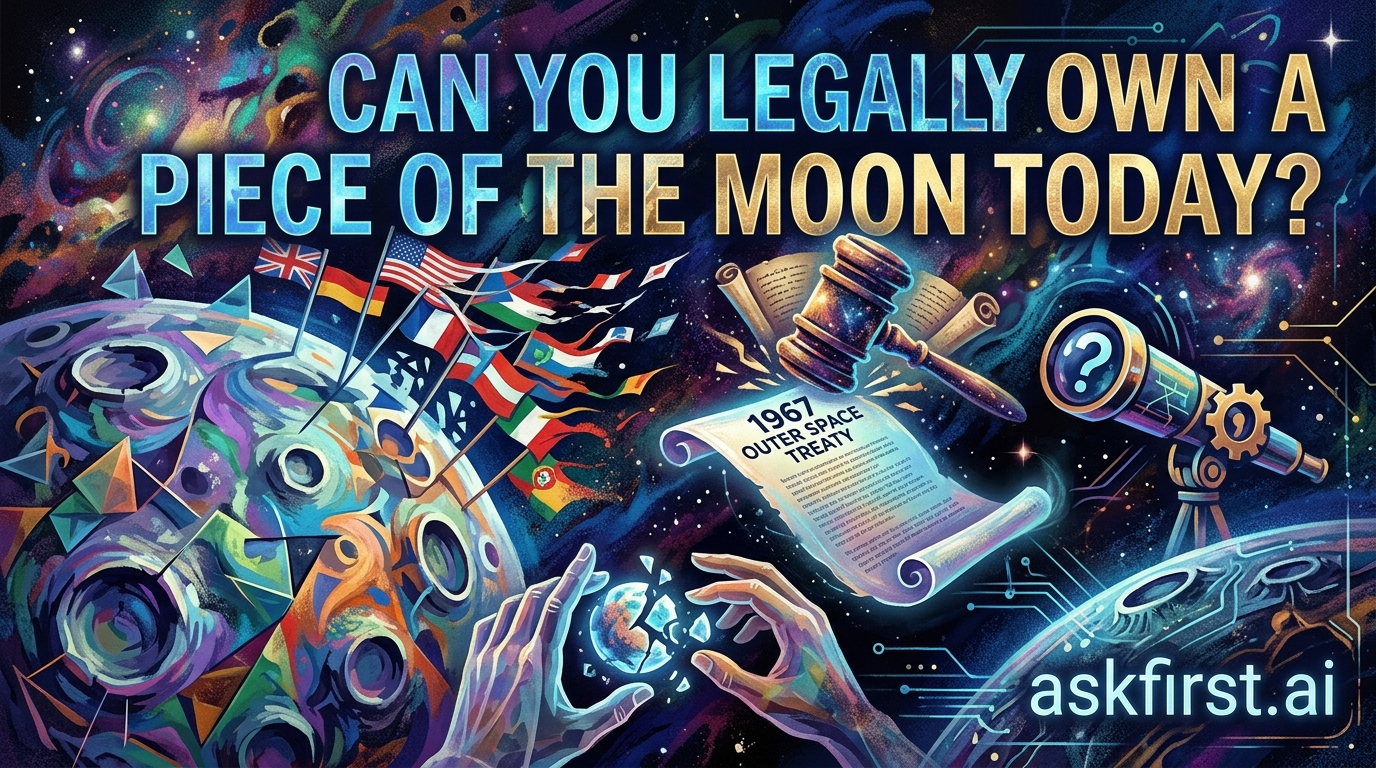
The Legal Landscape of Lunar Sovereignty
For decades, the concept of lunar ownership has captured the collective imagination. Many individuals have encountered websites offering 'deeds' to plots of lunar land, yet the reality remains grounded in international law, which explicitly forbids such claims. The definitive document governing this domain is the Treaty on Principles Governing the Activities of States in the Exploration and Use of Outer Space, including the Moon and Other Celestial Bodies, commonly known as the Outer Space Treaty of 1967.
The Outer Space Treaty: A Framework for Humanity
The Outer Space Treaty serves as the cornerstone of space law. It was drafted at the height of the space race between the United States and the Soviet Union to ensure that space remained a peaceful frontier. Article II of this treaty is the most critical component regarding your question: 'Outer space, including the moon and other celestial bodies, is not subject to national appropriation by claim of sovereignty, by means of use or occupation, or by any other means.'
This language is unambiguous. Because sovereign nations cannot claim the moon, they cannot delegate authority to citizens or corporations to do so. Consequently, any 'deed' purchased from private entities for land on the lunar surface is legally hollow. These certificates hold no standing in any court of law, international tribunal, or government agency.
Why Private Sales Are Considered Novelty Items
If you have purchased a lunar deed, it is categorized as a novelty gift rather than a legal land title. Much like buying a star-naming certificate, these documents are symbolic gestures intended for entertainment or sentimental purposes. They rely on a legal loophole—or rather, a complete lack of a legal framework—for private space development. Because there was no specific mention of private individual property rights in 1967, some enterprising individuals attempted to declare the moon a 'private enterprise' to sell plots. However, international law dictates that domestic property rights cannot exist on land that is legally beyond the jurisdiction of any nation.
The Nuance of Resource Extraction
While owning land is prohibited, the legal status of resources is currently a subject of intense debate. This is where the Artemis Accords and national legislation, such as the U.S. Commercial Space Launch Competitiveness Act of 2015, enter the picture. These policies generally suggest that while one cannot own the moon itself, companies might be permitted to extract, own, and sell resources (like water ice or regolith) found on the moon.
- The Distinction: You cannot own the backyard (the soil), but under evolving interpretation, you might be granted the right to harvest the apples (the resources) from the trees within that yard.
- The Complexity: This creates a 'gold rush' scenario where the legal definitions are being rewritten in real-time as private space exploration becomes technologically feasible.
The Future of Celestial Real Estate
As we look toward 2030 and beyond, the legal framework governing space will likely undergo significant revisions. International organizations, including the United Nations Office for Outer Space Affairs (UNOOSA), are constantly reviewing these treaties to prevent conflict as lunar bases become reality.
Summary of Legal Facts
- No Sovereign Claims: No government can claim the moon, which prevents the establishment of private property laws via government grant.
- Treaty Restrictions: The 1967 treaty binds all major space-faring nations, effectively banning land ownership for individuals.
- Symbolic Status: Documents claiming ownership of lunar land are considered legal nullities and hold zero real-world value or enforcement capabilities.
- Resource Rights: Future discussions will focus on the extraction of minerals and gases, which remains a legally complex grey area distinct from the ownership of the ground itself.
In conclusion, while the dream of owning a piece of the moon is romantic, it is not currently a legal possibility. The moon remains a global common, a shared heritage for all of mankind, preserved by international law from the reach of private ownership. Whether these laws will shift as humanity pivots toward multi-planetary life remains one of the most fascinating questions in modern jurisprudence.