The Legal Reality of Oral Agreements
There exists a pervasive myth in modern society that unless a contract is printed on expensive bond paper and signed with an ink pen, it carries no weight in the eyes of the law. However, the legal landscape surrounding verbal promises is far more nuanced and robust than the average person assumes. In many jurisdictions across the globe, an oral agreement is indeed a legally binding contract, provided it satisfies the fundamental elements required to create an enforceable obligation. Understanding these mechanics is vital for anyone engaging in professional, personal, or financial exchanges.
The Fundamental Requirements of a Contract
For any agreement to be considered a valid contract—whether it is shouted in a hallway or meticulously drafted by high-priced attorneys—four primary components must be present. Without these, even a written contract might fail to hold up in court.
- Offer: One party must clearly state an intent to enter into an agreement with specific terms.
- Acceptance: The other party must agree to those terms exactly as presented.
- Consideration: This is the 'bargained-for exchange.' Something of value must change hands or be promised. It could be money, services, or the forbearance of a legal right.
- Intention to Create Legal Relations: Both parties must intend for the agreement to have legal consequences. Casual social promises, such as promising to meet for coffee, generally do not meet this standard.
The 'Statute of Frauds' Hurdle
While verbal promises are often enforceable, there is a significant exception known as the Statute of Frauds. Originating from English common law, this doctrine dictates that certain types of contracts must be in writing to be legally recognized. While laws vary by region, the following categories typically require a written document:
- Real Estate Transactions: Agreements involving the sale or transfer of land or interests in real property.
- Contracts Lasting Over One Year: If the terms of the agreement cannot logically be performed within a twelve-month period.
- Suretyship: Promises to pay the debt of another person.
- Sale of Goods Over a Certain Value: Under the Uniform Commercial Code (UCC) in the United States, for example, the sale of goods over $500 generally requires written documentation.
If a verbal agreement falls into one of these categories, a court will almost certainly dismiss a breach of contract claim, regardless of the strength of the evidence provided.
The Evidentiary Challenge
If a verbal agreement is legally binding, why is it widely discouraged? The answer is simple: The evidentiary burden.
In a courtroom, a judge or jury must rely on evidence to determine the truth. With a written contract, the evidence is tangible. With a verbal promise, it becomes a 'he-said, she-said' scenario. To prevail in litigation involving a verbal agreement, the plaintiff must provide secondary evidence to support their claims. This may include:
- Partial Performance: Showing that actions were taken in accordance with the agreement (e.g., paying a deposit or beginning work).
- Communication Trails: Emails, text messages, voicemails, or social media interactions that reference the deal.
- Witness Testimony: Third parties who were present when the agreement was made.
- Past Conduct: Documented histories of similar dealings between the two parties.
Proving the Promise
Proving the existence of a verbal agreement requires a strategic approach to evidence. Without a paper trail, the court must perform a credibility assessment. They will look at the consistency of the narratives provided by both parties. If a party acted in a way that is inconsistent with the existence of a contract, their case will suffer. Conversely, if a party performed tasks or made payments that only make sense in the context of the alleged agreement, the court is far more likely to enforce it.
Best Practices for Protection
While knowing that oral promises are enforceable provides a layer of legal comfort, relying on them is rarely a prudent business strategy. To ensure maximum protection, adopt the following practices:
- The Follow-Up Email: Whenever a verbal agreement is made, immediately follow up with an email stating, 'As we discussed earlier, I understand the terms of our agreement to be X, Y, and Z.' If the other party does not object, this serves as strong written evidence of the verbal promise.
- Documentation of Payments: Always use traceable methods for payments, such as bank transfers or checks with clear memos.
- Third-Party Witnesses: Where possible, ensure important negotiations occur in the presence of a neutral third party.
Conclusion
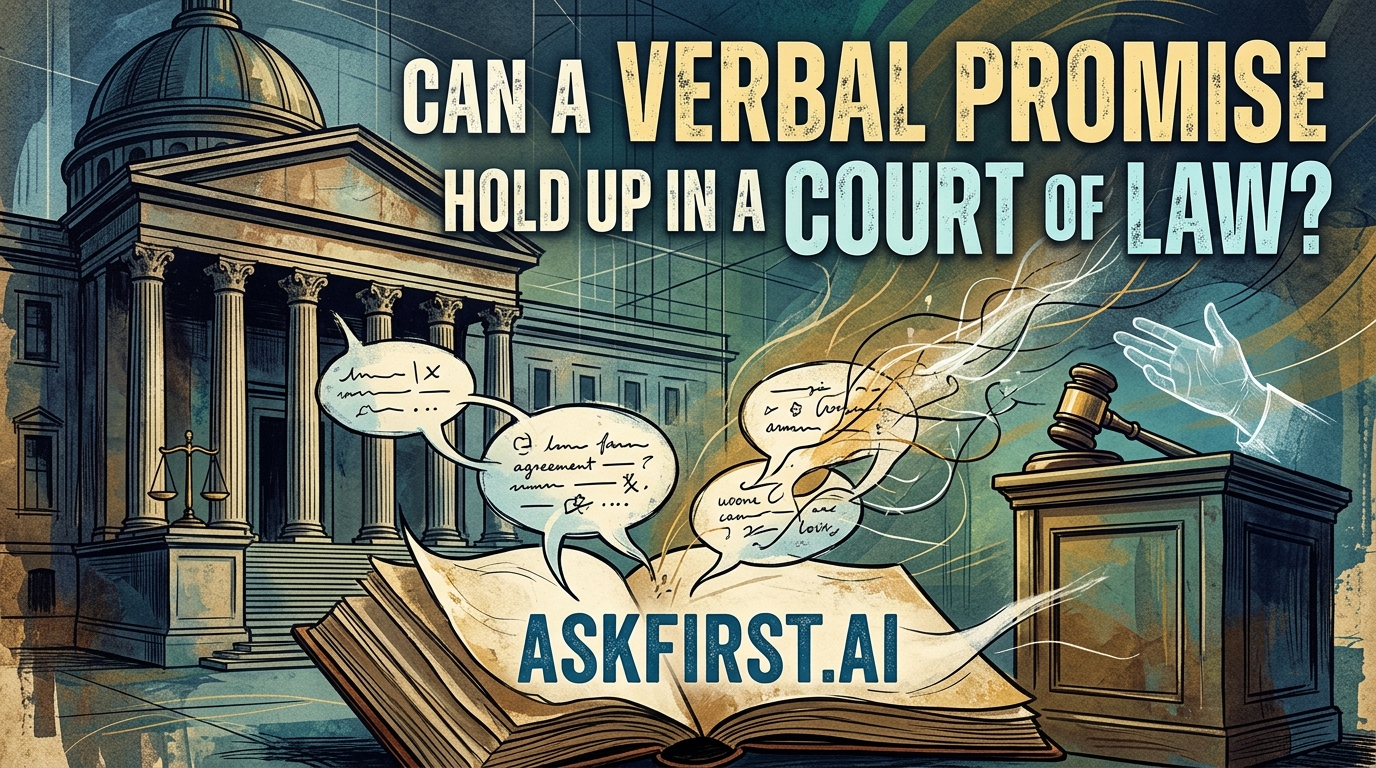
Can a verbal promise hold up in court? Absolutely. The law prioritizes the substance of an agreement over its form. However, the practical difficulty of proving that promise makes written contracts the gold standard for certainty. Treat verbal agreements with caution, document your interactions, and always remember that while a handshake can seal a deal, a signature provides the peace of mind necessary for long-term security.