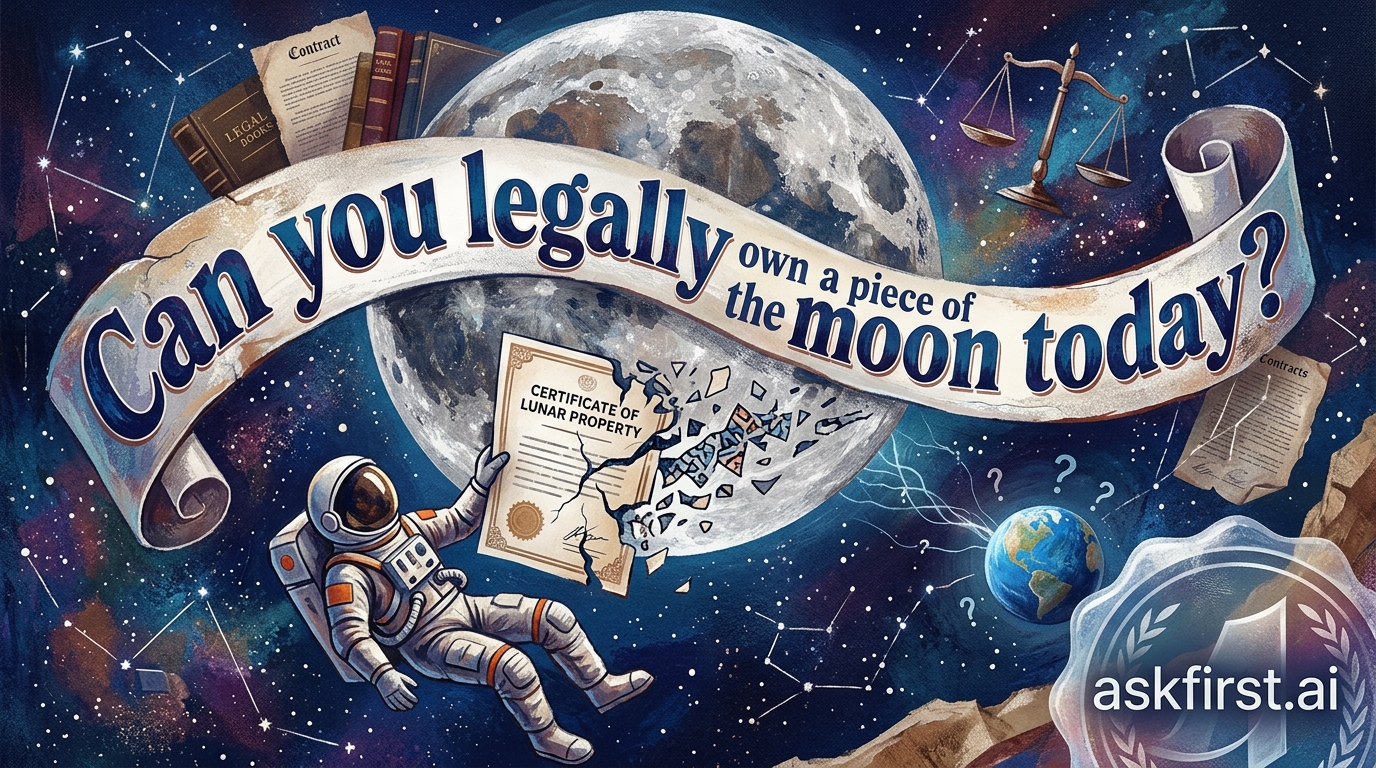
The Legal Landscape of Lunar Ownership
For decades, the concept of owning a piece of the moon has fascinated dreamers, entrepreneurs, and armchair astronomers alike. However, when exploring the question, 'Can you legally own a piece of the moon today?', one must navigate a complex web of international treaties, historical precedent, and property law. The short answer is a definitive 'no' in terms of sovereign territory, though the nuances regarding lunar soil and artifacts create a fascinating legal gray area.
The Outer Space Treaty of 1967
The foundation for lunar law rests primarily on the Treaty on Principles Governing the Activities of States in the Exploration and Use of Outer Space, including the Moon and Other Celestial Bodies, commonly known as the Outer Space Treaty. Adopted by the United Nations in 1967, this document serves as the 'constitution' for space law. Article II of this treaty is categorical: 'Outer space, including the moon and other celestial bodies, is not subject to national appropriation by claim of sovereignty, by means of use or occupation, or by any other means.'
This means that no nation can declare the moon, or any part of it, as its sovereign territory. Consequently, if a nation cannot own the land, it cannot legally grant land titles or deeds to its citizens. Any company or website claiming to sell you 'an acre of the moon' is engaging in a novelty transaction that holds zero legal weight in any court of law. These 'deeds' are effectively decorative documents rather than enforceable property rights.
Distinguishing Land from Samples
While claiming territory is forbidden, the possession of actual lunar material presents a different challenge. During the Apollo missions, the United States brought back several hundred kilograms of lunar rock and soil. These materials are technically property of the U.S. government, held in trust for scientific study. Under international law, space objects launched into space remain under the jurisdiction of the launching state. However, private ownership of lunar 'meteorites'—rocks that naturally ejected from the moon and fell to Earth—is perfectly legal.
Because these pieces of the moon arrived on Earth without human intervention, they are treated similarly to rare gemstones or mineral deposits found on land. Collectors can, and often do, purchase genuine lunar meteorites through reputable auction houses. These pieces provide a tangible, albeit tiny, connection to the lunar surface that is entirely legal to own, possess, and display. This represents the only legitimate way for an individual to own a 'piece of the moon.'
The Future of Space Resource Mining
The landscape is currently shifting due to the rise of the commercial space industry. In 2015, the United States passed the SPACE Act, which allows American citizens and companies to extract, own, and sell resources harvested from space, such as water ice or rare minerals. Other nations, including Luxembourg and the United Arab Emirates, have followed suit with similar domestic legislation.
Critics argue this might violate the spirit of the Outer Space Treaty by allowing entities to claim resources rather than land. Proponents, however, distinguish between 'appropriation of celestial bodies' (which remains banned) and 'utilization of space resources' (which they view as permissible). This distinction is critical: owning a shovel full of lunar regolith for mining purposes is being treated increasingly like deep-sea fishing—you don't own the ocean, but you own the fish you catch.
Why the Myths Persist
Despite the clear legal boundaries, the industry of selling lunar 'land' thrives on curiosity and the romanticism of the cosmos. These companies operate within the bounds of consumer protection laws by stating that their deeds are for novelty purposes only. The psychological hook is powerful: the moon remains the final frontier. Buying a certificate feels like buying a stake in the future of humanity, even if that stake exists purely in the imagination.
Summary of Legal Standing
- Land Ownership: Impossible. No nation or individual can hold title to lunar land.
- Novelty Deeds: Legally meaningless. They offer no sovereignty or property rights.
- Lunar Meteorites: Legal. If a piece of the moon falls to Earth naturally, it is considered private property.
- Resource Extraction: An evolving legal frontier. While land cannot be claimed, individual companies are seeking the right to own the materials they extract from the surface.
In conclusion, while one cannot purchase a plot of the moon, the ongoing evolution of international space law suggests that the definition of ownership is being tested. As humanity moves closer to a permanent presence on the lunar surface, the rules established in 1967 will face their greatest test yet, likely leading to new frameworks that balance private enterprise with the shared heritage of all mankind.