The Future of Jurisprudence: Can Artificial Intelligence Replace Human Litigators?
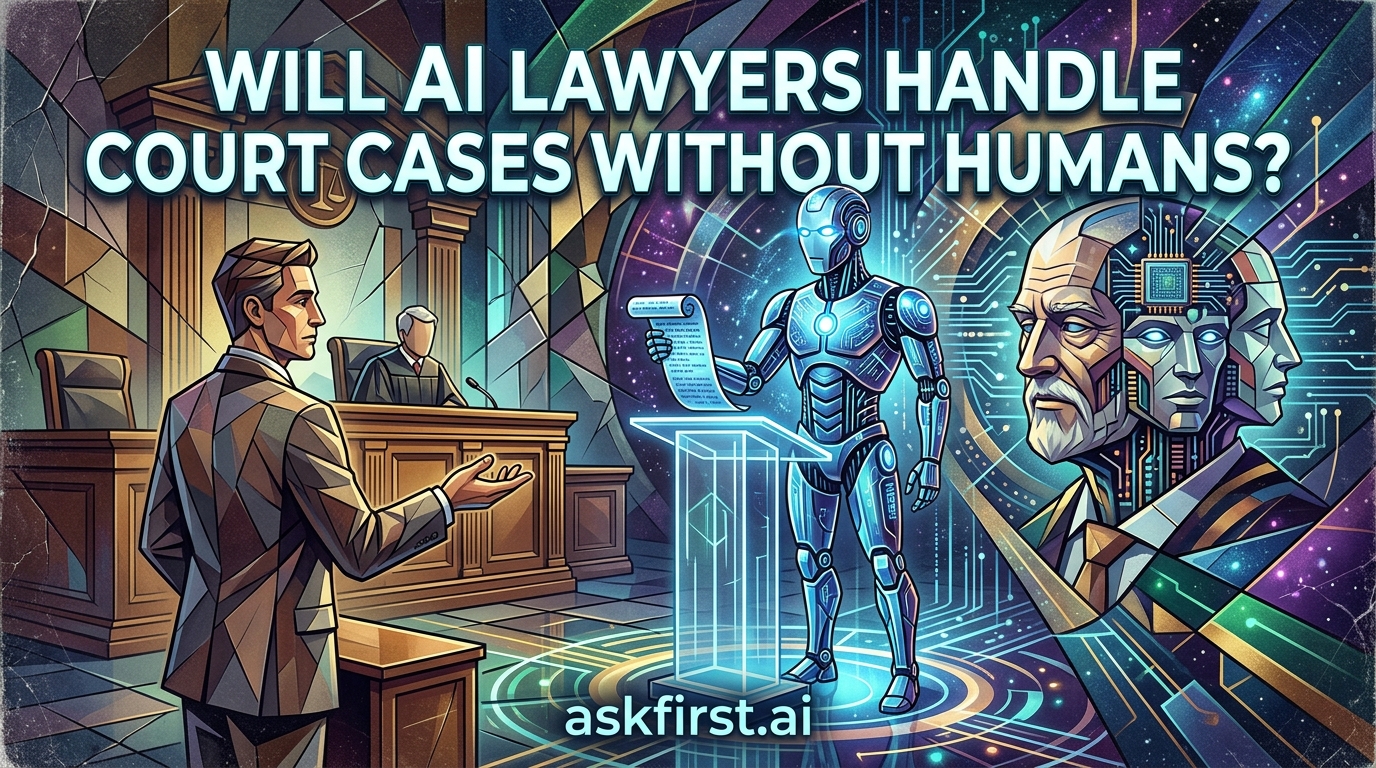
The legal profession, long considered a bastion of human intellect, tradition, and nuanced argumentation, is currently undergoing a seismic shift. As we stand in May 2026, the integration of advanced machine learning and Large Language Models (LLMs) into legal workflows has moved beyond mere document review or basic contract drafting. However, the question of whether an "AI lawyer" could independently argue a case in a court of law without human oversight remains one of the most contentious debates in modern jurisprudence. To understand the viability of this transition, we must dissect the nature of advocacy, the constraints of the current judicial framework, and the technical limitations of algorithmic reasoning.
The Evolution of Legal Automation: From Research to Reasoning
Historically, legal technology focused on "e-discovery"—the process of identifying and reviewing vast datasets of emails and documents. Tools like Relativity and Kira Systems transformed how associates spend their time. Today, we have moved into the era of "Generative Legal AI." Systems capable of drafting complex motions, predicting judicial outcomes, and analyzing precedents in seconds are now standard in top-tier firms.
In his seminal work The Future of the Professions, authors Richard Susskind and Daniel Susskind argue that legal work is increasingly being "decomposed." They posit that as tasks become standardized, they are inevitably automated. While this holds true for back-office functions, the courtroom is a different environment. A court case is not merely an exercise in data retrieval; it is a performance of rhetoric, ethics, and human empathy—elements that currently lack a mathematical equivalent.
The "Black Box" Problem and the Right to Due Process
The primary barrier to an AI-only courtroom is the constitutional and procedural requirement of "due process." In the United States, the Sixth Amendment guarantees the right to the assistance of counsel. This implies a human-to-human relationship defined by professional responsibility.
If an AI were to represent a client, the "Black Box" problem becomes a legal nightmare. When a machine provides a legal strategy, it often cannot explain the causal chain of its reasoning in a way that satisfies the evidentiary standards of a court. Judges require transparency. If an AI suggests a novel legal theory, the opposing counsel must be able to cross-examine the logic. Because deep learning models operate through probabilistic patterns rather than deductive legal logic, they lack the "duty of candor" required by the American Bar Association (ABA) Model Rules of Professional Conduct. An AI cannot be disbarred, it cannot be held in contempt, and it cannot experience the moral weight of a client’s potential incarceration or financial ruin.
The Human Element: Rhetoric and Judicial Discretion
Legal scholars like Lawrence Lessig, in Code and Other Laws of Cyberspace, have long noted that code can act as a regulator, but it cannot fully replicate the socio-political environment of a courtroom. A trial is a human drama. Jurors and judges are influenced by tone, timing, body language, and the ability to read the room.
Consider a criminal defense scenario. A human lawyer does not merely cite statutes; they plead for leniency, contextualize the defendant’s life history, and establish a rapport with the jury. AI, regardless of its sophistication, is a "stochastic parrot"—it predicts the next likely word based on training data. It does not "understand" justice or mercy. If a judge is having a bad day or if a witness is clearly lying despite a lack of physical evidence, a human lawyer’s intuition is irreplaceable. The ability to pivot mid-trial based on the emotional temperature of the courtroom is a distinctly human trait that algorithms have yet to replicate.
Concrete Examples of Current Limitations
We have already seen the risks of over-reliance on AI in court. In the 2023 case Mata v. Avianca, a lawyer famously used ChatGPT to draft a filing, only to find that the AI had invented non-existent legal precedents—a phenomenon known as "hallucination." This serves as a stark reminder: AI is a tool, not a practitioner. Even as models improve, the legal system requires an "accountability sink." Someone must sign the brief. Someone must be liable for malpractice. Without a human entity at the helm, the legal system would collapse into a landscape of unchecked, automated litigation where no one bears responsibility for errors.
Conclusion: The Collaborative Future
Will AI lawyers handle cases without humans? The answer is a definitive "no," at least in the foreseeable future. The role of the lawyer is shifting from that of a "legal researcher" to a "legal architect and strategist."
We are moving toward a hybrid model. AI will provide the heavy lifting—summarizing thousands of pages of testimony, identifying subtle inconsistencies in evidence, and drafting preliminary motions with superhuman speed. However, the human lawyer will remain the "pilot." The lawyer provides the ethical framework, the strategic intuition, and the final human judgment that is required to navigate the adversarial process. In the courtroom of 2026 and beyond, the most successful practitioners will not be those who compete with AI, but those who harness its power to amplify their own capacity to pursue justice. The human element is not a bug in the legal system; it is the essential feature that ensures the law remains a tool for people, by people.