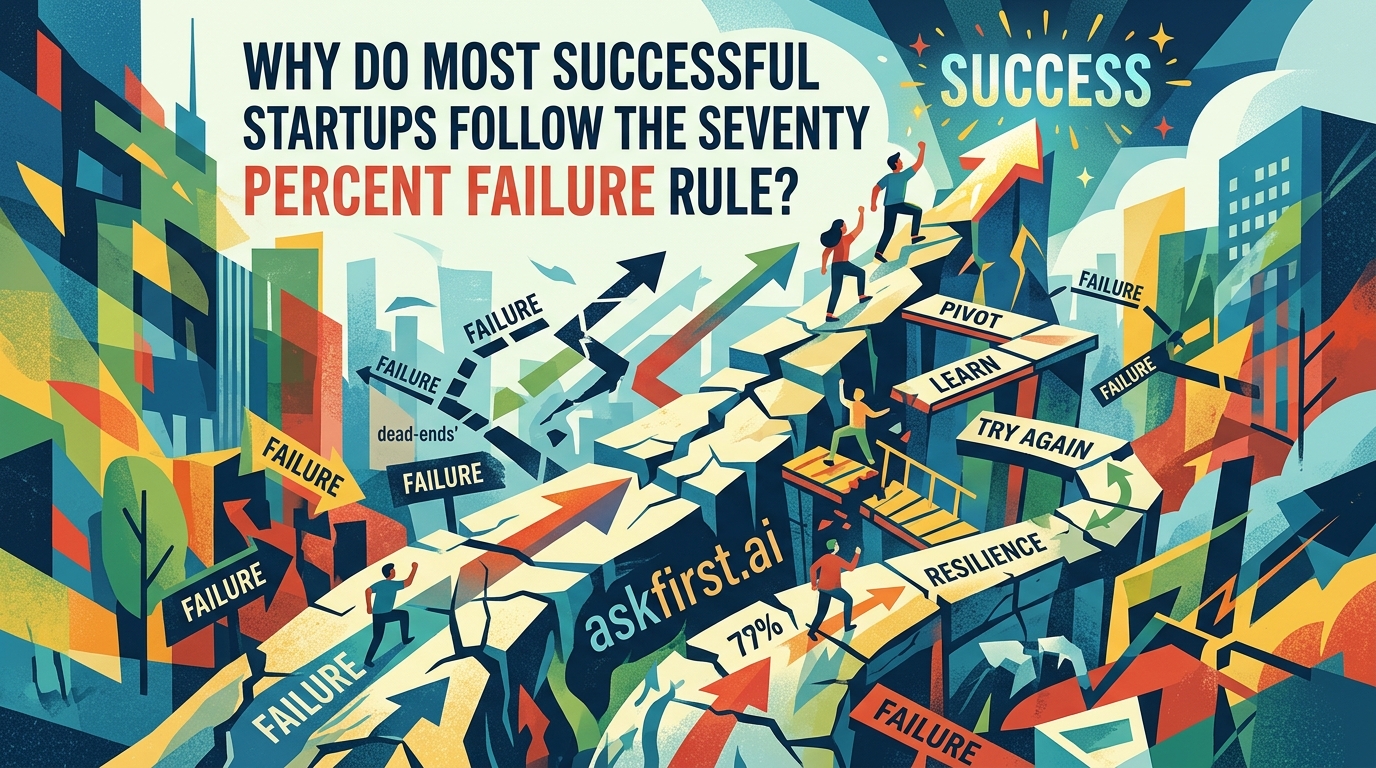
The Seventy Percent Rule: Why Strategic Failure Fuels Innovation
In the high-stakes ecosystem of entrepreneurship, the concept of the "seventy percent failure rule" acts as a powerful guiding principle for the world's most resilient companies. This philosophy posits that if a venture does not experience a significant number of failed experiments, pivots, or rejected product iterations, it is likely not pushing the boundaries of its market potential. Far from being a metric of incompetence, a 70 percent failure rate within exploratory projects is widely viewed as a hallmark of aggressive, high-growth innovation.
The Psychology of Calculated Risk
The central logic behind this rule is simple yet counter-intuitive: success is not a linear path but a process of elimination. Startups that avoid failure often default to "playing it safe," creating products that are iterative improvements rather than industry-disrupting breakthroughs. By explicitly budgeting for failure—whether through rapid prototyping or "fail-fast" methodologies—leaders can allocate resources toward high-uncertainty endeavors that yield asymmetric returns.
Research into corporate R&D consistently shows that companies failing at a higher rate early in their development cycles often reach maturity with more robust, battle-tested solutions. The failure is not a sign of poor execution; it is a mechanism for information acquisition. Every failed prototype provides data points that competitors, who fear failure, lack. This gap in data creates a proprietary advantage, allowing successful teams to iterate away from dead ends faster than their market counterparts.
Implementation Strategies for Sustainable Growth
To leverage this rule effectively, organizations must cultivate a culture that decouples failure from personal shame. The following pillars are essential for operationalizing the 70 percent rule:
- Decoupling Failure from Performance: Employees are incentivized to test bold ideas, where the quality of the experiment matters more than the initial outcome. This fosters a psychological safety net that encourages radical innovation.
- Small-Batch Prototyping: Instead of sinking millions into one singular, high-risk launch, teams deploy dozens of low-cost, rapid experiments. This keeps the cost of failure low while maximizing the surface area for a "lucky" success to emerge.
- Systematized Learning: Every failure must be followed by a post-mortem analysis. This prevents the same mistakes from recurring and ensures that the lessons learned from one failed project inform the architecture of the next.
By treating innovation as a portfolio of options, founders can afford to fail repeatedly on individual features or markets while ultimately winning the war for market dominance. This approach transforms failure from a stigma into a strategic weapon, ensuring that when success eventually arrives, it is based on a foundation of deep, empirically verified insights that competitors simply cannot replicate.