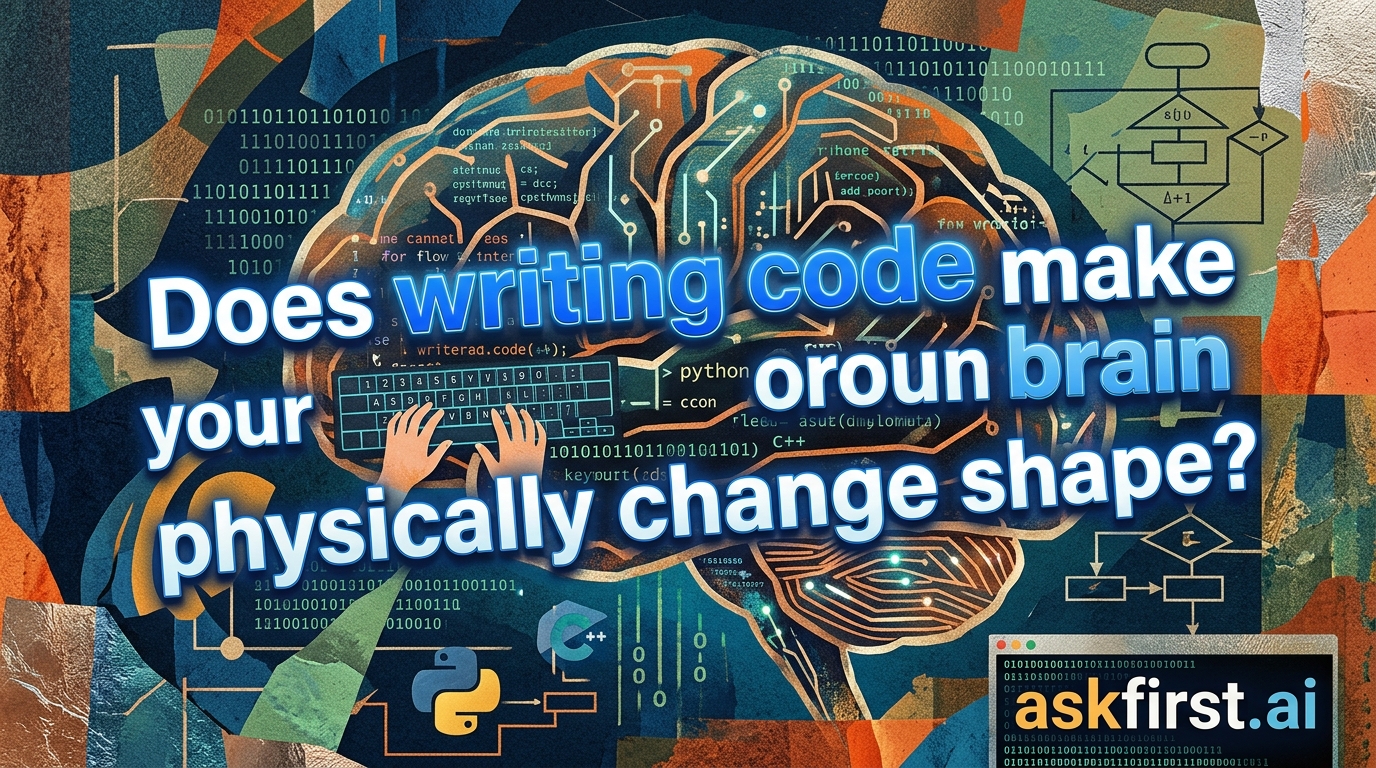
The Neuroplasticity of Programming: Rewiring the Human Brain
Recent advancements in neuroscience have debunked the long-standing belief that the adult brain is a static organ. Instead, it is highly dynamic, characterized by a property known as neuroplasticity—the brain's ability to reorganize itself by forming new neural connections throughout life. When individuals engage in complex, cognitively demanding activities like computer programming, the brain undergoes measurable structural and functional changes. These changes are not metaphorical; they are physical modifications in white matter integrity and grey matter density.
The Mechanisms of Structural Change
Programming requires a unique synthesis of logic, language acquisition, and spatial reasoning. Researchers studying the brains of professional software engineers have observed distinct adaptations in regions responsible for executive function and working memory. The Prefrontal Cortex (PFC), the brain's command center for decision-making and complex problem-solving, shows increased efficiency and synaptic density in proficient coders. Furthermore, the Parietal Lobe, which governs spatial awareness and mathematical processing, often exhibits localized thickening as a result of consistent abstract modeling and algorithmic design.
- White Matter Integrity: Through repetitive practice, the brain reinforces neural pathways. Myelin, the fatty sheath that insulates neurons, becomes thicker, leading to faster electrical impulses. Studies suggest that programmers develop highly efficient 'highways' of communication between the left hemisphere (linguistic processing) and the right hemisphere (spatial pattern recognition).
- Grey Matter Density: Engaging in intense debugging or architectural design stimulates neurogenesis in specific areas. Just as a weightlifter builds muscle mass through resistance, a coder builds 'cognitive mass' by constantly navigating the hierarchy of complex systems.
Syntax as Language: The Linguistic Bridge
One of the most fascinating aspects of coding is how it utilizes both linguistic and logic centers simultaneously. Neuroimaging studies, such as those performed using fMRI (functional Magnetic Resonance Imaging), indicate that reading code does not activate the same brain regions as reading prose. Instead, it creates a unique activation pattern that involves the Frontal Gyrus and the Temporal Gyrus. This implies that the brain essentially learns to interpret a third category of language that sits at the intersection of logical sequence and symbolic communication.
The Impact of 'Deep Work' on Neural Architecture
Programming necessitates periods of intense focus, often referred to as 'the flow state' or 'deep work.' During these sessions, the brain minimizes noise and allocates significant resources to the task at hand. Consistent entry into this state of hyper-focus contributes to:
- Increased Working Memory Capacity: Coders must hold multiple functions, variables, and potential edge cases in their minds simultaneously. This constant 'juggling' trains the brain to expand its temporary storage, effectively improving short-term memory.
- Enhanced Pattern Recognition: The brain develops shortcuts for identifying bugs or optimal structures. This is a physical shift in how the hippocampus and the cortex communicate to recall previous experiences and match them with current syntax patterns.
- Improved Cognitive Flexibility: Adapting to new programming paradigms or refactoring legacy code requires the ability to shift perspective rapidly. The brain learns to break rigid thought patterns, strengthening the neural pathways that allow for creative problem-solving.
Are the Changes Permanent?
Neuroplasticity is a use-it-or-lose-it phenomenon. The structural modifications observed in programmers are consistent with findings in other complex skill-acquisition domains, such as learning a musical instrument or becoming proficient in a second language. If a coder ceases to practice for an extended period, the synaptic density and white matter thickness can regress. However, the foundational improvements to the brain's processing speed and the refinement of problem-solving schemas often remain as enduring cognitive assets.
Conclusion: The Architect of One's Own Mind
Writing code is not merely a professional skill; it is an exercise in biological engineering. By intentionally challenging the brain with abstract logic, syntax, and complex systems, programmers are literally sculpting their neural architecture. These changes underscore a profound truth: the brain is not a finished product, but a work in progress. Whether solving a recursive loop or debugging a complex multi-threaded system, every line of code contributes to a more resilient, efficient, and interconnected neurological landscape. In this sense, every programmer is an architect, not only of digital infrastructure but of their own cognitive capability.