The Psychology of the 'Norman Door' Phenomenon
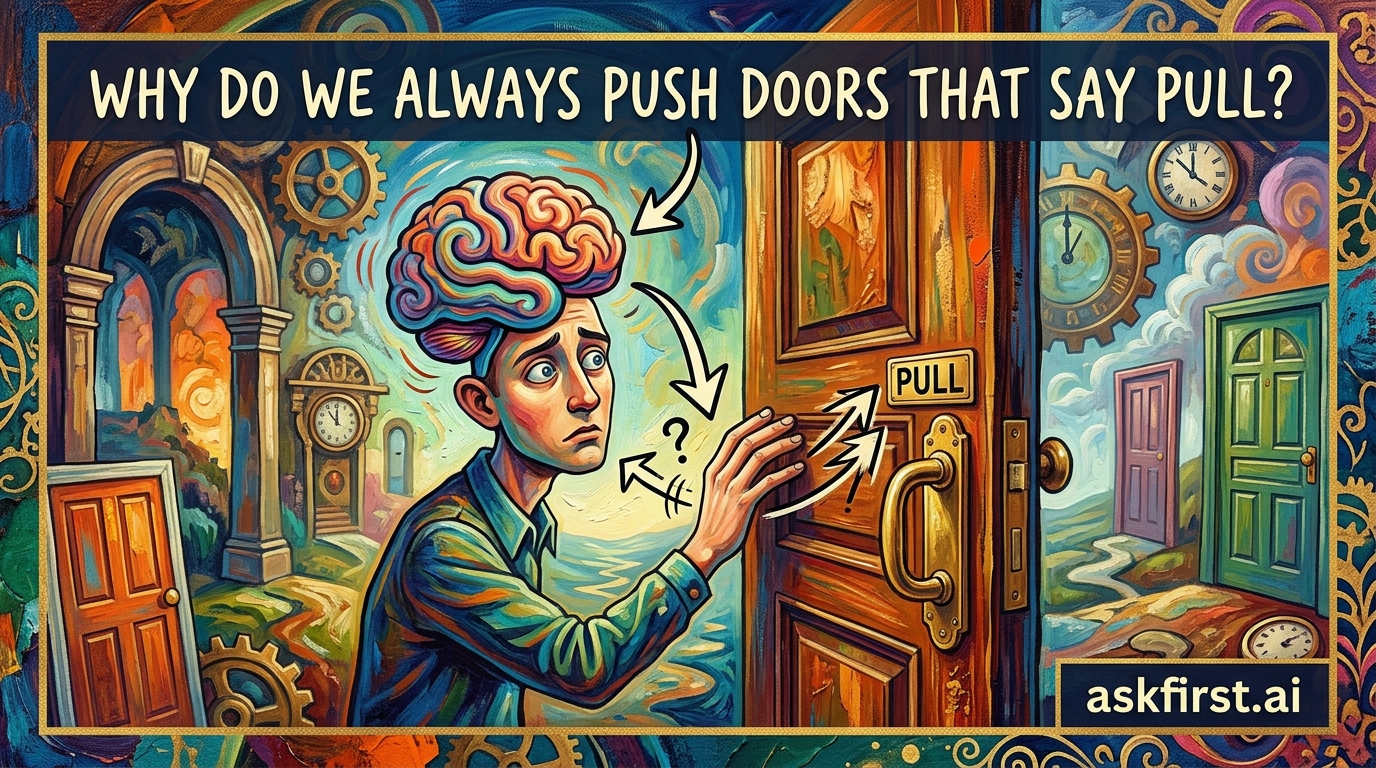
Human interaction with everyday objects is governed by the principles of cognitive psychology and environmental design. When an individual approaches a door and instinctively pushes it despite a sign clearly indicating 'pull,' they are experiencing a failure in intuitive design, famously categorized by cognitive scientist Don Norman as a 'Norman Door.' This phenomenon occurs because our brains rely on visual affordances rather than textual instructions.
The Role of Affordances in Human Cognition
Affordances are properties of an object that communicate how it should be used. A handle suggests pulling, while a flat plate suggests pushing. When a door features a vertical bar or handle, the human brain automatically perceives it as an object meant to be gripped and pulled. If that specific door is designed to be pushed, the designer has created a conflict between the object’s physical appearance and its functional reality. This mismatch forces the brain to override its intuitive, rapid processing system—System 1—in favor of the slower, more deliberate System 2, which involves reading signs. Under stress or in a distracted state, humans almost always default to the visual signal provided by the hardware.
The Failure of Signage as a Solution
Placing a 'Pull' sign on a door that has a handle is a classic example of 'design failure disguised by signage.' If a user must be told how to operate an object, the design is inherently flawed. Research in ergonomics suggests that:
- Visual Hierarchy: Signs are often ignored because the visual weight of the handle is significantly greater than the visual weight of a small sticker.
- Mental Models: Humans develop mental models based on years of successful experiences. If 90% of the doors one encounters work a certain way, the brain will generalize that rule to all doors, leading to automated, incorrect behaviors.
- Cognitive Load: In busy environments, the brain seeks to minimize the energy spent on mundane tasks. Reading signs requires higher cognitive effort than simply reacting to a handle.
Architectural Design and Behavior Modification
Architects and industrial designers are increasingly aware of these behavioral patterns. To mitigate the frustration of the 'push-pull' confusion, modern design standards emphasize clear physical feedback loops. If a door is meant to be pushed, the design should utilize a flat kick plate with no protruding handle. By removing the temptation to pull, the designer eliminates the possibility of user error without requiring any text at all. This is known as 'forcing functions,' where the design makes it physically impossible to take the wrong action.
The Cultural Context of Expectation
Cultural habits also play a significant role. In regions where buildings are primarily designed with specific egress patterns, inhabitants develop ingrained motor habits. If a person is conditioned by their environment to expect a certain type of hardware, they will approach a door with that specific expectation. This 'habit loop' is so strong that even a bright, neon-colored sign may not prevent the instinctive push, as the motor cortex initiates the action before the visual cortex has finished processing the text.
Design Evolution and Future UX
As we look toward the future of smart infrastructure, the focus is shifting toward 'invisibly intuitive' environments. The goal is to create spaces where human action aligns perfectly with intended functionality. This involves:
- Standardization: Implementing universal hardware codes where specific shapes strictly dictate the required motion.
- Proximity Sensing: Replacing manual push-pull doors with automated sensors, removing the human-door interface entirely.
- Tactile Cues: Using texture and material to signal functionality before the user even reaches for the door.
Conclusion
Ultimately, the urge to push a 'pull' door is not a sign of personal clumsiness or a lack of attention. It is a testament to the power of intuitive design. When an object’s physical cues contradict its instructions, the subconscious brain will almost always trust the design over the text. By understanding these cognitive traps, designers can create environments that respect the way humans perceive the world, leading to a smoother, less frustrating experience for everyone. The next time you find yourself pushing a pull door, recognize that the error lies in the hardware, not in the person using it.