The Neural Construction of Dreamscapes
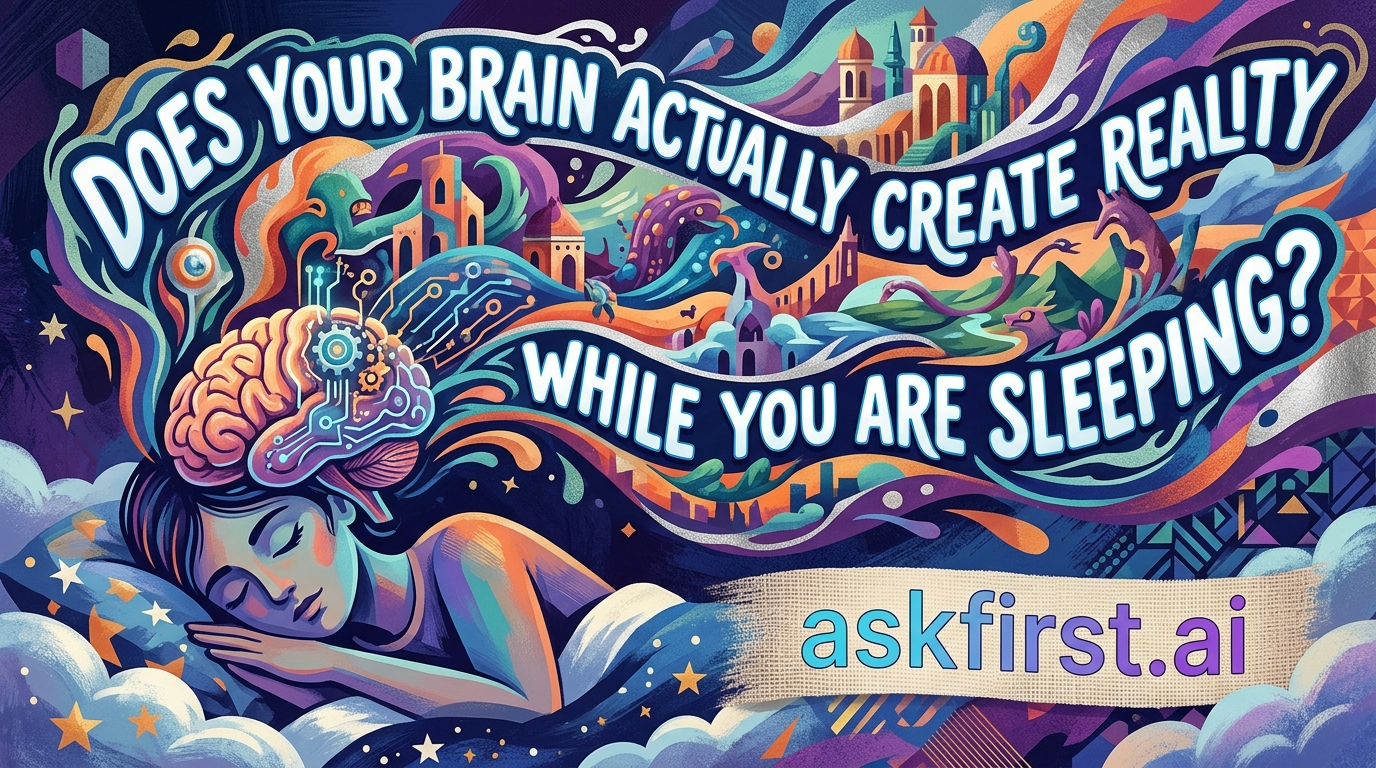
To understand whether the brain creates reality during sleep, one must first dismantle the common assumption that waking consciousness is a passive recording of the outside world. In reality, both waking and sleeping states represent a constructive process. When a person is awake, sensory input acts as a grounding wire, constraining the brain's internal models to match external stimuli. During sleep, specifically REM (Rapid Eye Movement) sleep, these external constraints vanish. The brain, freed from sensory input, enters a state of internal simulation where it constructs a vivid, multi-sensory reality that feels entirely authentic to the dreamer.
The Neurobiology of the Internal Cinema
The phenomenon of dreaming is governed by complex shifts in neurochemistry and regional brain activity. During REM sleep, the dorsolateral prefrontal cortex—the area responsible for logic, self-awareness, and critical thinking—becomes significantly deactivated. Simultaneously, the amygdala (the center for emotional processing) and the hippocampus (crucial for memory) remain highly active. This combination explains why dreams often feel surreal yet intensely emotional. The brain is effectively 'telling itself a story' by pulling fragments of autobiographical memories and weaving them into coherent narratives without the 'filter' of rational doubt.
Is Dream-Reality 'Real'?
From a phenomenological perspective, reality is defined by the experiences an individual undergoes. If 'reality' is defined as the subjective experience of existing within a space, feeling sensory input, and observing events, then the brain is absolutely creating a reality while sleeping. Studies utilizing functional Magnetic Resonance Imaging (fMRI) have shown that the visual cortex, the motor cortex, and the language processing areas of the brain activate in ways during dreams that mirror their activity during waking life.
- Sensory Mimicry: The brain simulates light, sound, and touch, forcing the consciousness to accept these as external truth.
- Narrative Synthesis: The brain utilizes predictive coding models to anticipate events, creating a consistent temporal flow even when the physics of the 'world' within the dream defy real-world laws.
Memory Consolidation and Simulation
Many experts, including proponents of the Threat Simulation Theory, argue that this nightly reality construction serves an evolutionary purpose. By simulating scenarios—ranging from social interactions to physical dangers—the brain is engaged in a sophisticated form of offline training. This is not merely 'hallucination' in a negative sense; it is a high-level cognitive function designed to sharpen survival skills, stabilize emotional regulation, and solidify long-term memory structures.
Key Mechanisms of the Sleeping Reality
- Active Inference: The brain acts as a prediction engine. It constantly generates hypotheses about the world. During sleep, these hypotheses are uncoupled from sensory data, allowing the brain to test models of reality that are not bound by mundane logic.
- The Role of PGO Waves: Pontine-Geniculate-Occipital (PGO) waves are burst-like neural signals that originate in the brainstem and travel to the visual cortex. These are thought to be the triggers for the vivid imagery experienced during REM sleep, essentially 'injecting' visual data into the consciousness without external input.
- Neuroplasticity and Synthesis: Sleep allows for the reorganization of synaptic connections. The 'reality' created in a dream may also reflect the brain's efforts to categorize new information, creating symbolic representations that facilitate learning.
The Boundary Between States
Philosophers and neuroscientists increasingly view the waking state as a 'controlled hallucination' and the dream state as an 'uncontrolled hallucination.' In both states, the brain is effectively modeling an environment. The crucial difference lies not in the mechanism of creation, but in the source of data. Waking life relies on sensory feedback to keep the brain's internal model tethered to common physical constants. Sleep releases those anchors, allowing the brain to inhabit a reality of its own creation.
Ultimately, the brain is an organ defined by its capacity to project and simulate. The experience of reality is a byproduct of neural computation. Whether one is watching a sunset in the physical world or flying over a cityscape in a dream, the seat of the experience remains identical. The brain does not simply perceive reality; it weaves it out of electrical impulses, and while you sleep, it simply chooses to weave without the thread of the external world.