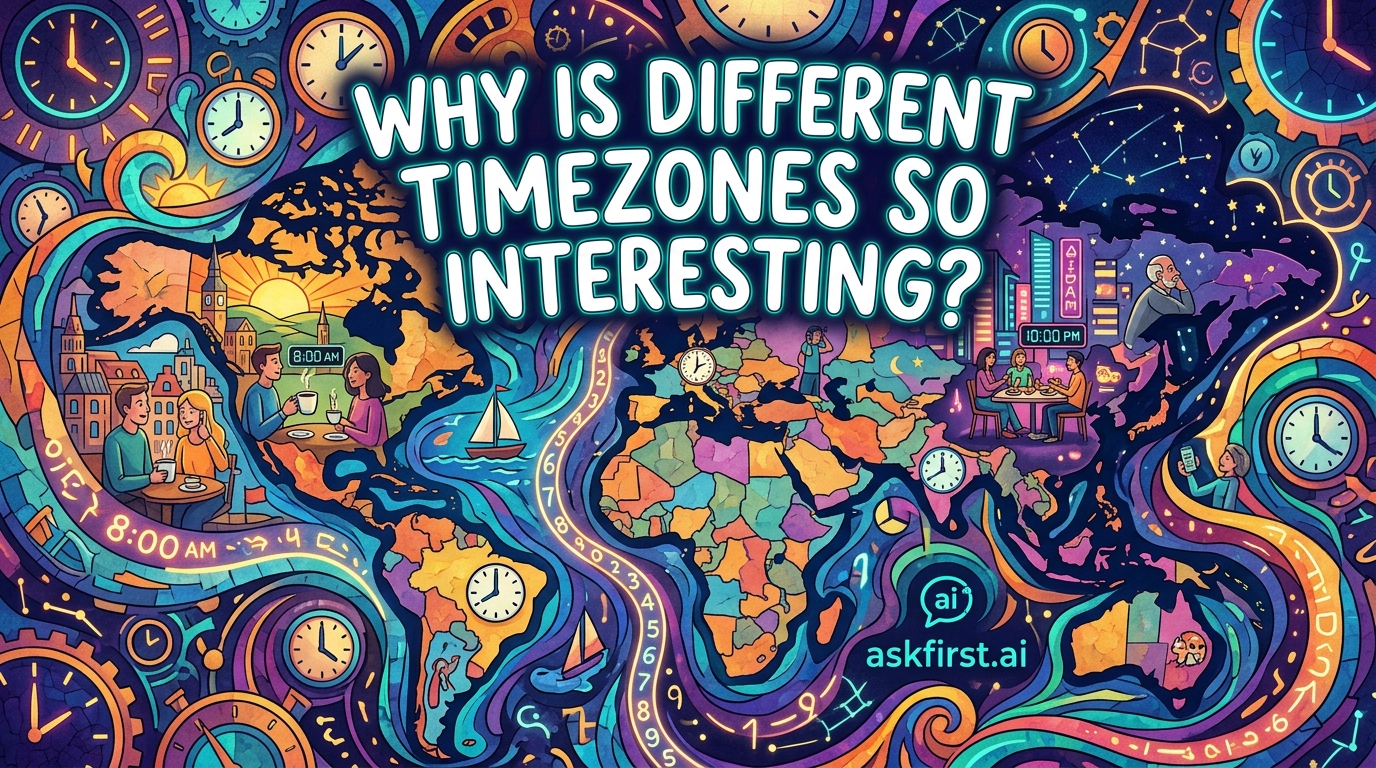
The concept of time zones is far more than a mere administrative necessity for global commerce; it is a profound intersection of celestial mechanics, human psychology, and the socio-political evolution of our species. To understand why time zones are inherently fascinating, one must look beyond the clock on the wall and consider the intricate dance between the Earth’s rotation and the way we have collectively decided to interpret that motion.
The Celestial Foundation: Earth as a Rotating Sphere
At the heart of the matter lies the simple, yet transformative, fact that the Earth is a rotating sphere. Because the planet rotates 360 degrees every 24 hours, it moves at a rate of 15 degrees of longitude per hour. This physical reality creates a "traveling noon"—a point where the sun reaches its zenith—that sweeps across the globe.
Before the mid-19th century, time was entirely local. In his seminal work Longitude: The True Story of a Lone Genius Who Solved the Greatest Scientific Problem of His Time, Dava Sobel illustrates how navigation and timekeeping were inextricably linked. Every town in England, for instance, once set its clocks to "local mean time," meaning that when it was noon in London, it might be 12:05 in Bristol. This was a nightmare for the burgeoning railway industry. The fascination lies in how humanity transitioned from these fragmented local realities to a standardized, synchronized global grid, effectively "taming" the sun to fit the requirements of modern infrastructure.
The Psychological Impact of "Time Travel"
Time zones offer a unique, near-magical experience that humans can engage in physically: the ability to "travel through time." When you cross a time zone boundary, you are essentially adjusting your relationship with the solar cycle.
Consider the phenomenon of flying westward across the Atlantic. By gaining hours, travelers often experience a strange, dilated sense of existence where a single day seems to stretch indefinitely. Conversely, traveling eastward feels like a theft of time. This psychological adjustment is the basis of jet lag, a biological rebellion against our artificial clocks. The interest here stems from the tension between our internal circadian rhythms—governed by the suprachiasmatic nucleus in the brain—and the rigid, arbitrary lines drawn on maps by governments. We are biological organisms trying to function in a world of political time.
Political Cartography and the "Social Construction" of Time
One of the most captivating aspects of time zones is how they reveal the influence of politics over nature. Time zones are not always straight lines. If they were, they would follow the lines of longitude perfectly. Instead, they zig-zag, bend, and curve to accommodate national borders, economic zones, and political ideologies.
A perfect example is the People’s Republic of China. Despite its massive geographical span—which should technically encompass five distinct time zones—the entire country operates on "Beijing Time." This creates surreal scenarios in the western province of Xinjiang, where the sun might not rise until 10:00 AM in the winter. This is a stark reminder that time is not just a scientific constant; it is a tool of statecraft. As author Benedict Anderson noted in Imagined Communities, the synchronization of time is a vital component of forging a unified national identity. By forcing a continent-sized nation to live by a single clock, the state exerts a powerful, invisible influence on the lives of its citizens.
Extreme Anomalies: The International Date Line and Beyond
The fascination deepens when we look at the edges of the system. The International Date Line, zig-zagging through the Pacific, is the ultimate "boundary of existence." Crossing it forces one to jump an entire day, a concept that feels like a glitch in the simulation of reality.
Furthermore, some countries choose "half-hour" or "quarter-hour" offsets. India, for instance, operates on UTC+5:30. This decision reflects a desire for national autonomy and cultural identity, rejecting the rigid 15-degree increments imposed by Western colonial history. These anomalies serve as a reminder that time is a human invention, and like all inventions, it is subject to the whims, cultures, and priorities of the people who use it.
Conclusion: The Synchronization of Civilization
Time zones are essentially the heartbeat of global synchronization. They are the invisible scaffolding that allows a trader in New York to coordinate with a manufacturer in Tokyo and a researcher in Berlin. The reason they remain so eternally interesting is that they represent the ultimate compromise: we have taken the raw, chaotic, and beautiful rotation of our planet and mapped it to a grid that allows for human cooperation on a planetary scale.
When you look at a time zone map, you aren't just looking at geography; you are looking at a snapshot of history, politics, and the relentless, universal human desire to organize the infinite flow of time into something we can measure, manage, and ultimately, share. Whether through the lens of physics, the struggles of the railroad barons, or the geopolitical maneuvers of modern states, time zones remain one of the most intellectually stimulating frameworks we have ever created.